
A South Bay collision can become complicated before the vehicles leave the roadway. Stop-and-go traffic, lane changes, commercial vehicles, and busy surface streets may leave several drivers, insurers, or other parties disputing what happened. Prompt medical attention and careful documentation help protect both your health and the evidence needed to evaluate a claim.
A Torrance car accident lawyer can investigate the collision, identify responsible parties, preserve reports and witness evidence, and handle insurer communications while you focus on recovery.
Contact DC Law Group at 310-571-8860 to discuss your next steps. The route where a crash occurs often shapes the evidence and liability questions that follow. Understanding how the South Bay's connected freeway corridors move traffic helps explain why these claims may require more than a quick account from one driver.
REQUEST A FREE CONSULTATIONThe South Bay Freeway Triangle: I-405, I-110, and SR-91
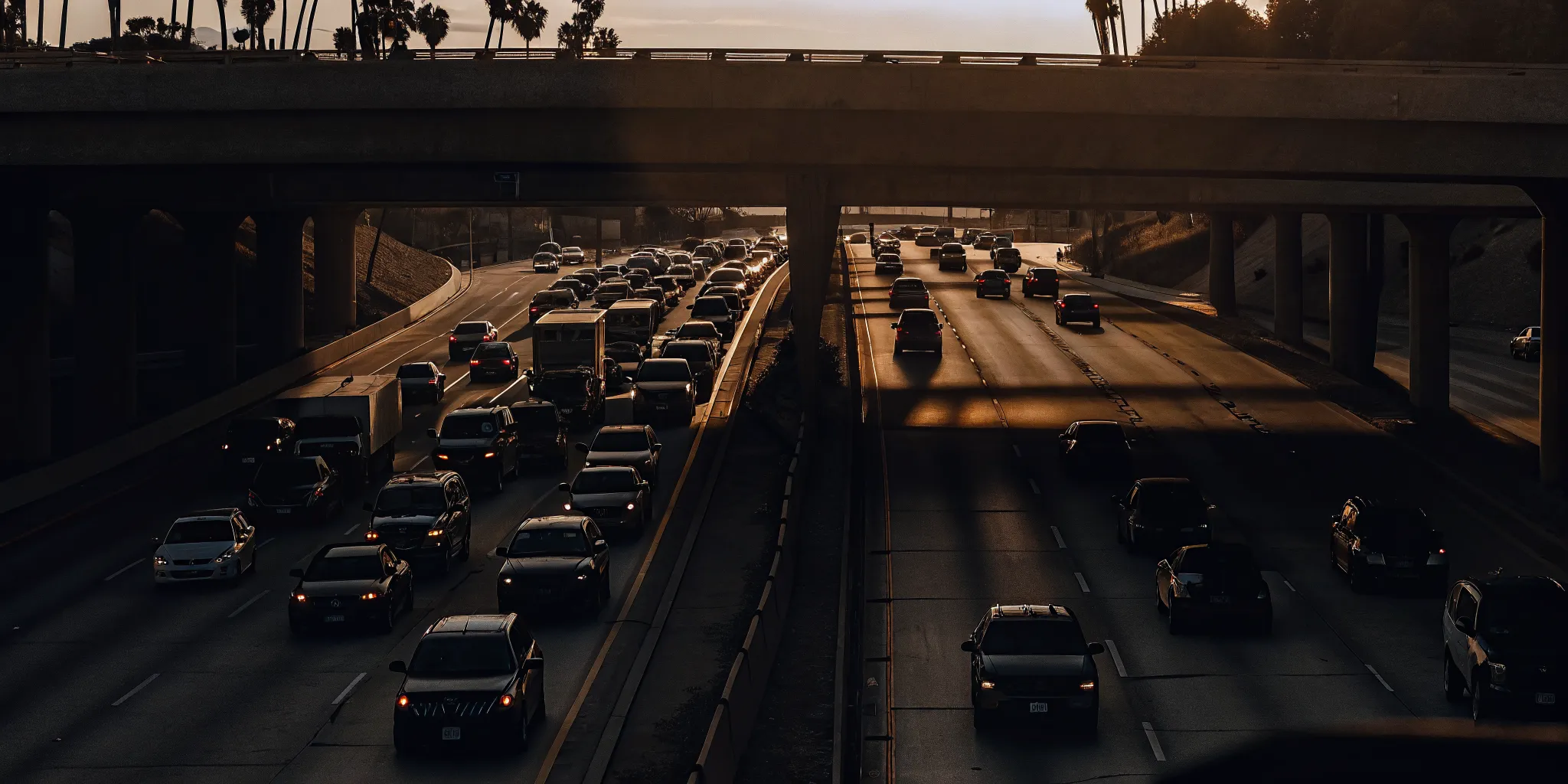
South Bay traffic patterns can change within seconds where I-405, I-110, and SR-91 connect major commuting routes. The I-405 is among California's most heavily traveled and accident-prone freeways. Congestion, abrupt braking, and vehicles entering or exiting at different speeds create little margin for error, particularly through the Torrance and Long Beach corridors.
The I-110, also known as the Harbor Freeway, carries traffic between Los Angeles, San Pedro, and the South Bay. Its merges and transitions bring together passenger vehicles, commercial traffic, and drivers navigating unfamiliar lanes. A small error can become a chain reaction when following distances are short. These conditions are also relevant to merging accidents on Southern California freeways, where determining which vehicle initiated the dangerous movement may require more than the final impact location.
SR-91 adds a different hazard profile. High speeds and rapid lane shifts can make a collision particularly severe, even when the initial contact appears minor. In a multi-vehicle crash, the first impact may force later drivers to react without enough time or space. Establishing the sequence matters when evaluating multi-vehicle freeway pileup claims.
Why driver behavior matters in a fast-moving corridor
Road design and congestion are only part of the analysis. Distracted driving, especially phone use, remains pervasive in the Los Angeles area. A driver looking down for a moment may miss stopped traffic, a lane change, or a vehicle entering the travel lane. Witness accounts, vehicle damage, roadway evidence, and available video can help distinguish a sudden unavoidable event from negligent driving.
The broader safety stakes are substantial. The CDC reports 41,241 motor vehicle traffic deaths and a rate of 12.1 deaths per 100,000 population in its injury fast facts. That national measure does not determine fault in an individual South Bay collision, but it underscores why freeway crashes require careful attention to injury evidence and causation. The California Office of Traffic Safety publishes crash-ranking results that researchers use to evaluate statewide collision patterns.
South Bay routes do not stop at city boundaries. For related context involving Long Beach I-405 collisions, the same questions often arise: which driver changed lanes, how quickly did traffic slow, and what evidence shows the order of impacts?
How a Torrance Car Accident Lawyer Investigates a Freeway Collision
A freeway collision on the I-405, I-110, or SR-91 can involve more than one driver, changing traffic patterns, and conflicting accounts of what happened. Establishing liability requires a disciplined review of the available evidence, not an assumption based solely on the location of the impact. In a multi-vehicle crash, investigators may need to determine which contact started the chain reaction. They may also examine whether a later driver had time to avoid the collision. Each vehicle's movement before and after impact matters too.
Preserving Evidence Before It Disappears
The investigation begins with evidence that can change or become harder to obtain. An attorney may request the California Highway Patrol accident report and collect witness statements. The team can also preserve photographs and video. Medical records document the timing and nature of injuries. Independent witnesses can be particularly important when accounts are inconsistent or when no single driver saw the entire sequence.
In a pileup, crash reconstruction may be necessary to establish the order of impacts and identify the conduct that created the initial hazard. Reconstruction can draw on vehicle damage, debris locations, roadway conditions, traffic-camera footage, photographs, and available event-data information. The goal is to connect the physical evidence to a clear liability analysis rather than rely on speculation. For more on this issue, see DC Law Group's guide to multi-vehicle freeway pileup claims.
Dealing With Insurance Adjusters
Commercial vehicles add another layer to the review. A truck or delivery van may involve the driver, an employer, a vehicle owner, a maintenance company, and multiple insurance policies. Commercial transportation also brings stricter regulatory requirements, so records and compliance evidence may matter alongside the collision facts.
Early legal engagement helps preserve this material and reduces the risk of an injured person making an inaccurate or harmful statement before the evidence is assembled. Insurance adjusters may seek an early account or use incomplete information to minimize a claim. Counsel can manage communications, identify what remains unknown, and protect the investigation while the medical record develops. If you need help evaluating a freeway collision, you can speak with the accident attorneys at DC Law Group.
Common Torrance Car Accidents: Rear-Ends on the 405 and Intersection Collisions
Torrance and the wider South Bay present different collision patterns. A crash may occur in freeway traffic, at a signalized intersection, along a busy pedestrian corridor, or after a driver leaves the scene. The location and mechanics of the impact often determine which evidence matters most. The following comparison can help identify the immediate investigative priorities after a collision.
How the collision setting shapes the investigation
- I-405 stop-and-go traffic. Following too closely, delayed braking, distraction, or sudden traffic compression can produce rear-end impacts in heavy freeway traffic. Whiplash, neck injuries, back pain, and spinal injuries can develop even when vehicle damage appears limited. Preserve photographs of vehicle damage, obtain the traffic collision report, identify witnesses, and keep medical records documenting symptoms that appear or worsen after the crash.
- Hawthorne Boulevard and Pacific Coast Highway intersections. Signal violations, unsafe turns, and failure to yield can cause side-impact or T-bone collisions when vehicles enter an intersection at conflicting times. The side of a vehicle provides less protection than the front or rear, increasing the risk of serious injuries to occupants. Fault may require a detailed review of traffic signals, driver statements, surveillance video, vehicle positions, scene photographs, and independent witnesses.
- Busy pedestrian corridors near PCH or Hawthorne. A driver may fail to see a person in a crosswalk, misjudge a turn, or fail to account for pedestrian movement in a dense urban area. Pedestrians have no vehicle structure to absorb impact, so the risk of severe injury is high. Document the crosswalk, lighting, signs, traffic controls, sight lines, vehicle position, and any available video. Local traffic rules and driver responsibility require careful analysis.
- Hit-and-run collisions. The at-fault driver leaves before exchanging information or assisting the injured person. Injuries may be compounded by delayed treatment, while the missing vehicle and driver create an immediate identification problem. Contact police promptly, preserve debris and photographs, gather witness accounts, and check nearby cameras. Early reporting can support efforts to identify the responsible party. Review guidance on phantom vehicle hit-and-run claims.
Rear-end and intersection crashes can involve disputed fault, especially when accounts conflict or the impact sequence is unclear. A careful review of the scene, vehicle damage, medical timeline, and available witnesses helps distinguish a supported claim from an assumption about what happened.
What Compensation Can You Recover After a Torrance Car Accident?
The value of a South Bay car accident claim depends on the specific injuries, medical treatment, and lasting effects. Compensation can cover economic losses such as medical bills, lost wages, and rehabilitation, as well as non-economic harm such as pain and suffering. A lawyer can help identify every category of damage supported by the evidence.
Economic damages tied to your recovery
Medical expenses often form the core of an economic damage claim. Treatment can include emergency care, hospital stays, surgery, physical therapy, medication, and follow-up visits. Lost income covers wages missed during recovery and a reduced ability to perform the same job in the future. Property damage can include the cost of repairing your vehicle or replacing it when the collision leaves it beyond practical repair. Keep photographs, repair estimates, towing records, and rental-car documentation.
Non-economic harm is part of the claim
Some losses do not appear on an invoice. Pain and suffering, emotional distress, sleep disruption, anxiety, loss of enjoyment, and the impact of an injury on family and ordinary activities may be compensable. These effects are often overlooked because they are harder to measure, not because they are less real. Medical notes, treatment history, personal journals, witness observations, and testimony about changes in your routine can help document them.
Calculating economic and non-economic damages fully helps protect your financial stability and prevents an early insurance evaluation from becoming the entire measure of your claim. Do not assume the first settlement proposal reflects every category of harm, particularly when symptoms or future treatment remain uncertain.
California follows a pure comparative negligence rule. If you are found partly responsible, your recovery may be reduced by your assigned share of fault. The evidence should therefore address not only your injuries, but also how the collision occurred and whether another driver, roadway condition, or vehicle contributed.
There are also timing and coverage issues. A personal-injury lawsuit generally must be filed within two years of the accident date under California's limitations rule, although exceptions can apply. Uninsured and underinsured motorist coverage may provide an additional safeguard when the at-fault driver lacks adequate insurance. Review the policy promptly and preserve all claim correspondence so these options are not missed.
Steps to Take After a South Bay Car Accident
The minutes and days after a collision can affect both your recovery and the evidence needed to establish what happened. Take these steps after an accident in Torrance or elsewhere in the South Bay.
- Move to safety and seek medical attention. If you can do so safely, move out of active traffic, turn on your hazard lights, and call 911 for serious injuries. Do not dismiss pain because it seems minor. A medical evaluation protects your health and creates a contemporaneous medical record connecting your symptoms to the collision.
- Call the police and obtain the collision report. Ask responding officers how to obtain the report and record the incident number. If the other driver leaves, report the hit-and-run immediately and provide every detail you remember, including the vehicle's make, model, color, direction of travel, and license plate information.
- Document the scene and identify witnesses. From a safe location, photograph vehicle damage, the roadway, traffic signals, lane markings, debris, visible injuries, and weather or lighting conditions. Write down witness names and contact information before people leave. Independent witnesses can be important when drivers disagree about right-of-way or the sequence of impacts.
- Do not admit fault or give a recorded statement to an insurer. Be courteous, but limit statements at the scene to accurate identifying and safety information. Do not speculate about speed, distraction, or responsibility. Insurance adjusters may ask questions that appear routine while building a record to minimize a claim. You can tell the adjuster that you will respond after receiving legal guidance.
- Speak with a car accident attorney early. Prompt legal guidance can help preserve vehicle evidence, photographs, surveillance footage, electronic records, and witness accounts before they disappear. An attorney can also handle insurer communications while you focus on medical care. Schedule a free consultation with DC Law Group to discuss your next steps.
What Not to Say to the Other Driver's Insurance Company
Avoid recorded interviews, broad medical authorizations, and casual explanations that minimize your injuries. Do not say you are "fine" or suggest that the collision was partly your fault before the facts are fully investigated. Report the basic facts accurately, then direct detailed questions to your attorney. This approach helps prevent an adjuster's early assumptions from defining the claim.
Why Local South Bay Representation Matters
Car accident claims in California can involve overlapping insurance policies, disputed liability, medical documentation, and procedural deadlines. The South Bay adds its own practical complications: a collision may involve traffic moving through Torrance, nearby cities, and several agencies or insurers. Experienced local counsel can organize those details into a focused claim strategy rather than treating every crash as a standard file.
Local Knowledge of the South Bay Corridors
An attorney familiar with the area understands how claims arising near the I-405, I-110, Hawthorne Boulevard, or Pacific Coast Highway may be investigated and handled. Local knowledge can also help counsel identify the relevant California Highway Patrol office. An experienced attorney understands which courts may handle a disputed case. Counsel can also communicate effectively with adjusters who regularly manage Torrance-area claims. That familiarity does not replace evidence, but it helps a legal team pursue the right evidence promptly.
A dedicated car accident lawyer can coordinate medical providers and gather collision reports and witness information. Counsel can assess the available insurance coverage. Negotiating with the carrier on a supported valuation of the injury claim is also part of the work. This effort is especially important when an insurer questions fault or attempts to minimize the significance of an injury. Learn about car accident legal services in the South Bay before giving a recorded statement or accepting an early settlement proposal.
Direct Access to the Attorney Handling Your Case
DC Law Group uses a boutique model centered on direct attorney involvement. David Cohen personally handles cases, giving clients a clear point of contact for decisions about investigation, medical care coordination, settlement negotiations, and litigation strategy. The firm also offers its "We Come To You" approach for home consultations when traveling after a collision is difficult.
That level of access can make the process more manageable. You can focus on following your treatment plan while counsel handles communications, preserves evidence, and presses the claim forward. For South Bay residents, choosing representation with local familiarity and direct attorney involvement can provide practical guidance without losing sight of the individual behind the case.
Frequently Asked Questions
What should I do immediately after a car accident in Torrance?
Move to a safe location if possible, call 911 when anyone is injured or traffic is dangerous, exchange information, and photograph the vehicles, roadway, and visible injuries. Seek medical attention promptly, even if symptoms seem minor, because a medical evaluation protects your health and creates a record of injuries. Identify witnesses and preserve their contact information.
How long do I have to file a car accident injury claim in California?
California generally gives an injured person two years from the accident date to file a personal injury lawsuit. Exceptions and claim requirements can change the analysis, so do not wait to obtain legal advice. Early review also helps preserve accident reports, witness accounts, vehicle evidence, and medical records. You can review the accident legal services at DC Law Group for more detail on how a claim is evaluated.
How can a lawyer help after a collision on the I-405 or I-110?
Major freeway crashes may involve several vehicles, changing traffic conditions, and disputed accounts. Counsel can collect reports, witness statements, photographs, and medical records, then reconstruct the sequence of events and manage insurer communications. That process is especially important when a commercial vehicle or multiple insurance policies are involved.
What if I was partly at fault for the accident?
California follows comparative negligence principles. An award may be reduced by the percentage of fault assigned to the injured person, but partial responsibility does not automatically eliminate a claim. The evidence, including witness accounts and the collision sequence, should be evaluated before accepting an insurer's liability decision.
What if the other driver was uninsured or fled the scene?
Report a hit-and-run to police immediately, preserve any vehicle or roadway details, and seek medical care. Your own uninsured or underinsured motorist coverage may provide an avenue for recovery when the responsible driver cannot be identified or lacks adequate insurance. Review the policy promptly and contact DC Law Group about the next steps.
Ready to discuss your South Bay car accident?
A focused review of the collision, injuries, and available evidence can help clarify the next steps for your claim. DC Law Group can listen to what happened and explain how the claims process may apply to your circumstances.
REQUEST A FREE CONSULTATIONContact DC Law Group for a free consultation about your South Bay car accident case.