
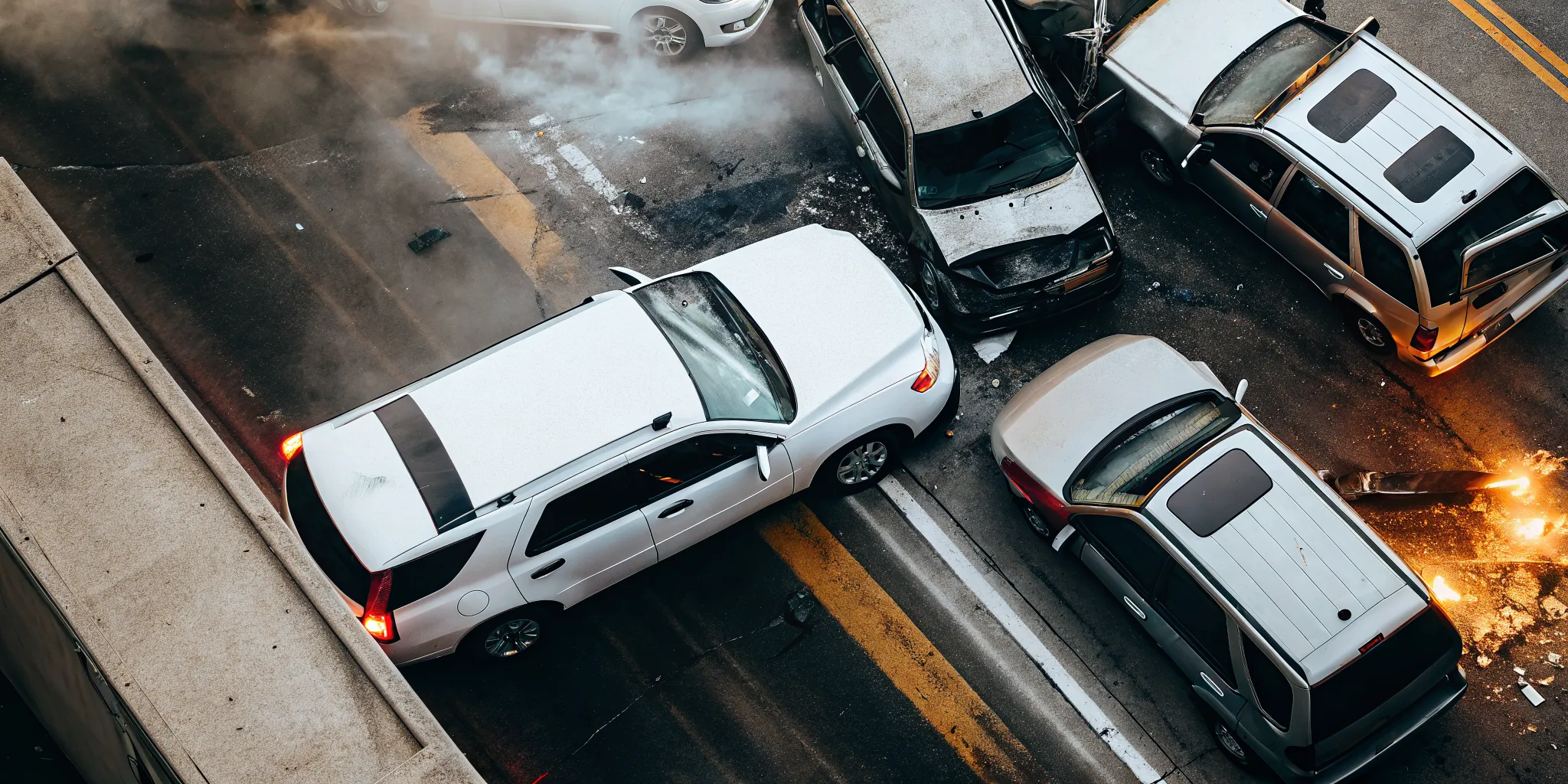
The screech of locked brakes, the shatter of colliding metal, the seconds of helpless waiting for the next impact. A chain-reaction crash on a California freeway can involve a dozen vehicles or more, leaving victims injured, disoriented, and unsure where to turn. When multiple collisions unfold in rapid succession, determining fault becomes a legal puzzle that requires experienced guidance.
Contact DC Law Group today for a free consultation about your pileup accident case.
A California freeway pileup accident lawyer helps victims identify every liable driver and seek full compensation following a complex multi-vehicle highway crash. Because multiple drivers often share responsibility for subsequent impacts, establishing fault in these collisions requires expert reconstruction and deep knowledge of California negligence law. Under California's pure comparative negligence system, you can recover damages from any negligent party who contributed to your injuries, including other motorists, commercial trucking companies, and even government entities responsible for roadway safety.
What Is a California Freeway Pileup Accident?
A freeway pileup occurs when three or more vehicles collide in a chain-reaction sequence on a high-speed California highway. Unlike a standard two-car collision where fault is often straightforward, pileups create a cascade of impacts where each subsequent crash may have a different cause and a different liable party. These events most commonly occur on major commuter arteries such as Interstate 5, Interstate 10, Interstate 405, and State Route 60, where high speeds and dense traffic converge.
The mechanics of a chain-reaction crash
A chain-reaction crash begins when one vehicle stops abruptly or collides with another, and the vehicles behind cannot stop in time. The California Supreme Court recognized in Ducey v. Argo Sales Co. that a single negligent act on a highway can create a domino effect, producing injuries far beyond the initial collision. Each impact in the chain must be independently evaluated to determine which driver or drivers caused that particular collision and what damages resulted from it.
How freeway pileups differ from ordinary collisions
The critical difference between a pileup and a standard crash lies in the number of liable parties. In a two-car collision, fault usually rests with one driver. In a pileup involving eight or ten vehicles, fault may be distributed across multiple drivers, commercial carriers, and even government agencies. Insurance companies representing different drivers will each try to minimize their policyholder's exposure, which often means shifting blame to others involved in the crash sequence.
Who Can Be Held Liable in a Multi-Vehicle Chain-Reaction Crash?
Determining liability in a freeway pileup requires a systematic analysis of each impact and each driver's conduct. Multiple parties may bear legal responsibility for your injuries, and identifying every potentially liable defendant is essential to securing full compensation.
Negligent drivers in the collision chain
The driver who caused the initial collision is often the most obvious target for liability. However, drivers who rear-end vehicles ahead of them, change lanes without signaling, or drive at unsafe speeds for conditions may also bear significant fault. California Vehicle Code Section 21703 requires drivers to follow at a safe distance, and violating this duty can create liability for subsequent collisions in the chain. As the court held in Lugtu v. California Highway Patrol, the sequence of impacts and each driver's role must be carefully mapped to assign fault accurately.
- Lead driver negligence: Sudden braking without cause, illegal lane changes, or stopping in a travel lane can trigger the initial crash.
- Following driver negligence: Tailgating, distracted driving, or excessive speed prevents safe stopping when traffic ahead slows.
- Multi-impact liability: A driver struck from behind may be pushed into the car ahead, creating a separate collision that requires independent fault analysis.
Employer liability for commercial drivers
When a commercial truck, delivery van, or rideshare vehicle is involved in a pileup, the driver's employer may share liability under the legal doctrine of respondeat superior. California law holds employers responsible for the negligent acts of their employees committed within the scope of employment. A truck accident attorney can subpoena driver logbooks, employment records, and GPS data to establish the employment relationship and pursue compensation from the company's commercial insurance policy.
Government entity liability for unsafe road conditions
California Government Code Section 835 allows injured parties to pursue claims against public entities when dangerous road conditions contribute to a collision. Examples include inadequate median barriers on known high-crash stretches of highway, missing or obscured signage, and poorly designed on-ramps or merging zones. Claims against government entities carry strict notice requirements and short filing deadlines, often within six months of the accident, making prompt legal action essential.
Apportioning fault among multiple defendants
California applies a system of joint and several liability for economic damages in multi-defendant cases. This means any defendant found even partially at fault can be held responsible for the full amount of your medical bills, lost wages, and other out-of-pocket losses. For non-economic damages such as pain and suffering, each defendant pays only their proportional share of fault as determined by the jury.
Common Causes of Freeway Pileups and Legal Negligence
Chain-reaction crashes on California freeways share identifiable patterns. Recognizing the most common contributing factors helps victims and their attorneys build stronger cases for liability.
| Contributing Factor | Legal Violation | How It Proves Negligence |
|---|---|---|
| Speeding for conditions | Vehicle Code Section 22350 | Driver failed to travel at a safe speed given traffic, weather, and roadway conditions |
| Following too closely | Vehicle Code Section 21703 | Insufficient stopping distance prevented avoiding a collision with the vehicle ahead |
| Distracted driving | Vehicle Code Section 23123.5 | Cell phone use or other distraction caused delayed reaction time |
| Impaired driving | Vehicle Code Section 23152 | Alcohol or drugs reduced reaction time and judgment |
| Unsafe lane change | Vehicle Code Section 22107 | Merging or turning without adequate warning or clearance |
A personal injury attorney can investigate which of these factors played a role in your pileup by analyzing police reports, witness statements, and vehicle data. When fog, rain, or poor road design contributed to the crash, multiple parties may share liability, including the state agency responsible for maintaining the roadway.
Critical Evidence Needed to Prove Liability in a Freeway Pileup
Evidence on a busy California freeway disappears within hours of a crash. Lane closures are cleared, vehicles are towed, and skid marks are erased by passing traffic. Collecting and preserving evidence requires immediate action.
Official crash reports and witness accounts
The California Highway Patrol or local police report is the foundation of any pileup claim. Officers document vehicle positions, driver statements, weather conditions, and their preliminary assessment of fault. Witness statements from drivers in unaffected lanes can provide crucial independent accounts of how the crash unfolded.
Digital evidence from vehicles and traffic cameras
Modern vehicles contain event data recorders (EDRs), commonly called black boxes, that capture speed, braking, steering angle, and seatbelt status in the seconds before a crash. Caltrans traffic cameras and nearby business surveillance footage may also have recorded the collision. Cell phone records can establish whether a driver was texting or talking at the time of the crash, which constitutes clear evidence of negligence under California's hands-free law.
1. Preserve the vehicle: Do not repair or sell your vehicle until an attorney has inspected it and downloaded the EDR data.
2. Request traffic camera footage: Caltrans and local transportation agencies retain footage for a limited time, typically 72 hours to 30 days.
3. Identify witnesses: Exchange contact information with other drivers and any bystanders who saw the crash.
4. Seek medical attention: Adrenaline can mask serious injuries. A prompt medical evaluation creates a record linking your injuries to the crash.
5. Retain all documentation: Keep tow bills, rental car receipts, medical records, and correspondence with insurance companies.
How California's Pure Comparative Negligence Rule Affects Pileup Claims
California is one of only a handful of states that applies pure comparative negligence to personal injury claims. Under California Civil Code Section 1714, you can recover damages even if you are found 99 percent at fault for the crash. Your total recovery is simply reduced by your percentage of fault. This rule is particularly important in pileup cases because insurance companies often argue that every driver in the chain shares some blame.
Example: If a jury determines your total damages are $200,000 but finds you 25 percent at fault for failing to brake in time, your recovery is $150,000. In a modified comparative fault state, that same 25 percent finding would bar you from any recovery at all if the threshold is 50 percent.
A motorcycle accident attorney or car accident lawyer at DC Law Group can help ensure that your percentage of fault is accurately assessed and that the insurance companies do not unfairly shift blame onto you to reduce their payout.
What Damages Can You Recover After a Multi-Vehicle Freeway Crash?
Victims of California freeway pileups may be entitled to a broad range of compensatory damages designed to restore them financially and account for the full impact of their injuries.
- Medical expenses: Emergency room care, surgical procedures, hospitalization, physical therapy, prescription medications, and anticipated future medical treatment.
- Lost income: Wages lost during recovery, reduced earning capacity if injuries prevent returning to the same occupation, and loss of employment benefits.
- Property damage: Vehicle repair or replacement, towing and storage fees, and damage to personal property inside the vehicle.
- Pain and suffering: Physical pain, emotional distress, anxiety, post-traumatic stress, and loss of enjoyment of life caused by the trauma of a high-speed collision.
- Wrongful death: If a family member died in the pileup, surviving dependents may pursue funeral expenses, loss of financial support, and loss of companionship.
Because California applies pure comparative negligence, your damages are not automatically eliminated if you bear some responsibility. A rideshare accident lawyer can evaluate all available insurance coverage, including your own uninsured and underinsured motorist policies, to identify every source of compensation.
Why You Need a California Freeway Pileup Accident Lawyer
Freeway pileups present legal challenges that standard car accident cases do not. Multiple defendants, competing insurance companies, complex evidence, and strict procedural deadlines make experienced legal representation essential.
Navigating multiple insurance claims
Each driver in a pileup is represented by their own insurance company, and each insurer will attempt to minimize its policyholder's liability. An experienced car accident lawyer manages communication with all carriers, ensures that settlement offers fairly account for your full damages, and prepares to file a lawsuit if negotiations fail to produce adequate compensation.
Meeting California's strict filing deadlines
California imposes a two-year statute of limitations for personal injury claims arising from motor vehicle accidents under Code of Civil Procedure Section 335.1. Claims against government entities have even shorter deadlines, often just six months under the California Tort Claims Act. Missing these deadlines permanently bars you from recovering any compensation. Schedule a free case evaluation with DC Law Group to ensure your claim is filed within the applicable time limits.
Frequently Asked Questions About California Freeway Pileup Accidents
What should I do immediately after a freeway pileup?
Check yourself and your passengers for injuries, call 911, and remain in your vehicle if it is safe to do so. Do not exit your car on an active freeway. Exchange insurance information with other drivers only when law enforcement directs you to do so, and seek medical evaluation even if you feel fine, as injuries like whiplash and internal trauma may not be immediately apparent.
Can I sue multiple drivers after a pileup crash?
Yes. California law allows you to pursue claims against every driver whose negligence contributed to the crash or your injuries. This includes the driver who caused the initial collision, any driver who rear-ended your vehicle, and drivers who were speeding, distracted, or otherwise negligent at the time of the pileup. A personal injury attorney can help identify all potentially liable parties.
How is fault determined in a chain-reaction crash?
Fault is determined through a detailed reconstruction of the crash sequence. Attorneys and accident reconstruction experts analyze vehicle damage patterns, skid marks, EDR data, traffic camera footage, and witness statements to determine which impacts were avoidable and which drivers failed to exercise reasonable care. Each impact in the chain is evaluated independently.
What if I was partially at fault for the pileup?
Under California's pure comparative negligence rule, you can still recover compensation even if you share some fault for the crash. Your total damages are simply reduced by your percentage of fault. For example, if you are 30 percent at fault and your damages total $100,000, you can still recover $70,000 from the other negligent parties.
How long do I have to file a lawsuit after a California freeway pileup?
California Code of Civil Procedure Section 335.1 gives you two years from the date of the crash to file a personal injury lawsuit. If the crash involved a government entity, such as Caltrans or a city public works department, you have only six months to file a government claim under the California Tort Claims Act. Consulting with an attorney promptly ensures you do not miss these critical deadlines.
How much does it cost to hire a pileup accident lawyer?
At DC Law Group, we handle pileup accident cases on a contingency fee basis. This means there are no upfront fees or out-of-pocket expenses. You pay nothing unless we secure a recovery on your behalf. This arrangement allows injured victims to access top-tier legal representation regardless of their financial situation.
Ready to Protect Your Rights After a Multi-Vehicle Crash
Contact DC Law Group today to schedule a free, no-obligation consultation with an experienced California freeway pileup accident lawyer. Managing Attorney David Cohan personally handles each case and will evaluate your claim, explain your legal options, and outline the steps needed to pursue maximum compensation. Book your free case evaluation online or call us 24 hours a day, 7 days a week. There are no fees unless we win your case.