

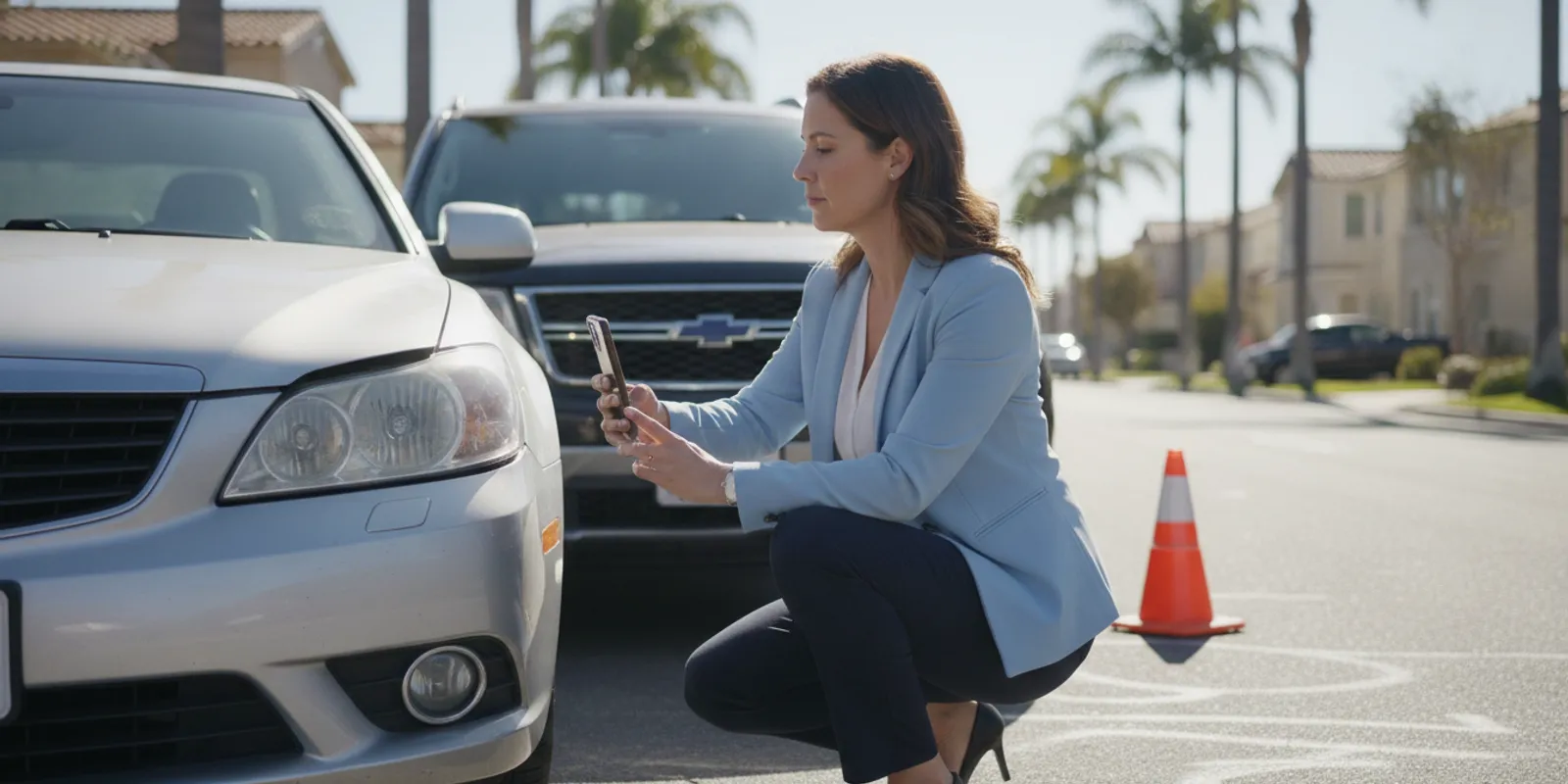
Knowing what to do after a car accident can be difficult when you are hurt, shaken, or unsure what happened. Start with safety and medical care. Then preserve the information that may help explain the collision, and keep your communications accurate and organized.
Request a free consultation with DC Law Group
What should you do first at the scene?
Take a moment to check for immediate danger. If anyone may be seriously hurt, contact emergency services. Do not move an injured person unless remaining in place presents a greater danger. Follow instructions from emergency responders, and tell them clearly if a person is unconscious, having trouble breathing, or unable to move.
If you can do so safely, move away from active traffic and turn on hazard lights. Do not stand between vehicles or in a lane to take photographs. If a vehicle cannot be moved safely, wait in a protected location and tell responders where you are. In a busy roadway, your first responsibility is to get yourself and others away from immediate danger, not to collect evidence.
Check whether other people need assistance, but do not put yourself in danger. Be calm and factual when speaking with the other driver. Avoid arguing about fault or making guesses about speed, distance, or what another person saw. You can exchange information without agreeing to anyone's account of the collision.
When police or other responders arrive, give an honest account of what you observed. Do not speculate about details you do not know. Ask how to obtain an incident or collision report, and write down any report or incident number provided to you. If you are too shaken or injured to give a complete account, say so and provide the information you can accurately recall.
Before leaving, make sure you know how each vehicle will be moved and whether anyone needs additional assistance. Do not leave simply because the vehicles appear drivable if a person is hurt or an official is giving instructions. If you must leave for medical care, prioritize treatment and ask a companion, if available, to preserve contact details or notes for you.
Why should you seek medical care promptly?
Some injuries are not obvious at the scene. Pain, stiffness, dizziness, or other symptoms may appear later. If you are hurt or concerned about a symptom, seek medical attention and follow the treating provider's instructions. Do not rely on how you feel in the first few minutes to decide whether an evaluation is needed.
Tell the provider when and how the collision happened, what symptoms you have, and whether they have changed. Be accurate and specific. If a symptom is new, worsening, or interfering with ordinary activities, report that too. Keep copies of discharge instructions, test results, referrals, and follow-up recommendations.
Keep attending follow-up appointments as directed, or contact the provider if you cannot attend. If you choose to delay or decline care, make your own decision with appropriate medical guidance. A gap in care can make it harder to connect later complaints to the crash, so keep a clear record of the reason and any instructions you receive.
Medical records are created for treatment, not as a script for a legal claim. Describe your condition honestly. Do not exaggerate, minimize, or ask a provider to use particular wording. Your health comes first; documentation is a useful result of appropriate care. If you seek care from more than one provider, mention the other treatment so the medical team has a complete picture.
It can help to write down the date symptoms began and what prompted you to seek care. For example, note whether pain began at the scene, appeared after you got home, or increased during a particular activity. This is a factual timeline, not a medical conclusion. Ask a provider to explain any instructions you do not understand, including when to return for follow-up.
Which details should you record before leaving?
Once the scene is safe, record information while your memory is fresh. Use a phone or notebook. If you are unable to do this because of an injury, ask a trusted person to help when possible. Label notes with the date and approximate time you created them, and keep later additions separate so the sequence remains clear.
- People and vehicles: Record the names and contact details of drivers, passengers, and witnesses, along with vehicle make, model, color, and plate number if visible.
- Insurance and registration: Ask the other driver for insurer and policy information, and note the vehicle owner if different from the driver. Do not photograph or share another person's sensitive information beyond what is needed for the claim.
- Location and conditions: Write down the street, direction of travel, nearby intersections, date, approximate time, weather, lighting, traffic, and road conditions.
- What you observed: Note the sequence of events in your own words, including where the vehicles were, what you saw or heard, and what happened immediately afterward.
- Official response: Record the responding agency, officer name or badge number if available, and the report number.
Separate what you personally observed from what someone else told you. For example, note that a witness said they saw a signal change, rather than recording it as something you saw yourself. This simple distinction can help keep your notes reliable. If you cannot remember a detail, mark it as unknown instead of filling in a likely answer.
Make a brief diagram if it helps you remember the positions and directions of the vehicles. Include street names, lanes, nearby signs, and the direction each vehicle was moving. Mark uncertain details as estimates. A rough drawing made soon after the collision can be more useful than a polished diagram created much later from incomplete memory.
What photographs and recordings may help explain the crash?
Take photographs only from a safe place. Start with wide views that show the position of vehicles and the surrounding roadway. Then photograph damage to each vehicle, vehicle plates, traffic signs and signals, visible debris, skid marks, and conditions that may have affected visibility or movement. Capture more than one angle where useful.
Photograph damage before vehicles are repaired or moved, if possible. Include close views and wider context. Do not step into traffic or delay medical care to gather images. If you could not document the scene, note why and ask whether another person has photographs. Include details such as the location of a traffic signal relative to the vehicles rather than relying only on close-ups.
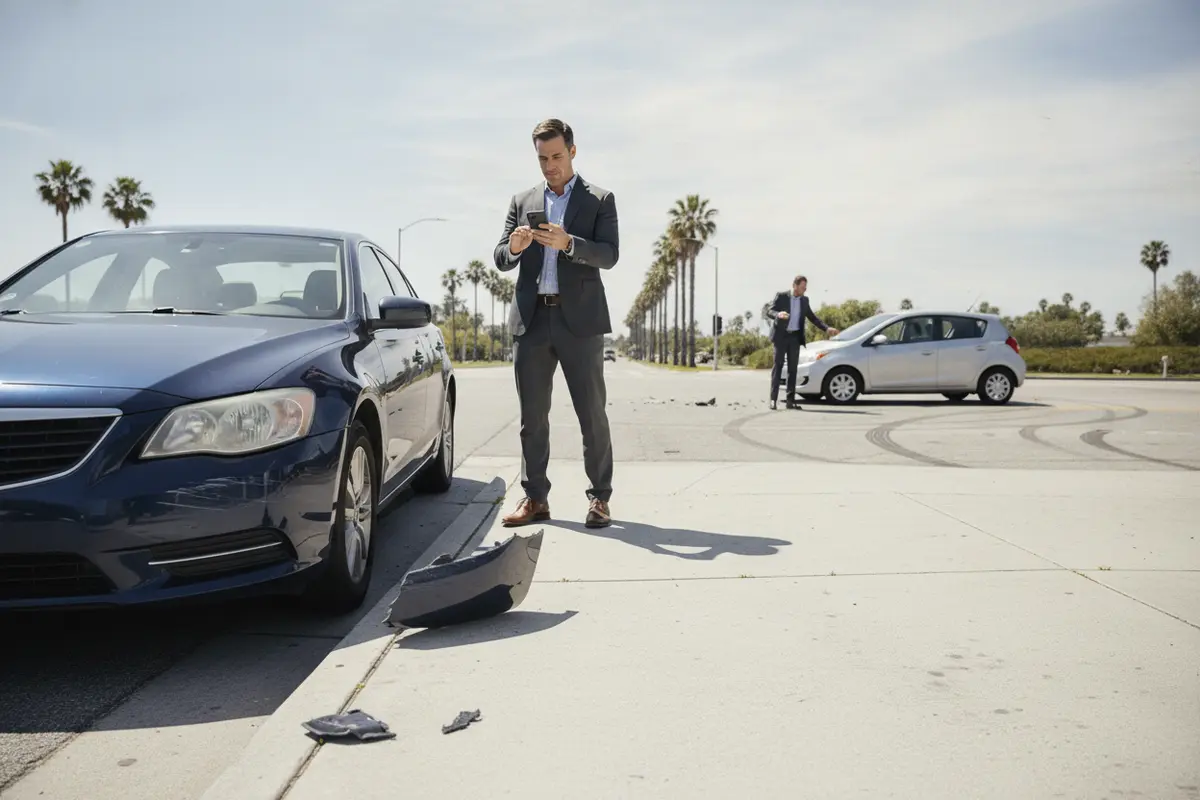
A person safely photographing vehicle damage and the roadway after a California collision
Keep the original image files when possible. Avoid cropping, adding labels, or applying filters to the only copy. If you need to mark up an image for personal notes, save a separate version and retain the original. Record who took each image and when, if known. Back up the files to a secure location and avoid sending the only copy through an app that may reduce image quality.
Look for nearby cameras only from a safe location. Businesses, homes, buses, or traffic systems may have recordings, but access and retention vary. Make a note of the camera location and the time window that may include the crash. Do not trespass or confront anyone. A lawyer can discuss a proper way to request preservation or review. If a nearby business is willing to help, ask whom to contact and how to submit a written request; do not assume footage will remain available.
Phone video can also capture the general scene, traffic flow, weather, and the location of vehicles. Keep the original file and note what the recording shows. Do not narrate speculation as fact or ask someone else to stage a reenactment. If a passenger or bystander captured the event, ask for their contact details and the original recording rather than a reposted or edited copy.
How should you speak with the other driver and witnesses?
Exchange the information needed to identify the drivers, vehicles, and insurers. Keep the conversation brief and courteous. Do not threaten anyone, sign a statement about fault at the scene, or agree to a private payment arrangement before you understand the situation. Do not apologize in a way that could be misunderstood as accepting responsibility; you can express concern for another person's wellbeing without assigning blame.
Ask witnesses for their names and a reliable way to contact them. If they are willing, ask what they observed in their own words. Do not coach them or suggest what they should say. Write down where each witness was located and whether they saw the events before, during, or after impact. A passenger, nearby worker, or person waiting at an intersection may have seen a different part of the sequence, so identify each witness separately.
If the other driver leaves, do not follow them. Note the direction of travel, vehicle description, and any plate details you observed, then tell law enforcement. For a collision involving a commercial vehicle or a rideshare vehicle, record identifying details visible on the vehicle or app, but do not put yourself at risk to obtain them. DC Law Group also provides information on California car accident representation and rideshare accident claims.
What should you tell your insurer?
Review your policy and contact your insurer using the process it specifies. Report the collision truthfully and within any applicable reporting period stated in your policy. Ask what information is needed, how to submit it, and how to obtain a copy of your claim file or communications when available. Save confirmation numbers and copies of uploaded forms.
Give facts you know, not estimates presented as certainty. If you do not know an answer, say so. You can explain that you are still seeking medical evaluation or obtaining the collision report. Keep notes of the date, time, name of the person you spoke with, and the substance of the conversation. When an insurer asks for a document you do not have, identify what is missing and ask how to provide it later.
An insurance representative may ask for a recorded statement or request documents. Before agreeing to a recorded statement, signing a release, or accepting a settlement, make sure you understand the request and its effect. A release can resolve claims beyond the immediate vehicle damage or treatment. You can ask for the request in writing and take time to review it. If you are uncertain, consider speaking with an attorney first.
Keep discussions focused on information you can verify. Avoid estimating how quickly a vehicle was moving unless you have a reliable basis, and distinguish your recollection from what a report or another person says. If you later notice that an earlier statement was incomplete or mistaken, ask how to correct or supplement it rather than repeating an uncertain detail as fact.
Be careful when posting about the collision on social media. A short post or photograph can lack context and may be interpreted in ways you did not intend. Keep updates private and factual, and do not discuss fault or your recovery publicly while you are handling the claim. Do not delete relevant material after a dispute arises; if concerned about a post or message, seek guidance on preserving it.
Which records should you preserve after the collision?
Create one folder, either digital or paper, for the documents connected with the crash. Keep originals when practical and save a backup. Add a brief note explaining the source and date for documents that are not self-explanatory. Use a consistent file name, such as the date followed by the document type, so records can be found quickly.
- Police or agency report details, report number, and any correspondence about obtaining the report.
- Photographs, videos, witness contacts, and your notes about the scene.
- Medical visit summaries, test results, work restrictions, referrals, and follow-up instructions.
- Insurance claim numbers, letters, emails, forms, and a log of phone calls.
- Receipts and records tied to the collision, including vehicle towing, repair assessments, rental arrangements, or travel to treatment.
- Work schedules, pay records, or employer notes if the injury affected your ability to work.
Keep a simple recovery journal if symptoms affect daily activities. Record the date, what changed, the activity that was difficult, and any appointment or instruction related to it. Use ordinary language and be consistent. Do not turn the journal into a legal argument or guess at a diagnosis. Concrete examples can make an entry clearer: describe how long you could sit, whether you needed help carrying groceries, or whether you had to change a usual routine.
Do not discard damaged items or authorize repairs before documenting the condition when it is safe and practical. If storage, towing, or repair decisions are urgent, ask the provider or insurer what documentation they need, and save copies of written estimates and approvals. For other kinds of motor-vehicle claims, you may also find DC Law Group's motorcycle collision next-step guide and guide to reading a police report useful.
Keep a simple contact log as well. For each call or message, note who contacted whom, the date and time, the subject, any documents requested, and the next expected step. If you send a document, record the date and method. This makes it easier to follow up on missing records and to explain the history of a claim without relying on memory alone.
Schedule a consultation with DC Law Group
Which California reporting and insurance rules should you check?
Requirements depend on the facts, and different reporting duties may apply to a driver, an insurer, or another party. Check the directions given by law enforcement and consult the California DMV's current financial responsibility, insurance, and collision guidance. The DMV explains that drivers may need to show evidence of financial responsibility in connection with a collision. Confirm current instructions directly with the agency rather than relying on an old form or an online summary.
Keep proof of insurance available and follow the instructions in your policy. If you are unsure whether a report is required or how to submit it, contact the appropriate agency or insurer and record the guidance you receive. Do not assume that a police response completes every separate reporting step. Save copies of anything you file and make a note of the date and method of submission.
If a collision involves more than one vehicle, an injury, or property damage beyond the vehicles themselves, do not guess which reporting procedure applies. Review the current agency instructions and ask the relevant agency how to proceed. This article offers general information, not legal advice about a particular collision. Deadlines and duties can depend on facts such as the type of incident, the people involved, and the policy terms.
| Record or action | When to address it | Why it may matter |
|---|---|---|
| Emergency response and medical evaluation | At once when someone may be hurt or in danger | Protects health and creates a timely record of reported symptoms |
| Driver, vehicle, insurer, and witness details | At the scene, if safe | Helps identify people and organizations connected to the event |
| Scene photographs and notes | At the scene or as soon as safely possible | Preserves visible conditions before they change |
| Insurer notice and claim records | As directed by the policy and insurer | Documents notice and the exchange of claim information |
| Collision report and agency instructions | After the response; follow the agency's process | Helps you track official records and any separate reporting steps |
| Treatment and recovery documents | Throughout care and recovery | Records symptoms, evaluations, recommendations, and effects on daily life |
When can a California car accident attorney help?
You can ask an attorney to review questions about fault, insurance communications, available records, or deadlines that may apply to your circumstances. This can be useful when an injury is significant, several vehicles or insurers are involved, the other driver disputes responsibility, or you are asked to sign a release before you understand its scope.
Bring the records you have, even if the file is incomplete. A useful first review can include your notes, photographs, report number, insurer letters, and a basic treatment timeline. You do not have to resolve every missing detail before asking what the next steps may be. Avoid relying on a general online checklist as a substitute for advice based on the facts of your collision.
For a serious collision, relevant records may include vehicle data, camera footage, maintenance documents, or information about a commercial operator. Those materials may be held by someone else and may not remain available indefinitely. An attorney can discuss whether a preservation request or further investigation is appropriate. See DC Law Group's California truck collision guide for additional context about preserving information after a commercial-vehicle crash.
A first conversation can also help you identify what you do not yet know. You might ask how to obtain a report, whether a release covers more than one category of claim, or how to organize records from multiple providers. Bring questions in writing and take notes on the answers. A consultation does not require you to arrive with a completed file or a final view about who caused the collision.
DC Law Group is a California personal injury law firm with a team of attorneys. If you want to discuss an injury collision, you can contact the firm or review its guide to when legal representation may help.
Contact DC Law Group to discuss your accident
What are the key steps to remember?
Put safety and medical care first, gather identifying information only when safe, and write down what you observed while the details are fresh. Preserve original photographs and relevant records, communicate accurately with insurers, and check California agency instructions for reporting requirements. If an injury or insurance dispute raises questions, a consultation can help you understand which next steps fit your circumstances.