
After a California collision, a police report can look authoritative while still containing only one officer's recorded observations, statements, and preliminary opinions. Read it carefully before relying on it in an insurance claim. Call DC Law Group at (310) 571-8860 for help reviewing an accident report and protecting your claim.
To understand how to read a police report, start with the report number, date, location, involved people and vehicles. Then compare the narrative, diagram, codes, and injury information with photographs, medical records, witness accounts, and your own notes. A report may support an insurance claim, but it does not automatically decide legal fault.
Obtaining the complete report is the first step. If the California Highway Patrol investigated the collision, an eligible party of interest may request the record through the CHP Crash Portal. Requests may also be made by mail or in person using the CHP 190 form. Once you have it, separate documented facts from conclusions and examine each section for omissions or inaccuracies before evaluating liability.
How to Read a Police Report Before Evaluating Fault
A police report is an incident record prepared by the investigating agency. It can organize information gathered at the scene, including the people involved, the reported location, observations, statements, and other recorded details. It is useful evidence, but it is not automatically a final legal determination of who caused a collision. The report should be read as one part of the larger factual record.
Start with the identifying information. Confirm the name of the agency, its report or incident number, the date and approximate time, and the exact location listed. Then check every involved party: drivers, passengers, pedestrians, vehicle owners, and witnesses. Compare names, addresses, vehicle descriptions, license information, and any listed injuries with your own records. A small clerical error can affect how an insurer or another reviewer understands the event.
California report formats vary by agency. If the California Highway Patrol investigated the collision, a qualifying party of interest may request the CHP crash report or investigation through the CHP Crash Portal. The CHP identifies drivers, passengers, pedestrians, vehicle or property owners, and certain representatives among the categories that may qualify. If you do not know the exact crash date, the CHP says an approximate date may be provided. If the precise location is unknown, provide as much location information as possible.
Next, separate recorded facts from conclusions. The narrative may reflect an officer's observations, statements from people at the scene, and an initial interpretation of what occurred. A diagram may show vehicle positions or movement as understood during the investigation. Codes or checkboxes may summarize possible contributing circumstances. Read those entries carefully, but do not assume that an officer's initial view conclusively establishes civil liability. Fault may depend on additional photographs, physical evidence, witness accounts, medical records, and applicable California law.
California Courts lists a police report as one possible form of evidence, alongside photographs, repair bills, proof of payment, witness statements, insurance claims, and investigations. A motor-vehicle collision may involve both property damage and personal injury, so preserve the complete report with your other records. If the report raises questions about your California motor vehicle accident claim, a careful review can identify what should be clarified. It can also show what supporting evidence may still be needed.
What Information Does a California Police Report Usually Contain?
California collision reports are organized around the people, vehicles, scene, and observations connected to the incident. The exact layout depends on the investigating agency. A report from the California Highway Patrol may not look identical to one prepared by a city police department or county sheriff. Use the agency's own code key or instructions when available. For CHP-specific records and forms, see the CHP crash-report request page.
Identifying information and involved parties
The opening portions commonly identify the report or incident number, date, time, location, investigating agency, and people involved. Driver and passenger entries may include names, addresses, contact details, license information, and statements about what each person observed. Witness information may appear separately. Check these entries carefully against your records, because a misspelled name, incorrect date, or omitted witness can affect how later reviewers understand the file.
Driver, vehicle, and insurance details
Vehicle sections generally connect each driver to a vehicle and may record the make, model, license plate, vehicle identification number, registered owner, and insurance information. Accident-report guides commonly identify driver, vehicle, insurance, VIN, and contact-information sections, but those descriptions are illustrations of common report organization, not a universal California form. Verify the labels and abbreviations used by the agency that prepared your report.
A report may also describe visible vehicle damage or assign a numeric damage rating. Treat that entry as an officer's scene observation, not a complete mechanical inspection. Hidden structural damage may not be apparent immediately, and a damage rating may not reflect the full condition of a vehicle.
Injuries, citations, and contributing factors
The report may record reported injuries, medical transport, complaints made at the scene, citations, and other enforcement actions. It may also list contributing circumstances, such as a suspected traffic violation or other factor noted by the officer. Numeric codes can refer to issues such as speeding or distracted driving, but the meaning varies by agency. Do not assume a code's meaning without checking the report's key or asking the records department.
Narrative and diagram
The narrative explains the officer's account of the investigation, while the diagram depicts positions, directions, roadway features, and points of impact. Read them together, then compare both with photographs, vehicle damage, witness accounts, and other evidence. A narrative, diagram, citation, or contributing-factor entry is important evidence, but it does not by itself conclusively establish legal liability. Non-California examples found online may help you recognize possible fields, but they should not be treated as California rules.
How Do You Read Police Report Codes and the Diagram?
To learn how to read a police report, start by identifying the agency's form and locating its instructions or code key. California agencies do not necessarily use one universal code list. A code printed on a report from another state, or on a different agency's form, should not be treated as the meaning of a California entry. Read each code in the context of the key attached to that report, then compare the entry with the officer's narrative and the available physical evidence.
Reports commonly separate identifying information, contributing circumstances, vehicle damage, a narrative, and a diagram. One guide describes numeric entries for factors such as speeding or distracted driving, while also noting that a damage rating may not capture hidden structural damage. Those are useful reading cautions, not universal California rules. See the source discussion of report sections and codes at this police report guide.
| Field type | What to check | Corroborating evidence |
|---|---|---|
| Numeric factor or contributing-circumstances code | Find the form's own key. Confirm whether the entry describes an observation, a reported circumstance, or an officer's assessment. Do not assume a number has the same meaning on another form. | Statements, traffic-camera or nearby surveillance footage, photographs, vehicle data, scene measurements, and the narrative. |
| Injury code or injury field | Read the labels and key supplied with the report. Check whether the entry records a complaint observed at the scene, a reported symptom, or another classification. | Medical records, photographs, emergency-care records, and later evaluations. A report entry is not a complete medical diagnosis. |
| Vehicle-damage rating | Determine what scale the agency uses and whether the rating reflects visible damage only. Do not treat a low number as proof that damage is minor. | Photographs taken after the crash, repair records, inspection findings, and qualified collision or engineering evaluations. |
| Diagram | Orient the road, lanes, directions, vehicles, impact points, traffic controls, and final positions. Compare the drawing with the written narrative and look for omissions or mismatched vehicle labels. | Scene photographs, vehicle damage patterns, independent witness accounts, video, roadway markings, and measurements. |
Some out-of-state guides illustrate the problem. A New York format described in one source uses separate entries for injury location, injury type, and injury severity, with code definitions printed on another page. It also gives examples of numeric codes for conditions such as unsafe speed and texting. These examples show why the attached key matters; they do not establish the meaning of a code on a California report. The same source expressly ties the definitions to its own report format: New York report code examples.
Finally, treat the diagram and codes as evidence to evaluate, not as a conclusive legal ruling. If an entry conflicts with photographs, witness information, or the narrative. Preserve the original report and document the discrepancy before relying on it in an insurance or injury claim.
How Can You Find Errors or Missing Information?
A police report may contain transcription or administrative mistakes, omitted witnesses, inaccurate narrative statements, or a diagram that does not match the physical evidence. Review the report against what you remember and what you can document. Treat the report as evidence to evaluate, not as a binding decision about liability. The following checklist can help you identify issues without altering the original record.
- Check names and identifying details. Confirm that your name, the other driver's name, addresses, vehicle descriptions, license plate information, and insurance details are accurate. Look for misspellings, swapped driver or vehicle information, and omissions. These details can affect whether an insurer or investigator connects the report to the correct person and vehicle.
- Verify the date, time, and location. Compare the report with photographs, phone records, receipts, witness messages, and any other contemporaneous documentation. Note whether the intersection, roadway, lane, direction of travel, weather, or lighting description is incomplete or inconsistent with the scene.
- Compare vehicle positions and damage descriptions. Examine the vehicle numbers in the diagram, the listed points of impact, lane positions, movement arrows, and descriptions of visible damage. An officer's damage rating may not reflect hidden structural damage, so preserve repair and inspection records rather than treating that rating as a complete assessment.
- Review injury information carefully. Check whether the report records the injuries you reported, emergency treatment, complaints of pain, or ambulance transport. If symptoms appeared later, document when they began and seek appropriate medical evaluation. Do not assume that a brief report entry captures the full medical picture.
- Look for missing witnesses and evidence. Confirm whether witnesses you identified appear in the report, including their names and contact information when available. Also note omitted photographs, video sources, vehicle occupants, or physical evidence. California Courts identifies photographs, witness statements, repair records, insurance investigations, and police reports as possible evidence in a property-damage position: California Courts evidence guidance.
- Separate observations from assumptions in the narrative. Mark statements based on a person's direct account or the officer's observation separately from conclusions that assume speed, distraction, intent, or sequence. Identify wording that conflicts with your account, witness evidence, photographs, or vehicle damage. A narrative can contain inaccuracies or perspective-based assumptions, and an officer's preliminary view is not automatically the final legal analysis.
- Compare the diagram with the narrative. Read both sections independently, then compare them with photographs and the roadway. Record every mismatch, such as a vehicle shown in the wrong lane, an incorrect travel direction, or an impact point that does not fit the physical evidence. A factual diagram error may be amendable, but the correction process depends on the investigating agency.
- Preserve and document discrepancies. Keep the original report unchanged. Make a separate dated list identifying the page, field, or sentence at issue, the correction you believe is needed, and the evidence supporting it. Ask the investigating department or agency about its procedure for submitting a correction or supplemental statement, and provide relevant documentation to the insurer when appropriate. Keep copies of everything submitted and note dates, recipients, and responses. If the error involves disputed liability or injuries, consider case-specific legal guidance before making substantive statements.
These steps help create a clear record of what is inconsistent and why. They do not guarantee that an agency will revise its report, and they do not replace an independent review of the available evidence.
How Does a Police Report Support an Insurance Claim?
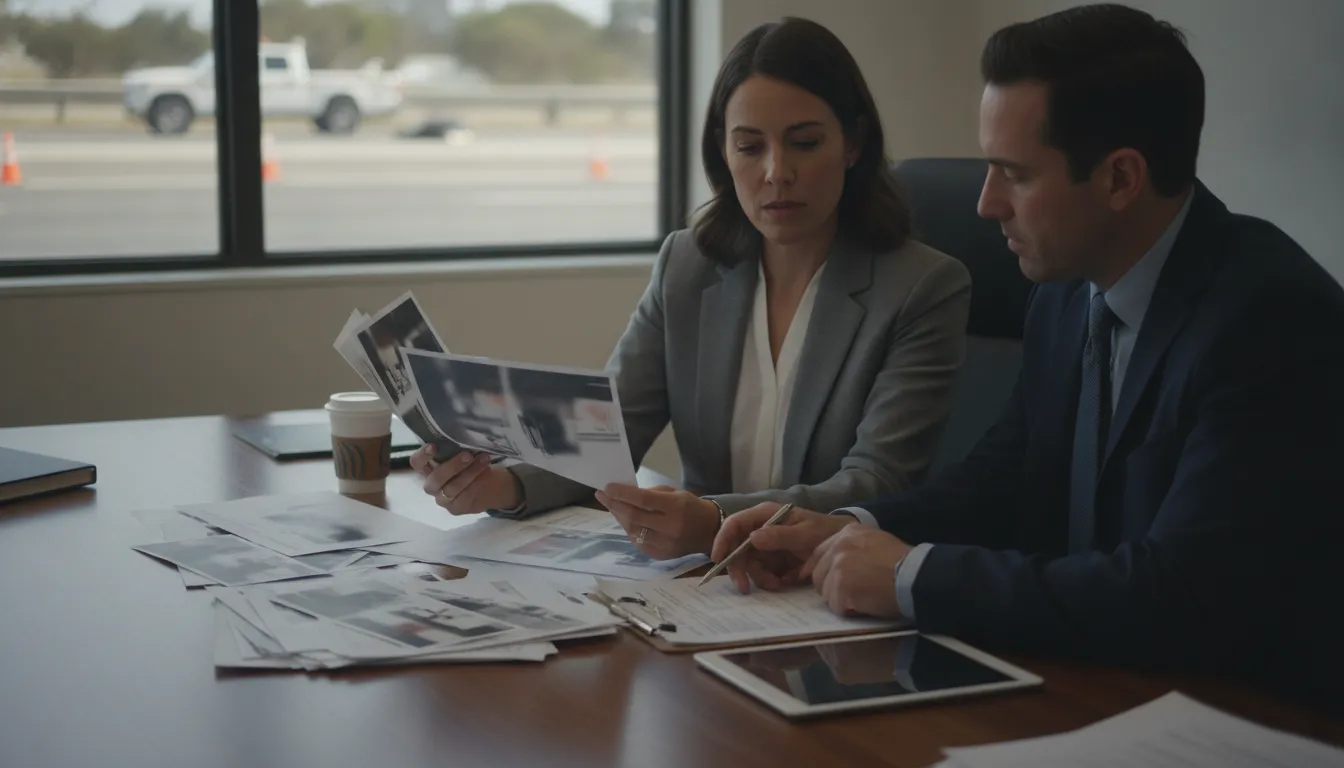
California accident evidence review with collision photographs and claim documents
A police report can give an insurance adjuster a starting point for reviewing a collision, but it is only one part of the claim file. California Courts identifies police reports, photographs, witness statements, repair bills, proof of payment, insurance documents, and investigation materials as potential evidence supporting a property-damage position. A motor-vehicle collision may also involve personal injury, so the report should be reviewed alongside medical records and other injury documentation.
Begin by separating what the report records from what it suggests. Check the crash date, location, involved drivers and vehicles, stated injuries, diagram, narrative, citations, and any contributing-circumstances or damage codes. Accident reports commonly include driver, vehicle, insurance, VIN, and contact information. They may also contain a narrative and diagram that need to be examined independently. Report formats and code systems vary by agency, so do not assume that a number or abbreviation has the same meaning on every form.
Next, compare each material entry with the rest of your evidence:
- Photographs and video: Compare vehicle positions, roadway conditions, traffic controls, visible damage, and debris with the report's diagram and narrative.
- Witness statements: Determine whether witnesses listed in the report support or contradict the described sequence. Also note people who saw the collision but were not identified.
- Medical records: Compare the report's injury notation with later evaluations and treatment records. A brief notation at the scene does not necessarily describe the full extent of an injury.
- Repair records: Use inspection findings, repair bills, and photographs to evaluate the nature and timing of vehicle damage. An officer's numeric damage rating may not reveal hidden structural damage.
- Insurer documents: Review claim notes, recorded statements, correspondence, and requests for information. Keep your account consistent, precise, and limited to facts you can personally support.
An adjuster may focus heavily on the report's contributing-circumstances section when evaluating fault. That section should not be treated as the sole answer, however. A contributing factor, citation, or officer opinion is not automatically a final legal determination of liability. The complete evidence may show a different sequence or reveal that important context was missing.
For a practical overview of organizing evidence, review DC Law Group's car accident claim process. If the report and insurer's position conflict, auto accident attorney help can provide case-specific guidance on preserving and presenting the record.
What If the Report Does Not Match What Happened?
A police report can contain transcription or administrative errors, omit witnesses, or present a narrative that does not reflect every relevant fact. A diagram may also leave out a vehicle movement or depict positions differently from what you observed. Treat the discrepancy as a documentation issue to investigate, not as a reason to alter the original report or assume the officer made a final liability determination. These are recognized areas for careful report review. Learn more about common accident-report errors.
Preserve the original and identify each discrepancy
Save the complete report exactly as received, including every page, attachment, diagram, and code key. Then create a separate list of specific concerns. Note incorrect names, dates, locations, vehicle descriptions, lane positions, injury information, missing witnesses, and statements that do not match your recollection. Compare the narrative and diagram with photographs, vehicle damage, video, text messages, medical records, and witness contact information. Avoid writing on the original report. A dated explanation of what you believe is inaccurate can help keep your records organized.
Ask about correction or supplemental procedures
Contact the agency that investigated the collision and ask how it handles factual corrections, supplemental statements, or requests to add information. Procedures may vary by agency, and submitting a disagreement does not guarantee that the report will be changed. Follow the agency's instructions, provide supporting documentation, and keep copies of your request and any response. If a witness was omitted, provide the person's name and contact information if available. If the diagram conflicts with photographs or available video, identify the particular point of conflict rather than making a broad accusation.
Give the insurer an organized packet that includes the original report, your discrepancy list, supporting photographs, witness statements, repair documentation, and relevant medical records. California Courts identifies police reports, photographs, witness statements, insurance materials, and repair records as possible evidence for a property-damage position. A report is one piece of the evidence, not the entire claim record.
Consider the full collision context
Case-specific review can be especially important when someone was injured, fault is disputed, several vehicles were involved, or a commercial vehicle or rideshare was part of the collision. Those circumstances may require examining additional witnesses, insurance policies, vehicle ownership, company records, or competing accounts. An unidentified driver can create a different evidence problem; see DC Law Group's guide to a phantom vehicle accident claim. For help organizing a California motor vehicle accident claim and its supporting records, review DC Law Group's California motor vehicle accident representation page.
When Should You Get Help Reviewing a Police Report?
You may benefit from case-specific guidance when the report is more than a simple record of undisputed facts. A police report can document observations, statements, vehicle positions, and an officer's preliminary assessment. It does not automatically decide legal liability. Careful review becomes especially important when the report conflicts with your memory, photographs, vehicle damage, witness accounts, or other records.
Situations that deserve closer review
- Liability is disputed. If another driver or an insurer says you caused the collision, compare the narrative and diagram with the physical evidence before accepting that conclusion.
- Symptoms are serious, delayed, or not described accurately. Some whiplash symptoms may begin within days, according to Mayo Clinic. The CDC also explains that some mild traumatic brain injury or concussion symptoms may appear immediately or develop hours or days after an injury. These sources provide general medical information, not a diagnosis. Seek medical evaluation for symptoms after a collision, and obtain emergency care for danger signs such as worsening headache. Repeated vomiting, confusion, weakness, or loss of consciousness, as appropriate.
- Important witnesses or vehicles are missing. A missing witness, phantom vehicle, multiple-vehicle collision, commercial truck, or rideshare can create additional questions about what happened and which parties or insurers may be involved.
- The report contains factual errors. Names, dates, locations, vehicle positions, injury descriptions, and quotations should be checked against your records. Preserve the original report, identify each discrepancy, and ask the investigating agency about its correction or supplemental-report procedure.
- Insurance communications become difficult. If an adjuster pressures you to accept an account you believe is inaccurate, asks you to provide a recorded statement. Or relies on a disputed report interpretation, consider obtaining legal guidance before making a consequential response.
DC Law Group handles California motor vehicle, truck, rideshare, and multi-vehicle accident matters. If you need help organizing the report and related evidence, you can contact DC Law Group or book an appointment. Bring the complete report, photographs, medical records, witness information, correspondence with insurers, and any notes about what occurred. A review can then focus on the specific facts rather than assumptions drawn from a single document.
Call DC Law Group at (310) 571-8860 before you respond to a disputed accident-report entry.
Frequently Asked Questions
Can I get a California police report online?
Often, yes, but the process depends on the investigating agency. A qualifying party of interest can request a California Highway Patrol crash report through the CHP Crash Portal. CHP also accepts requests in person or by mail using Form CHP 190. Drivers, passengers, pedestrians, vehicle owners, and certain legal representatives may qualify. CHP explains its eligibility and request process.
Does a police report determine who was at fault?
No. An officer's observations, diagram, narrative, citations, and contributing-factor codes can be important evidence, but they do not conclusively decide civil liability. Review the report alongside photographs, vehicle damage, witness accounts, medical records, and other evidence that explains what happened.
What should I do if information in the report is wrong?
Preserve the original report, identify each disputed entry, and gather supporting proof. Common issues include incorrect names or dates, omitted witnesses, inaccurate vehicle positions, and assumptions in the narrative. Ask the investigating agency about its correction or supplemental-report procedure. Do not alter the original copy, and provide a clear written explanation with relevant evidence.
What do police report codes mean?
Codes identify entries such as contributing circumstances, traffic violations, or vehicle damage ratings, but code systems and meanings vary by agency and report form. Use the report's own key or contact the agency for clarification. Treat a code as a recorded classification, not as a complete explanation of the collision or a final legal conclusion.
Can a police report help with an insurance claim?
Yes. A police report can be included with photographs, repair documentation, witness statements, and insurance records as part of an evidence package. California Courts identifies police reports and these other materials as possible evidence, and advises insured people to ask their insurer what information and steps it requires. See California Courts' evidence guidance.
Talk With DC Law Group About Your Accident Report
A police report can be useful when you are comparing the recorded details with photographs, medical records, witness accounts, and insurance communications. If the report contains an error or leaves an important fact unclear, reviewing those issues early may help you organize your claim and understand your options.
Call DC Law Group at (310) 571-8860 to discuss your California accident report and claim.