
A Fresno motorcycle crash can leave you managing injuries, medical appointments, motorcycle damage, lost work, and insurance calls at the same time. A Fresno motorcycle accident lawyer can help you understand what evidence matters, how California comparative negligence may affect a claim, and what to consider before signing a release or giving a recorded statement.
Start with safety and medical care. If it is safe to do so, preserve photographs, witness details, damaged riding gear, and the motorcycle itself. Keep medical and work records as treatment continues. The sections below explain practical steps for Fresno riders. They also explain why the crash location, roadway evidence, and insurance communications can matter.
What should you do immediately after a Fresno motorcycle crash?
Your first priority is safety. Call 911 when anyone may be injured or the scene is unsafe. Move away from traffic only when it is safe. If you are able, ask law enforcement and emergency medical personnel to respond.
1. Get medical attention. Do not dismiss pain because it seems manageable. Tell the provider that your symptoms followed a motorcycle collision. Describe every symptom accurately, including pain, dizziness, numbness, weakness, sleep changes, and difficulty moving.
2. Record the scene safely. Photograph the motorcycle, other vehicles, visible injuries, protective gear, roadway, signs, traffic controls, lighting, debris, and surface conditions. Take wide views and closer images. Do not step into traffic or delay urgent care to take photographs.
3. Exchange information. Obtain the other driver's name, contact details, license plate, insurance information, and vehicle description. Ask witnesses for their names and contact information before they leave, if possible.
4. Preserve your gear. Keep your helmet, jacket, gloves, boots, and other riding equipment. Do not wash, repair, discard, or alter damaged gear before it has been photographed and evaluated.
5. Be careful with early insurance conversations. Report the collision as required by your policy. Give accurate identifying information, but do not guess about speed, distance, fault, or the cause of the crash. Consider legal guidance before giving a detailed recorded statement.
California's Department of Insurance advises drivers to obtain information from other drivers and witnesses. It also recommends photographing the scene and keeping records about injuries, treatment, and lost wages. That agency guidance is a useful starting point. The right next step still depends on the facts of your collision.
A helmet can reduce the risk of head injury. Protective equipment does not replace medical evaluation or a careful investigation. Preserve the full sequence of events, including what the other driver did, the roadway conditions, the point of impact, and how your injuries developed.
Why does the Fresno crash location matter?
A roadway is more than a place name in a motorcycle injury claim. The precise location may help identify traffic controls, lane configurations, sight lines, lighting, nearby businesses, construction activity, and agencies or businesses that may hold evidence.
Fresno riders may travel through several different settings in one trip. SR-41 connects major Fresno-area destinations, while SR-99 carries traffic through the Central Valley. SR-168 and SR-180 connect Fresno with surrounding communities and routes. The same collision facts cannot be assumed from a road name alone. An investigation should focus on the actual lane pattern, intersection, visibility, traffic control, and roadway condition.
Write down the nearest cross street, exit, intersection, business, mile marker, or landmark as soon as you can. If the collision occurred near an interchange or active construction area, preserve photographs of the lane pattern and traffic controls. Caltrans materials describing the SR-41 interchange system show why a precise location can provide useful context. Roadway context alone does not prove who caused a particular crash.
Roadway conditions can change. Traffic-camera footage may not remain available, and witnesses can become difficult to locate. If a nearby business may have exterior video, note its name and address. Do not trespass or confront anyone. Give the information to an attorney or investigator who can assess whether a preservation request is appropriate.
DC Law Group's Central Valley motorcycle claims resource addresses a different location and claim angle. This Fresno guide should remain focused on the evidence and legal issues tied to the Fresno crash site.
How should you preserve evidence after a motorcycle accident?
Evidence preservation is often most effective before the motorcycle is repaired or moved from storage. Create a dated folder and keep original files. Make copies for sharing, but do not replace the original photograph or video with an edited version.
* Keep wide and close photographs of the scene, motorcycle damage, other vehicles, skid marks, traffic controls, road surface, lighting, and visibility.
* Photograph the motorcycle from every side. Save repair estimates, towing records, storage records, inspection notes, and records of parts removed during evaluation.
* Preserve the helmet and riding gear. Photograph damage before cleaning or repair and keep the items available for inspection.
* Save the incident report number, responding officer information, witness details, and records showing where the motorcycle and other vehicles were taken.
* Keep insurance correspondence, claim numbers, policy documents, letters, emails, text messages, requests for recorded statements, and medical-authorization forms.
* Maintain medical records, discharge instructions, prescriptions, appointment confirmations, bills, work records, and a simple daily symptom journal.
Do not post crash photographs, opinions about fault, or conversations with an insurer on social media. A post can be viewed outside its original context. Avoid deleting messages or photographs, even when you believe they are unimportant. Let legal counsel determine what is relevant after reviewing the complete record.
The firm's steps after a motorcycle crash provide a related general resource. The Fresno-specific issue is preserving details that may be unique to the local intersection, interchange, business, traffic pattern, or roadway condition.
How does California comparative negligence affect a Fresno motorcycle claim?
California uses a comparative negligence approach. A rider is not automatically barred from bringing a claim simply because an insurer alleges that the rider contributed to the crash. The facts may be evaluated to determine whether each person's conduct contributed to the harm and, if so, what share of responsibility is supported by the evidence.
In general terms, a claimant's damages may be reduced in proportion to the claimant's share of responsibility. The California Supreme Court discussed comparative negligence in American Motorcycle Association v. Superior Court. The result in an individual case depends on evidence, causation, the conduct of each person involved, and the injuries claimed.
California Vehicle Code section 27803 requires a driver and passenger to wear a compliant safety helmet on a motorcycle. Read the statute at California Vehicle Code section 27803. A helmet issue may be relevant to a particular injury. It does not by itself determine who caused the collision or whether another driver's conduct caused other harm.
Preserve evidence that addresses the entire sequence: what the other driver did, what you did, roadway conditions, the point of impact, motorcycle mechanics, and how each injury occurred. A partial-fault allegation should be tested against the evidence, not accepted as a final legal conclusion during an early insurance call.
What should you know about the insurance claim?
Report the collision as required by your policy and record when and how you reported it. Ask for the claim number and the adjuster's contact information. Gather the declarations page for your policy, information about uninsured or underinsured motorist coverage, and the other driver's insurance details.
Be accurate and consistent. Do not minimize symptoms because you hope they will resolve. Do not describe a diagnosis you have not received. If an adjuster asks for a recorded statement, broad medical authorization, or a quick settlement before treatment is complete, consider speaking with a Fresno motorcycle accident lawyer first. Signing a release can affect injuries that are not fully understood yet.
The California Department of Insurance explains that an insurer may request information about the loss and contact drivers and witnesses. Its consumer guidance also emphasizes keeping documentation about injuries, medical treatment, medical expenses, and lost wages. Use that guidance while gathering your records, but do not treat a general checklist as a decision about your own claim.
An attorney can help separate the liability investigation from the medical documentation process, identify missing evidence, and communicate with the insurer. That does not guarantee a particular result. It can provide a clearer process for evaluating what happened and what records support the claim.
Keep every letter, email, text message, estimate, and authorization request. If the other driver disputes the crash or the available coverage is unclear, preserve the dispute in writing. Ask questions before signing documents you do not understand.
How should you document motorcycle injuries and losses?
Document the injury itself, the treatment required, and the practical effect on work and daily life. Motorcycle collisions can involve serious physical injuries, but the legal significance of an injury depends on medical records, causation, treatment, and the facts of the crash.
* Follow medical instructions and attend recommended appointments. Keep a dated list of symptoms, changes in mobility, sleep disruption, medication effects, and activities you cannot perform.
* Photograph visible injuries over time when your medical provider says it is appropriate. Preserve the original images with their dates.
* Save emergency-care records, imaging results, surgery records, physical-therapy notes, specialist visits, prescriptions, and follow-up appointments.
* Tell providers about prior injuries accurately. Do not assume a prior condition eliminates a claim. The medical question may include how the collision affected your condition.
* Track missed work, modified duties, reduced hours, and employer communications. Keep reliable records of lost earnings and work restrictions.
* Record how the injury affects driving, household tasks, exercise, family responsibilities, sleep, and other normal activities.
Keep the motorcycle and riding gear available for inspection. Damage patterns, broken parts, and contact marks may help experts evaluate the direction and force of an impact. Do not authorize repairs before the condition has been documented and relevant evidence preserved.

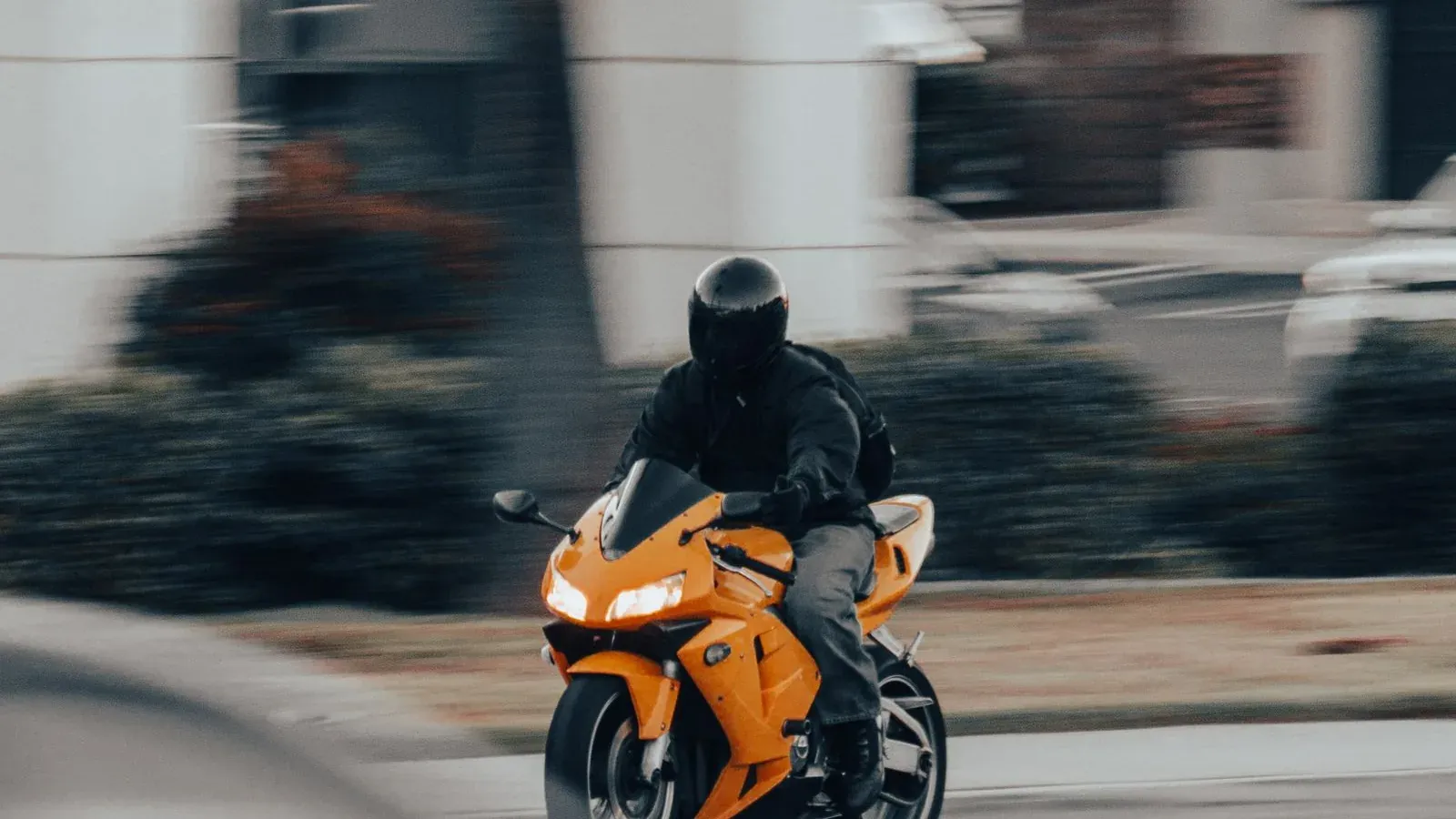
Motorcyclist riding in full protective gear on a California roadway
Preserve photographs of the motorcycle, protective gear, roadway, and visible injuries after a crash.
Do not delay necessary care to strengthen a claim. Health comes first. If you have questions about records or an insurer's request for medical information, bring the request and your treatment records to a lawyer for review.
Who may be responsible, and when should you contact a Fresno motorcycle accident lawyer?
Responsibility depends on the evidence. A driver may be responsible after turning across a motorcycle's path, changing lanes without safe clearance, following too closely, driving while distracted, or violating a traffic rule. Other potential sources may include an employer or commercial vehicle operator, a manufacturer when a defective component contributed. Or a government entity or property owner when a qualifying roadway or property condition contributed.
These possibilities do not mean every case has multiple defendants. They show why an investigation should not stop with the first insurance policy identified at the scene. Keep reports, photographs, vehicle records, medical records, and communications so the potential sources of responsibility can be evaluated.
Consider contacting a lawyer promptly when you have significant injuries, disputed fault, an uninsured or underinsured driver. A commercial vehicle, a hit-and-run, a motorcycle that needs inspection, or an insurer pressing for a recorded statement or release. Early legal review may help identify time-sensitive evidence and prevent avoidable communication problems.
California personal injury claims commonly involve a two-year limitations period under California Code of Civil Procedure section 335.1. Exceptions and different deadlines can apply. Claims involving public entities, minors, medical issues, or other special facts may require a different analysis. Read California Code of Civil Procedure section 335.1, but do not wait until the end of any possible period to seek advice.
For a service-focused resource, visit DC Law Group's California motorcycle accident attorneys page. A service page and this Fresno guide serve different purposes. This article provides general information about evidence, claims, and legal issues after a local crash. It does not predict whether a particular rider will recover or how a claim will resolve.
Call DC Law Group at (310) 571-8860 to discuss your Fresno motorcycle accident and next steps.
Frequently asked questions
What should you do after a Fresno motorcycle accident?
Get to a safe place, call 911 when necessary, obtain medical care. Photograph the scene if it is safe, collect witness and insurance information, and preserve the motorcycle and riding gear. Report the crash as required by your policy. Avoid guessing about fault or giving a detailed recorded statement before you understand the request.
Are motorcycle accidents common in Fresno?
A location-specific conclusion requires reliable local data for the relevant period. Regardless of a frequency question, Fresno riders should document the exact roadway, intersection, traffic controls, visibility, and conduct of each person involved. Those details are more useful to an individual claim than a general assumption about how often crashes occur.
What causes motorcycle accidents in Fresno?
Possible causes include unsafe lane changes, turns across a rider's path, following too closely, distraction, poor visibility, roadway conditions, and other traffic violations. The cause cannot be determined from the vehicle type or location alone. Photographs, damage patterns, witness accounts, reports, and roadway evidence should be reviewed together.
Should I get a lawyer for a motorcycle accident?
Consider legal guidance when injuries are significant, fault is disputed, an uninsured or underinsured driver is involved, a commercial vehicle is involved. The crash was a hit-and-run, the motorcycle needs inspection, or an insurer requests a recorded statement or release. A lawyer can explain the issues to investigate without promising a specific result.
How long do I have to file a California motorcycle accident claim?
Many California personal injury claims involve the two-year period in Code of Civil Procedure section 335.1. But the correct deadline depends on the parties, claim type, date of discovery, and other facts. Public-entity claims and other special situations may have different requirements. Seek a fact-specific review promptly.
This article provides general legal information and does not create an attorney-client relationship. Every case is different and should be evaluated on its individual facts and circumstances.