
After a fatal accident, surviving family members in Riverside may face grief, urgent paperwork, and insurance communications. They may also have difficult questions about what happens next. A wrongful death claim is a civil action that may allow eligible survivors or a personal representative to seek legally recognized recovery. This applies when another party's wrongful act or neglect caused the death. The right claimant, available damages, and filing deadline depend on California law and the facts of the case.
A riverside wrongful death lawyer can help a family understand who may have standing, how negligence and liability are evaluated, which losses may be legally recoverable, and whether separate estate rights are involved. This review is fact-specific and is not a guarantee of any result.
Call DC Law Group at (310) 571-8860 for a case evaluation.
The starting point is the legal definition of wrongful death under California law, followed by a careful look at who may bring the claim and why eligibility matters.
What Is a Wrongful Death Claim in California?
A wrongful death claim is a civil action that may arise when a person dies because of another person's wrongful act or neglect. In California, the claim is not limited to one type of accident. A family may need to examine a fatal car, truck, motorcycle, rideshare, or pedestrian collision. As well as other incidents where another person or entity may have caused the death.
The legal question is usually not whether the death was tragic. It is whether the available evidence supports a claim that another party had a legal responsibility, failed to meet it, and caused the fatal injury. For Riverside and Inland Empire families, that review may involve roadway evidence, vehicle records, witness accounts, insurance policies, or the conduct of more than one potentially responsible party.
How a civil claim differs from a criminal case
A wrongful death claim is separate from a criminal prosecution. The family generally does not have to prove that the defendant intended to kill the person. A death may support a civil claim when it resulted from negligent, reckless, or intentional conduct, depending on the facts and the evidence. A criminal investigation, citation, or charge may be relevant, but the outcome of that process does not by itself answer every question in a civil case.
Duty, breach, and causation
In a negligence-based claim, the analysis commonly begins with duty. A driver, business, property owner, or other party may owe a duty to act with reasonable care under the circumstances. The next question is breach: did that party fail to use the care the situation required? Finally, causation must be examined. The evidence must connect the alleged breach to the fatal injury, rather than merely showing that the party was present or involved.
These issues can arise in different Riverside fatal-accident contexts. A collision may involve a commercial vehicle, a rideshare company, multiple drivers, or more than one insurer. A pedestrian death may require a close review of roadway conditions and the conduct of the people involved. A fatal incident reported in Riverside County can provide local context, but a news report does not establish liability in a particular family's case. The facts still require an independent investigation.
California Code of Civil Procedure section 377.60 describes a cause of action for a death caused by the wrongful act or neglect of another. It also identifies people who may assert it or do so through a personal representative: read the statute. Eligibility, evidence, and filing requirements depend on the family's circumstances. Families can also review DC Law Group's personal injury and accident representation page for related information, while keeping in mind that educational material cannot determine whether a specific claim is viable.
Who Can Bring a Riverside Wrongful Death Claim?
After a fatal accident, one of the first legal questions is who has the right to bring a claim. In California, standing depends on the relationship to the deceased person, financial dependency in some circumstances, and the family's specific facts. The rules are not limited to the person who handled the decedent's day-to-day affairs, and they do not always produce the same result as the estate's separate rights.
Surviving family members who may qualify
California Code of Civil Procedure section 377.60 generally identifies a surviving spouse, domestic partner, children. And the issue of deceased children among the people who may assert a wrongful-death cause of action. The statute also addresses other relationships and dependency situations. For example, certain dependent relatives, a putative spouse, qualifying stepchildren, parents, or legal guardians may have rights under circumstances described by the law. See the full text of California Code of Civil Procedure section 377.60 for the statutory language.
Some eligibility questions require close attention to facts that may not be obvious from a family tree. California law defines a putative spouse as a surviving spouse who believed in good faith that a void or voidable marriage was valid. A minor who lived in the decedent's household for the prior 180 days and depended on the decedent for at least half of the minor's support may also qualify under the statute. These are examples, not a complete list of every possible claimant or limitation.
The role of a personal representative
A personal representative may assert the wrongful-death cause of action on behalf of eligible people. That role can matter when several family members have potential interests, when the estate is involved, or when the family needs a coordinated legal approach. Eligible survivors and the personal representative may have different rights, so opening or administering an estate does not by itself answer every standing question.
Why family coordination and facts matter
When more than one person may qualify, the family should identify all potentially eligible survivors early and avoid making inconsistent claims to insurers or other parties. Marriage or domestic-partner records, birth records, household history, support arrangements, and estate documents may help clarify the relationships and dependency issues. The analysis can be especially sensitive when relatives disagree, when a child or stepchild is involved, or when a putative marriage is part of the history.
A Riverside wrongful death lawyer can review the family structure, available records, and circumstances of the fatal accident before advising who may participate. This section is general information, not a determination of standing in any particular case. The controlling answer depends on California law and the facts of the family involved.
How Is Liability Established After a Fatal Riverside Accident?
Liability is established by examining what happened, who had a legal duty, whether that duty was breached, and whether the breach caused the death. The analysis is specific to the evidence and circumstances of the accident. A fatal collision involving a car, truck, motorcycle, rideshare vehicle, pedestrian, or premises may require a different investigation.
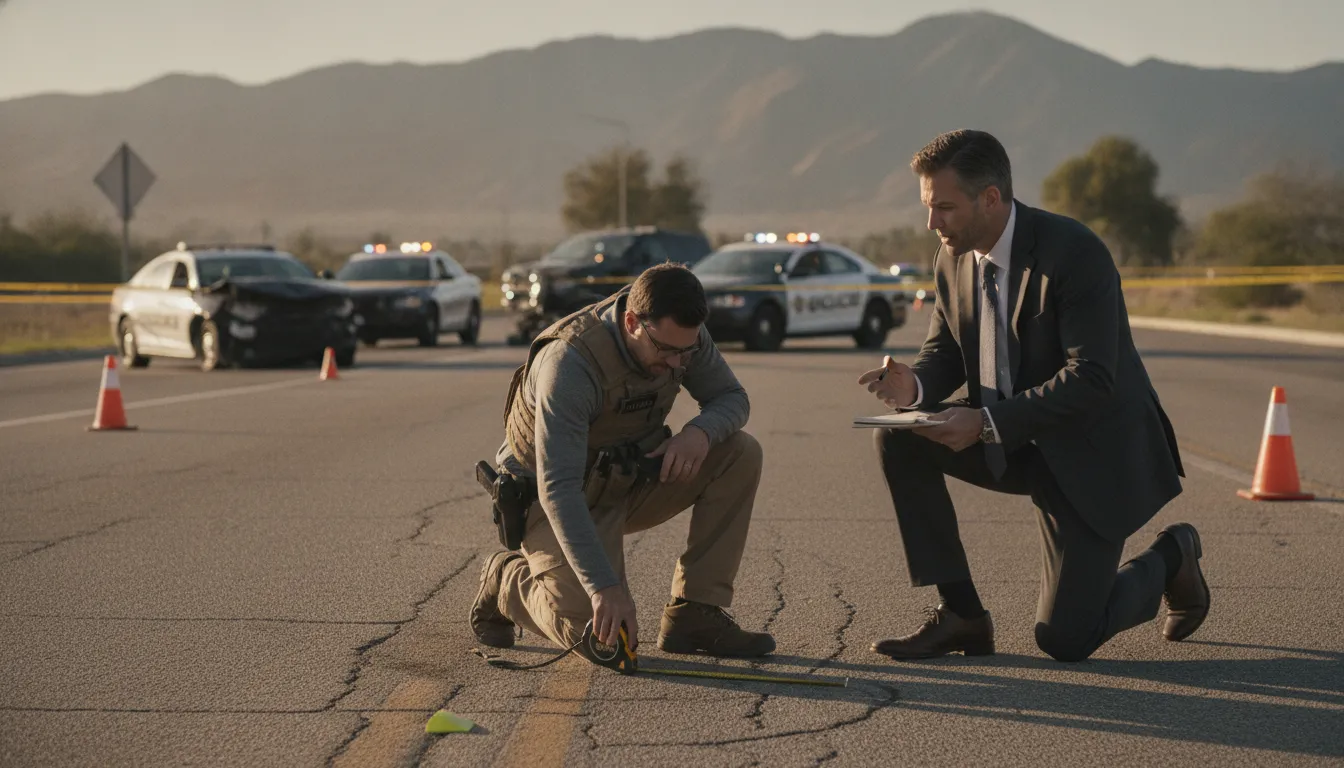
California traffic investigator reviewing a Riverside roadway after a serious collision
Accident evidence should be documented carefully before conditions change.
Investigators may review the scene, vehicle damage, roadway design, traffic signals, surveillance video, photographs, event-data information, police reports, medical records, and witness accounts. Accident reports, witness statements, and qualified expert opinions may help explain the sequence of events, but no single document automatically determines civil liability. A police citation, arrest, or preliminary report may provide useful information while still requiring independent review.
More than one party or insurance policy may be involved
Some Riverside fatal-accident claims involve more than the person who was driving. A rideshare or commercial-vehicle investigation may require review of the driver, an employer, a vehicle owner, a maintenance provider, a transportation company, or another responsible entity. Insurance coverage can also involve multiple policies, each with different terms and issues. Identifying every potentially responsible party early can help prevent an investigation from focusing too narrowly on one account of the crash.
The type of incident matters. A multi-vehicle crash may require analysis of each driver's actions, lane positions, vehicle movement, and roadway evidence. A pedestrian fatality may raise different questions about visibility, traffic conditions, vehicle speed, and the location of the impact. A Riverside pedestrian fatality can provide local context for why the accident type matters, but a news report is not proof that any person or entity was legally responsible.
Preserving evidence can protect the investigation
Evidence may change or disappear as vehicles are repaired, surveillance systems overwrite recordings, roadway conditions change, and witnesses' memories fade. Families should preserve photographs, messages, insurance communications, medical and funeral records, and the names and contact information of witnesses. They should also keep copies of police or incident reports and avoid discarding damaged property that may be relevant.
Prompt legal review can help identify evidence to request and parties to notify. A documented investigation may include collecting accident details, reports, medical records, insurance information. Witness statements, and other records, followed by evidence preservation, claim discussions, and litigation preparation when appropriate. The goal is not to assume liability, but to build a fact-based account of what occurred and determine whether a viable claim may exist.
What Damages May Be Recoverable?
A wrongful-death claim and a survival action address different kinds of loss. The first generally belongs to eligible family members and focuses on the harm they experienced because of the death. The second continues a legal claim the deceased person could have pursued, with the personal representative or successor in interest pursuing it for the estate. California Code of Civil Procedure section 377.30 describes how a cause of action that survives death passes to the decedent's personal representative or, if none, successor in interest: CCP section 377.30.
California law provides that wrongful-death damages may be awarded as justice requires under the circumstances, but it distinguishes those damages from amounts recoverable through a survival claim. The court may also determine the respective rights of people entitled to an award. These rules make documentation important. Medical records, employment information, household responsibilities, financial records, and evidence of the relationship may help show how the death affected particular family members. The relevant evidence will vary by case.
There is no reliable universal damages figure for a Riverside fatal-accident case. Insurance coverage, the quality of available evidence, the deceased person's circumstances, lost income, and other facts can affect the analysis. A personal injury and accident representation team can help distinguish family losses from estate claims and assess which categories may be legally available. This information is general and does not determine what any particular claimant may recover.
What Is the California Wrongful Death Filing Deadline?
California Code of Civil Procedure section 335.1 generally states that an action for a death caused by the wrongful act or neglect of another must be filed within two years. The statute provides an important starting point for a Riverside family considering a wrongful death claim. But it should not be treated as a universal answer for every case. Read the current statutory language at California Code of Civil Procedure section 335.1.
A filing deadline is commonly called a statute of limitations. If the applicable period expires, a surviving family member may face a serious challenge to pursuing the claim. Even when the underlying death was deeply harmful and the family believes another person or entity was responsible. The date of death, the legal theory involved, the identity of the defendant, and other facts can affect how the deadline is evaluated.
Why the deadline may not be the same in every case
Deadlines can vary based on the type of claim and the parties involved. A claim involving a private individual, business, commercial vehicle operator, or insurer may require a different analysis from a matter involving a government entity. Government involvement can create additional claim procedures and timing issues. The applicable rules may also depend on whether the family is pursuing a wrongful death claim, a related claim, or a separate estate-based action. Those issues should be reviewed together rather than assumed from a general internet deadline.
Family circumstances matter as well. California law recognizes that eligible survivors and a decedent's personal representative may have different rights. The person bringing a claim, the legal capacity in which it is brought, and the claims asserted can affect the analysis. A deadline question therefore cannot be answered reliably from the accident location alone. Riverside and Inland Empire families should obtain a case-specific review before relying on a general two-year statement.
Why prompt review matters after a fatal accident
Grief, medical records, insurance communications, police reports, and estate paperwork can make it difficult to focus on legal timing. Delay can also complicate the preservation of evidence and the identification of witnesses or potentially responsible parties. Promptly gathering the death certificate, accident information, insurance correspondence, reports, and relevant family or estate documents can help an attorney evaluate the claim and the applicable deadline.
This article provides general information, not individualized legal advice. If a family is considering a wrongful death claim. Contacting a Riverside wrongful death lawyer promptly can help clarify which deadline rules may apply and what steps should be taken next. Do not wait until the end of a possible filing period to seek a case-specific review.
How a Riverside Wrongful Death Lawyer Helps Families Evaluate a Claim
After a fatal accident, a family may be managing grief while also facing paperwork, medical bills, lost income, transportation problems, and insurance communications. There is no need to resolve every legal question immediately, but early organization can help preserve information that may matter later. The following steps are practical starting points, not a substitute for case-specific legal advice.
- Preserve available evidence. Keep photographs, videos, damaged personal property, vehicle information, scene details, and messages related to the accident. Do not discard or repair relevant items before they can be documented. If witnesses shared contact information, preserve those details. Evidence can become harder to locate as time passes, so write down what the family remembers while those recollections are still clear.
- Create one records file. Gather the police or incident report, medical records and bills, insurance policies and letters, employment information, funeral and related documentation, and correspondence from involved parties. A documented intake may also include accident details, witness statements, and other supporting evidence. Keep originals secure and use a dated folder for copies and new communications.
- Be careful with insurer communications. Notify the appropriate carrier when required by the policy, but avoid guessing about fault, speculating about facts, or giving a recorded statement before understanding what is being requested. Do not sign a release or accept an offer without reviewing its effect on potential claims. In matters involving rideshare or commercial vehicles, more than one party or insurance policy may require review.
- Document the family's losses and responsibilities. Track medical expenses, lost income, household support, transportation needs, and other practical effects of the death. Keep receipts and note who paid each expense. These records do not establish that every item is legally recoverable. But they can help a lawyer evaluate the family's circumstances and distinguish family losses from claims belonging to the estate.
- Seek prompt, case-specific review. California filing rules depend on the claim, defendant, possible government involvement, and other facts. A timely review can help identify potential responsible parties, preserve evidence, coordinate eligible family members, and assess whether a wrongful-death claim or a separate estate claim may apply. DC Law Group describes a process that may include information gathering, evidence preservation, claim negotiation, and litigation preparation when necessary.
Frequently Asked Questions
What constitutes a wrongful death in California?
California permits a wrongful-death claim when a person dies because of another party's wrongful act or neglect. Depending on the facts, the claim may involve negligence, recklessness, or intentional conduct. A civil claim generally focuses on duty, breach, causation, and resulting losses, not whether anyone intended the death. California Code of Civil Procedure section 377.60 provides the statutory framework.
Who can file a wrongful death lawsuit in California?
Potential claimants may include a surviving spouse or domestic partner, children, and certain other relatives or dependents. A decedent's personal representative may also assert the claim on behalf of eligible people. Standing depends on California law and the family's circumstances, so relatives should not assume that every potential beneficiary has identical rights.
What is the time limit to file a wrongful death claim in Riverside?
California Code of Civil Procedure section 335.1 generally provides a two-year period for an action based on death caused by wrongful act or neglect. Measured from the date of death. That period is not universal for every claim. Government involvement, the defendant, and other facts may affect the applicable deadline, making prompt case-specific review important.
What damages may be available in a wrongful death claim?
Potential family losses may include medical expenses, lost income, and loss of household support, depending on the evidence and applicable law. California law permits damages that are just under the circumstances, while the court determines the respective rights of people entitled to an award. No fixed result applies to every family or claim.
How is a survival action different from wrongful death?
A wrongful-death claim addresses losses suffered by eligible surviving family members. A survival action is pursued through the estate for claims the decedent could have pursued had they lived, subject to California law and applicable limits. The two proceedings can involve different rights, damages, and procedural questions, so the distinction should be reviewed with the family's full facts.
Contact us about your Riverside wrongful death claim
After a fatal accident, a case-specific review can help your family understand which legal issues and next steps may apply. DC Law Group can discuss the circumstances and answer initial questions about pursuing a wrongful death claim in Riverside. Call DC Law Group at (310) 571-8860 to get started and request a case evaluation.