

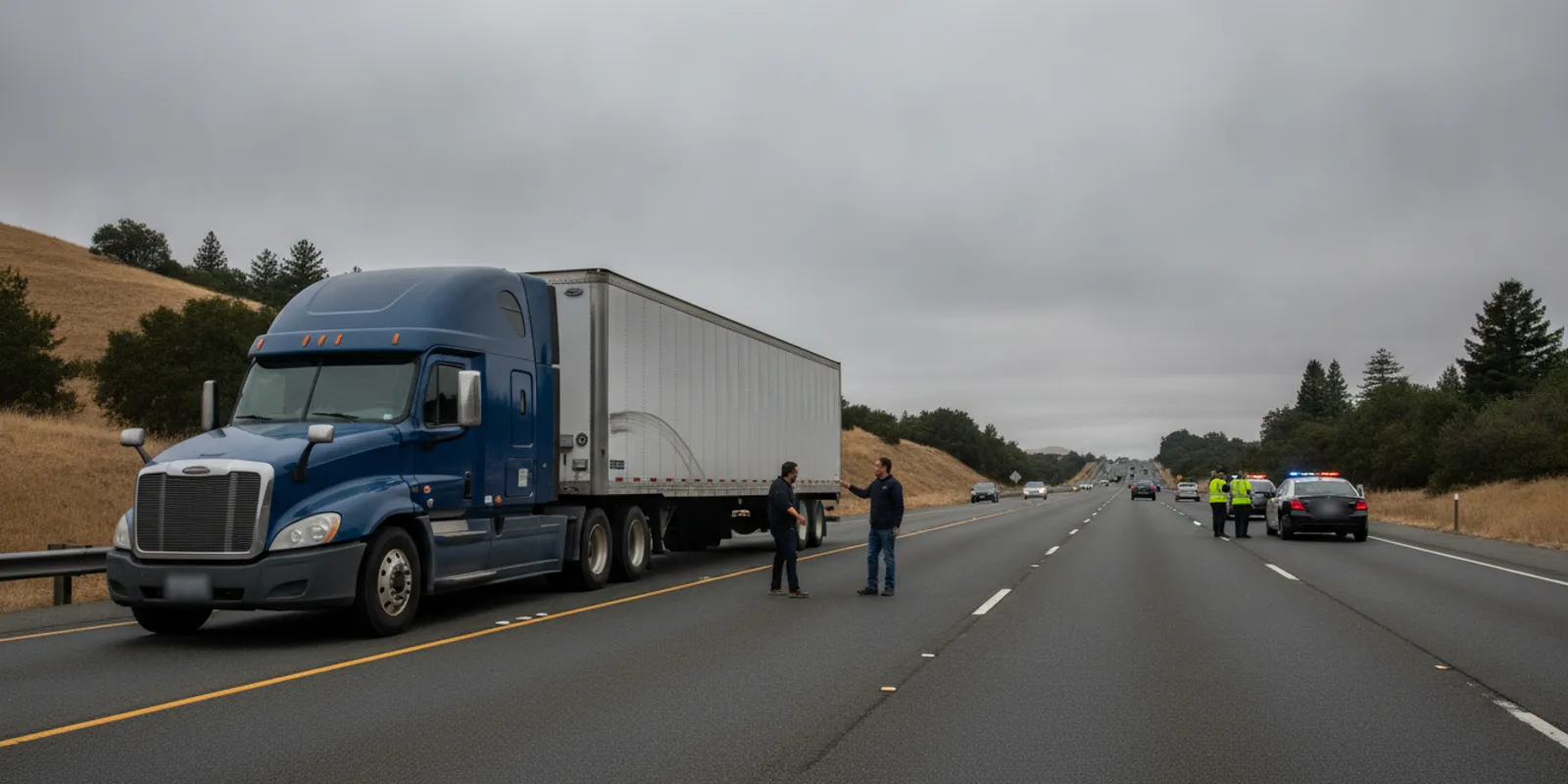
A commercial-truck collision can raise questions that do not arise in the same way after a crash between two passenger vehicles. The truck may have an employer, owner, maintenance provider, cargo handler, and several records that help explain what happened. If you are looking for a truck accident lawyer, start by understanding which evidence may matter, who may have responsibility, and how to protect useful information. This article offers general information, not legal advice about a particular event.
Call DC Law Group at (310) 571-8860 about your truck collision
Why can a commercial-truck claim involve different questions?
A large commercial vehicle is part of a working operation, not just a vehicle on the road. The driver may be working for a carrier or another business. A different company may own the tractor or trailer, arrange the shipment, or perform maintenance. The roles depend on the facts and the agreements involved. Naming a company on a vehicle does not, by itself, establish that it is legally responsible.
There can also be more than one explanation for a collision. Driver conduct, vehicle condition, cargo loading, scheduling, roadway conditions, and the actions of other road users may all deserve investigation. A useful review keeps these possibilities open until records and other evidence clarify them. It does not assume that every truck case has the same cause or the same responsible parties.
These differences make early preservation important. Some electronic or business records may be kept for a limited period under ordinary retention practices. A person involved in a crash should not try to obtain restricted company records personally or confront a driver or employer. Instead, record what is known, preserve accessible material, and consider prompt legal guidance about the proper steps.
Preservation is not the same as proving a claim. It means taking reasonable care not to lose evidence that may later help explain the event. Do not attempt to access a company system, remove a vehicle part, or make a private inspection of equipment. If an item is in someone else’s control, an attorney can advise whether a formal request or other lawful process is appropriate. If the truck or another vehicle is scheduled for repair, document what you can lawfully observe and ask the insurer or responsible representative about an inspection before work begins.
Deadlines also matter, and they may vary according to the parties, claim type, and circumstances. A claim involving a public entity can raise different notice rules from a claim against a private business. Do not assume that an ongoing insurance discussion pauses a legal deadline. A lawyer can assess which time limits may apply based on the date and facts.
What evidence may help explain how the collision happened?
Evidence can answer different questions: where the vehicles were, what they did before impact, whether a mechanical issue was present, and how the crash affected the injured person. No single item necessarily answers every question. Records should be considered together, with attention to when they were created and who collected them.
- Scene details: Photographs of vehicle positions, visible damage, road markings, traffic controls, weather, and debris may help preserve conditions that later change. If it is safe, capture broad views as well as close details.
- People and accounts: Names and contact details for witnesses, responding officers, and other involved people can help identify sources of information. Write down your own recollection while it is fresh, separating what you saw from what someone else told you.
- Vehicle information: Record the truck’s identifying markings, trailer details, plate information, and any visible company or carrier name. Do not enter a vehicle or remove equipment.
- Electronic data: Some vehicles may have event data or other onboard systems. Depending on the vehicle and system, available records may relate to speed, braking, or vehicle operation near a triggering event. Availability, retention, and meaning vary.
- Business records: Dispatch communications, delivery schedules, inspection and repair records, driver qualification materials, and route information may be relevant in some cases. Access and relevance depend on the facts and applicable rules.
- Medical documentation: Evaluation records, treatment instructions, diagnostic findings, and a timeline of symptoms can document the injury and its effects. Seek appropriate medical care and follow the treating professional’s instructions.
Preserve original photographs and files where possible. Keep copies in a secure place and note when and how each item was obtained. Avoid editing an original image; if you need to mark up a copy for your own reference, retain the unaltered version too. A short dated note can record the source of an item and what it depicts without making conclusions about fault.
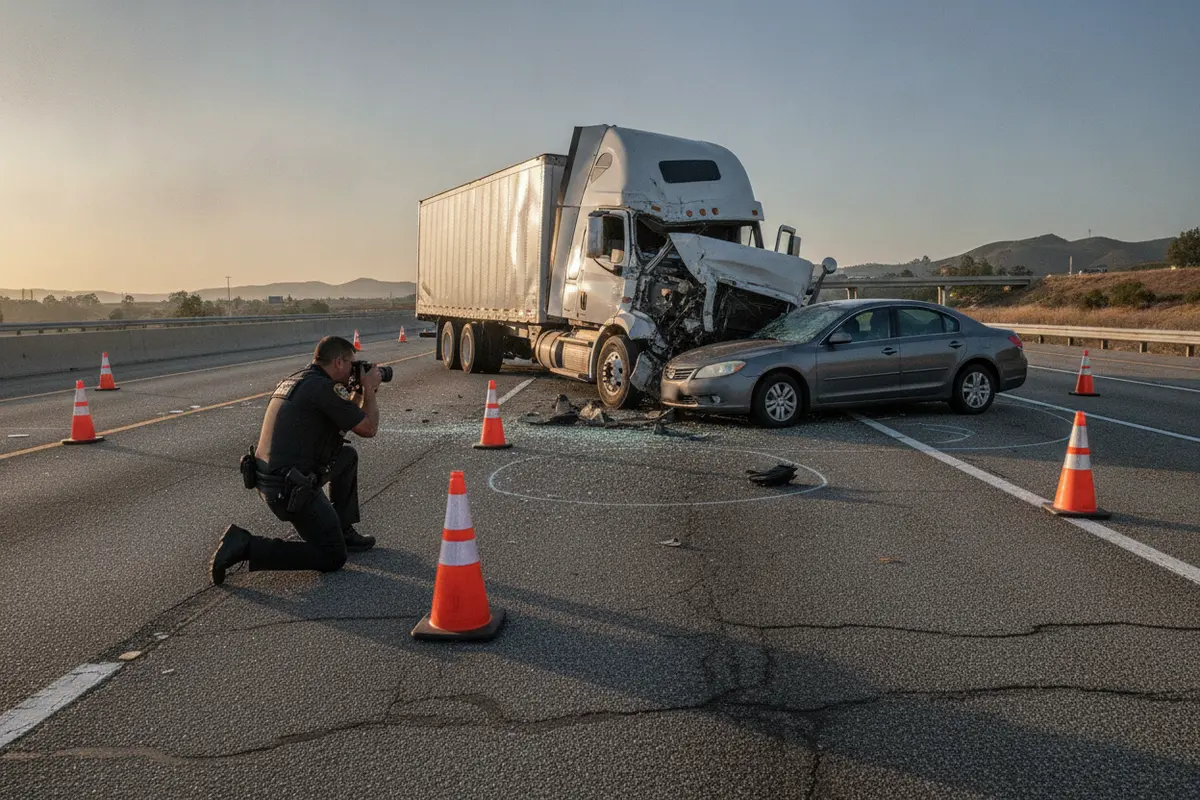
Officer documenting a commercial truck collision scene in California
How do truck records differ from ordinary crash evidence?
A passenger-car collision may be investigated with photographs, witness accounts, vehicle damage, and available electronic data. A commercial-truck inquiry may need those same sources plus records tied to the work being performed. Those records are not automatically available to an injured person, and their existence should not be presumed in a specific case. A lawyer may assess what to request and how to preserve it through appropriate channels.
| Evidence category | Possible question it helps address | Practical point |
|---|---|---|
| Scene photographs and witness accounts | Vehicle positions, visibility, sequence of events, and immediate observations | Keep originals and note the date, location, and source. |
| Vehicle or event data | Whether available system records show vehicle activity near a recorded event | Systems and retention differ; do not assume a particular data set exists. |
| Inspection and repair history | Whether a reported mechanical condition may be relevant | Records need context, including who made each entry and when. |
| Dispatch, route, or delivery records | What work was scheduled and what communications may relate to timing | Relevance depends on the collision facts; preserve requests through proper channels. |
| Medical records and symptom notes | What care was provided and how the injury developed over time | Keep appointment details and follow the treating professional’s advice. |
| Police report and insurance correspondence | What was reported and how the claim is being handled | Review for factual errors and keep copies of communications. |
The table is a starting point, not a checklist that fits every collision. A damaged truck component, for example, may be important in one investigation but irrelevant in another. Likewise, a schedule or dispatch record may provide context without proving that a driver or company violated a duty. Evidence must be interpreted alongside the applicable legal standards and all available facts.
Think of evidence as a set of connected pieces rather than a single decisive document. A photograph may show where a vehicle came to rest but not why it moved there. A repair record may document work without establishing when a defect began. A witness may remember the impact but not the events beforehand. Comparing accounts against physical details and dated records can help identify gaps and guide further investigation.
Keep a simple inventory as materials come in. Record the item, date received, person or business that provided it, and where the original is stored. If a report contains a detail you believe is inaccurate, make a note of the exact passage and the facts you believe are correct. Do not alter the report itself. This kind of organized record helps a lawyer understand both what is known and what still needs verification.
How is a truck claim different from a passenger-vehicle claim?
The basic questions remain familiar: what happened, whether someone failed to use reasonable care, whether that conduct caused an injury, and what harm can be documented. The investigation may be broader because a commercial vehicle can be used in a business operation involving multiple people and organizations. Instead of focusing only on two drivers, the review may need to establish who employed or directed the driver, who maintained the vehicle, and which business records connect an entity to the trip.
That difference affects how evidence is gathered. A passenger vehicle owner may have direct access to the vehicle and its repair history. In a commercial operation, the truck, trailer, maintenance files, dispatch information, and onboard systems may be controlled by different parties. An injured person may not have a right to inspect or obtain those materials informally. A lawyer can evaluate whether a preservation request, records request, or other formal process fits the facts and applicable procedure.
The difference does not mean that every truck claim is more serious or that a business is automatically responsible. The injury, evidence, legal issues, and potential coverage depend on the individual collision. The useful takeaway is to identify the operation behind the vehicle without jumping to conclusions, then connect each possible party to a specific role and supporting evidence.
Who may have legal responsibility?
California injury claims generally require an analysis of duty, breach, causation, and harm. In a truck collision, the driver’s actions may be considered, but the inquiry can extend beyond the person behind the wheel. Depending on the evidence, a carrier, vehicle owner, maintenance contractor, cargo-related business, or another road user could be relevant. A company’s connection to the truck alone does not establish liability.
Responsibility can also be disputed or shared. One party may argue that another driver contributed to the collision, or that the injury was caused by a separate event. California’s comparative-fault rules can affect the way responsibility is assessed. The percentages and legal consequences cannot be determined from a brief description alone, so avoid relying on an informal assumption about who is at fault.
For a clearer view, organize the key questions: What happened? Identify the sequence of movements, traffic conditions, and points that remain uncertain.
- Who controlled each relevant activity? Separate the driver’s role from ownership, dispatch, maintenance, and cargo arrangements.
- What evidence can test each explanation? Match each disputed point to a potential record, witness, or physical item.
- What injury and losses are documented? Keep medical records and relevant personal or work records for review.
For broader context about the legal tasks involved, see DC Law Group’s guide to what a truck accident lawyer does and its overview of how a truck collision attorney may approach a claim.
What should you do in the days after a truck collision?
Put safety and health first. If emergency assistance is needed, contact the appropriate emergency service. Obtain medical evaluation for injuries, including symptoms that appear after the initial shock of a collision. Describe symptoms accurately to the treating professional and keep the written instructions and follow-up information you receive.
When safe, preserve basic information: the date and location, vehicle and company identifiers, witness contacts, photographs, and the responding agency’s report details. Make a simple chronology of events and communications. This is not a substitute for an official report or a legal investigation, but it can help you recall details later.
- Keep the damaged vehicle and related property information organized. Before repairs or disposal, document visible damage and ask the appropriate insurer or representative about an inspection.
- Save letters, emails, texts, claim numbers, and the names of people who contact you. Note the date, time, and substance of each conversation.
- Be accurate and restrained when discussing the event. Do not guess at speed, distance, or the cause if you do not know.
- Do not post detailed accounts, photographs, or commentary about the claim publicly without considering how they may be interpreted outside their original context.
- Do not sign a release or provide a recorded statement without understanding what is being requested and how it may affect your claim. You may ask for time to review a document or seek legal advice.
California’s Department of Insurance advises motorists to notify their agent and insurer after an accident and states that an insurer should accept or deny a claim within 40 days after receiving proof of claim. The agency’s accident guidance provides additional information. Claim handling can depend on the circumstances and the information submitted, so keep a copy of what you provide and when you sent it.
For a step-by-step overview of immediate actions, read DC Law Group’s article on what to do after a truck accident in California. If the collision involved a delivery vehicle, its separate discussion of a delivery van accident claim may also help you identify the questions to ask.
How can insurance communications affect the claim?
Several insurance policies may be involved, and the relevant coverage depends on who owned or operated the vehicle, the driver’s work status, and the facts of the crash. An insurer may ask for documents or an account of what happened. Provide truthful information, keep records of what you send, and ask for clarification if a request is unclear. Do not treat an adjuster’s preliminary position as a final legal determination.
It is useful to distinguish three issues that are sometimes blended together: Coverage: Which policy may apply, and what terms, limits, exclusions, or conditions may matter?
- Responsibility: Which people or entities may be legally accountable for the collision or injury?
- Damages: What injury-related harm can be supported by records and other evidence?
A dispute over one issue does not necessarily answer the others. For example, an insurer’s coverage position does not by itself decide whether a driver or business acted negligently. Likewise, a preliminary view of fault does not establish the full scope of an injury. Keep communications organized and seek advice before making decisions that could affect your rights.
When you receive a request, identify who is asking, what information is sought, the response date, and whether the request is written or spoken. Ask for a copy of any form or document you are asked to sign. If you do not understand a question, ask for it to be clarified rather than speculating. Keep your answers factual and consistent with what you know. If you need time to obtain a record or review a document, say so and keep a note of the exchange.
Be careful not to treat a quick estimate or initial discussion as a complete evaluation of an injury claim. The available medical information may develop over time, and the investigation may identify additional parties or evidence. Before resolving a claim or signing a release, understand what rights the document covers and whether it affects other claims. A qualified attorney can explain the document and its potential effect in light of your circumstances.
Call DC Law Group at (310) 571-8860 to review a California truck collision
When may a truck accident lawyer be useful?
A consultation may be useful when a serious injury is involved, the facts are disputed, a commercial employer or several businesses may be connected to the vehicle, or important records could be lost or changed. A lawyer can review the available account, identify unanswered questions, explain potential avenues for obtaining evidence, and discuss applicable deadlines. The consultation should not be understood as a promise about the outcome of a claim.
Prepare for a discussion by gathering the crash date and location, report information, photographs, insurance correspondence, medical records you have, and a list of questions. You can also explain which facts are uncertain. If you were a passenger or a family member is helping, note who directly witnessed each event and who is reporting information secondhand.
Choosing counsel is a personal decision. Ask who will communicate with you, how questions are handled, what documents the firm needs, how fees and case expenses are addressed, and what steps may come next. Request clear explanations rather than relying on a predicted result. DC Law Group’s guide to choosing a commercial-truck attorney offers additional questions to consider. You can also learn about the firm’s team on its Meet the Team page.
Some collisions involve a driver’s work activity or disputes about vehicle records. DC Law Group also explains the role that truck driver log records may play in an investigation. Whether any particular record is relevant depends on the facts; a title or log entry alone does not establish fault.
Contact DC Law Group to discuss your California truck collision
What should you take away?
Commercial-truck claims can require attention to evidence beyond the vehicles and people at the scene. Preserve what you can access, seek appropriate medical care, keep an organized record of communications, and avoid guessing about unresolved facts. A careful review can clarify which people, businesses, records, and insurance questions matter in your particular situation.
Call DC Law Group at (310) 571-8860 to request a consultation
For guidance tailored to your circumstances, consider speaking with a California personal-injury attorney.