
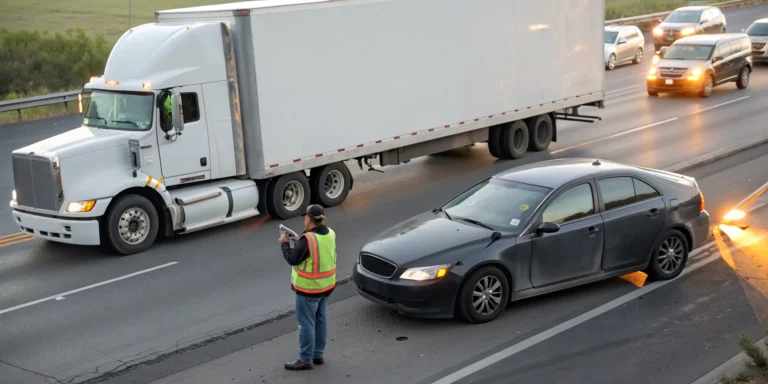

Commercial truck accident with a damaged car and safety worker directing traffic on the highway.
Being involved in a truck accident in California is one of the most terrifying experiences a driver can face. Commercial trucks can weigh up to 80,000 pounds fully loaded, meaning collisions with passenger vehicles often result in catastrophic injuries or fatalities. If you or a loved one has been injured in a truck accident on a California freeway or highway, knowing the right steps to take immediately afterward can significantly impact your ability to recover compensation. This guide walks you through the five critical steps every truck accident victim in California should follow, from the scene of the crash through hiring legal representation. Whether your accident occurred on a major interstate, a rural highway, or a city street, these steps apply to all truck collision scenarios in California.
Injured in a truck accident? Call DC Law Group at [(310) 571-8860](tel:3105718860) for a free consultation. We are available 24/7 and you pay nothing unless we win your case.
!A lawyer reviews a truck accident claim with a semi-truck visible through the office windowA truck accident attorney can help protect your rights and pursue maximum compensation under California law.
Step 1: Ensure Safety and Call 911
Your first priority after any truck accident is safety. If you are able to move, get yourself and any passengers to a safe location away from traffic. Turn on your hazard lights and set up flares or warning triangles if available.
Call 911 immediately, even if injuries appear minor. Truck accidents often involve hazardous materials, fuel spills, or debris that require specialized emergency response. The CHP or local police will create an official accident report, which serves as critical evidence for your claim.
Many truck accident victims experience an adrenaline rush that masks pain. Internal injuries, traumatic brain injuries, and spinal damage may not show symptoms for hours or even days. Always accept medical transport to the hospital if emergency responders recommend it.
Step 2: Document Everything at the Scene
If you are physically able, gather as much evidence as possible:
- Photographs: Take photos of all vehicles involved, damage, road conditions, traffic signs, skid marks, and any debris
- Truck information: Record the trucking company name (on the door or trailer), truck number, license plate, and USDOT number
- Driver information: Get the truck driver’s name, license number, and insurance information
- Witness contacts: Collect names and phone numbers of anyone who saw the accident
- Your own notes: Write down what happened while details are fresh, including the time, weather, and road conditions
This evidence becomes invaluable when building your case. Trucking companies and their insurers often send rapid response teams to accident scenes to gather evidence that supports their defense. Having your own documentation levels the playing field.
What Medical Attention Do You Need After a Truck Accident?
Even if you feel fine after a truck accident, see a doctor within 24 hours. Medical records create a direct link between the accident and your injuries, which is essential for your claim. Common truck accident injuries include:
- Traumatic brain injuries (TBI) and concussions
- Spinal cord injuries and paralysis
- Broken bones and fractures
- Internal organ damage
- Burns from fuel spills or fires
- Whiplash and soft tissue injuries
- Post-traumatic stress disorder (PTSD)
Follow your doctor’s treatment plan completely and attend all follow-up appointments. Gaps in treatment give insurance companies an excuse to argue your injuries are not serious.
Step 4: Do Not Speak with the Trucking Company’s Insurance
After a truck accident, you will likely receive a call from the trucking company’s insurance adjuster within days, sometimes hours. They may sound sympathetic, but their goal is to minimize the company’s payout. Common tactics include:
- Asking you to give a recorded statement (which they will use against you)
- Offering a quick, lowball settlement before you know the full extent of your injuries
- Requesting access to your entire medical history to find pre-existing conditions
- Suggesting you were partially at fault
Politely decline to discuss the accident and direct all communication to your attorney. You are not required to speak with the other party’s insurance company.
Do not sign anything or accept any settlement offer without first speaking to an attorney. Call DC Law Group at [(310) 571-8860](tel:3105718860) or [(833) DC LAW 4 U](tel:8333252948) for a free case evaluation.
Why Should You Hire a Truck Accident Attorney in California?
Truck accident cases are significantly more complex than standard car accident claims. They involve federal trucking regulations, multiple potentially liable parties, and corporate legal teams with extensive resources. An experienced truck accident attorney will:
- Preserve evidence: Send spoliation letters to prevent the trucking company from destroying electronic logging device (ELD) data, dashcam footage, and maintenance records
- Investigate thoroughly: Review the driver’s hours of service, drug and alcohol testing records, training history, and the truck’s maintenance logs
- Identify all liable parties: The truck driver, trucking company, cargo loader, truck manufacturer, and maintenance provider may all share responsibility
- Calculate full damages: Account for current and future medical expenses, lost wages, diminished earning capacity, pain and suffering, and loss of quality of life
- Handle negotiations: Deal with multiple insurance companies and corporate legal teams so you can focus on recovery
DC Law Group represents truck accident victims throughout California, including the Inland Empire, Central Valley, and San Diego. Our team works on a contingency fee basis, meaning you pay nothing unless we recover compensation for you.
Understanding California Truck Accident Laws
Several California and federal laws apply specifically to truck accident cases:
- Statute of limitations: You generally have two years from the date of the accident to file a personal injury lawsuit in California
- Comparative fault: California follows a pure comparative negligence system. Even if you are partially at fault, you can still recover damages, reduced by your percentage of fault
- Federal Motor Carrier Safety Regulations: Commercial trucks must comply with hours-of-service rules, weight limits, maintenance requirements, and driver qualification standards
- Respondeat superior: Trucking companies can be held liable for their drivers’ negligence while the driver is acting within the scope of employment
Understanding these laws requires legal expertise. Contact DC Law Group for a free case evaluation. An accident attorney can evaluate whether the truck driver or trucking company violated any regulations that contributed to your accident.
Common Types of Truck Accidents on California Highways
California’s extensive highway system, including Interstates 5, 10, 15, and 99, carries heavy commercial truck traffic year-round. Understanding the different types of truck accidents can help victims and their families recognize the unique dangers each presents.
Jackknife accidents occur when a truck’s trailer swings outward at a sharp angle from the cab, often blocking multiple lanes of traffic. These typically happen when a driver brakes too hard or encounters slippery road conditions. Jackknife crashes are especially dangerous on multi-lane freeways where other vehicles have limited room to avoid the swinging trailer.
Rollover accidents happen when a truck tips onto its side or rolls completely over, often caused by taking curves too fast, shifting cargo loads, or strong crosswinds through mountain passes like the Cajon Pass or Grapevine on I-5. A rolled semi-truck can block an entire freeway and spill hazardous cargo across the roadway.
Underride accidents are among the most deadly truck crash types. These occur when a smaller vehicle slides underneath a truck’s trailer, often shearing off the passenger compartment’s roof. Rear underride crashes can happen when a truck is stopped or slow-moving and a following vehicle cannot brake in time. Side underride crashes occur when a vehicle strikes the side of a trailer at an intersection.
Tire blowout accidents pose significant hazards on California freeways, particularly during summer months when road temperatures soar. When a commercial truck tire fails at highway speed, large rubber debris can strike following vehicles, and the driver may lose control. Proper tire maintenance is a federal requirement for commercial carriers, and failure to maintain tires can establish negligence.
Wide turn accidents frequently occur at intersections when truck drivers swing left before making a right turn, creating a gap that other vehicles attempt to pass through. As the truck completes its turn, it can crush vehicles caught between the trailer and the curb. These are sometimes called “squeeze play” accidents.
How Trucking Company Negligence Contributes to Accidents
Many truck accidents are not simply the result of a single driver’s mistake. Trucking companies have a duty to hire qualified drivers, maintain their fleet, and ensure compliance with federal safety regulations. When companies cut corners to increase profits, the consequences on California roads can be devastating.
Common forms of trucking company negligence include:
- Pressuring drivers to exceed hours-of-service limits to meet delivery deadlines, leading to fatigued driving crashes
- Inadequate driver training for the specific vehicles and routes they are assigned
- Deferred maintenance on brakes, tires, lights, and other critical safety systems to reduce costs
- Negligent hiring practices that put drivers with poor safety records or insufficient credentials behind the wheel
- Overloading cargo beyond federal weight limits, which increases stopping distance and rollover risk
- Failure to install safety equipment such as underride guards, lane departure warning systems, and collision avoidance technology
Under the legal doctrine of _respondeat superior_, trucking companies can be held directly liable for accidents caused by their employees’ negligence. Additionally, direct negligence claims can be brought against the company itself for failures in hiring, training, supervision, and vehicle maintenance.
California law also allows for punitive damages in cases where the trucking company’s conduct was especially reckless or showed a conscious disregard for public safety. These additional damages are designed to punish the wrongdoer and deter similar behavior in the future. Examples might include a company that knowingly allowed a driver with a history of DUI violations to operate a commercial vehicle, or a carrier that systematically falsified maintenance logs to avoid costly repairs.
An experienced truck accident lawyer will subpoena the trucking company’s records, depose company officials, and work with accident reconstruction experts to build the strongest possible case for maximum compensation.
If a negligent trucking company caused your accident, you deserve maximum compensation. Call DC Law Group at [(833) DC LAW 4 U](tel:8333252948) today. Our [truck accident lawyers](/best-commercial-truck-accident-lawyer/) fight to hold corporate carriers accountable.
Frequently Asked Questions
How long do I have to file a truck accident lawsuit in California?
In California, the statute of limitations for personal injury claims is generally two years from the date of the accident. However, if a government entity is involved, you may need to file a claim within six months. Contact an attorney as soon as possible to protect your rights.
What compensation can I recover after a truck accident?
Truck accident victims may recover compensation for medical bills, future medical care, lost wages, loss of earning capacity, property damage, pain and suffering, emotional distress, and in some cases, punitive damages.
Who is responsible for a truck accident in California?
Multiple parties can be liable, including the truck driver, the trucking company, the cargo loading company, the truck or parts manufacturer, and maintenance providers. An experienced attorney will investigate all potentially liable parties to maximize your recovery.
Should I accept the insurance company’s first settlement offer?
Almost never. Initial settlement offers from trucking company insurers are typically far below the true value of your claim. Always consult an attorney before accepting any offer.
What if the truck driver was violating hours-of-service rules?
If the truck driver was driving beyond legally permitted hours, this is strong evidence of negligence. Federal regulations limit commercial drivers to 11 hours of driving after 10 consecutive hours off duty. Violations are recorded in electronic logging devices and can significantly strengthen your case.
How common are truck accidents in California?
California consistently ranks among the states with the highest number of fatal truck accidents. The Federal Motor Carrier Safety Administration reports thousands of large truck crashes annually in the state, with the highest concentrations on Interstate 5, Interstate 10, Interstate 15, and State Route 99. The sheer volume of commercial traffic through California’s ports, agricultural regions, and distribution centers makes truck accident risk a significant concern for all motorists.
Do not let the trucking company’s insurance team take advantage of you after an accident. [Request your free consultation](/accident/) with DC Law Group today by calling [(310) 571-8860](tel:3105718860). We serve truck accident victims across California, and there are no fees unless we win for you. _Hablamos Espanol._