
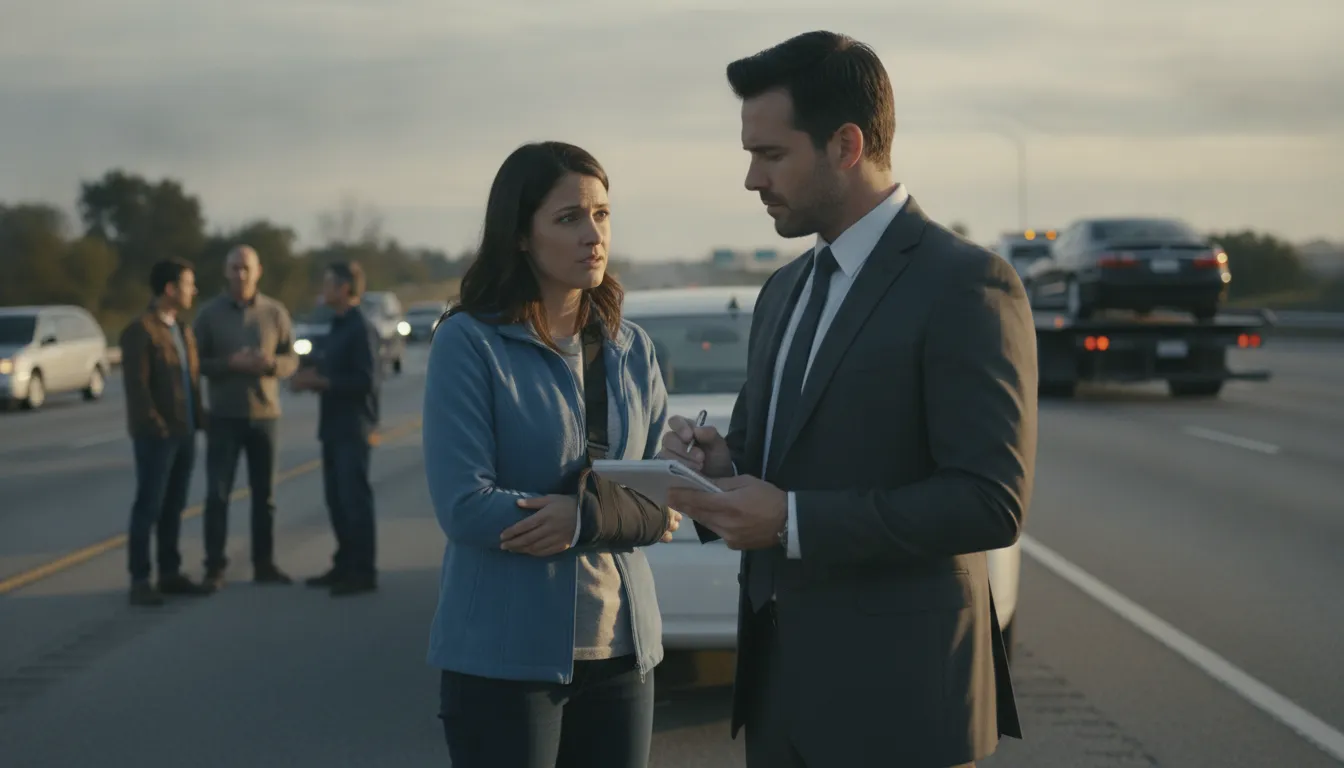
A California crash can make the decision to seek legal help urgent when the claim is more complicated than exchanging insurance information. Serious injuries, disputed fault, commercial vehicles, uninsured drivers, or pressure from an adjuster can affect both the evidence and the recovery available to you.
In general, when do you need to hire a car accident lawyer? Contact one promptly when you have significant injuries, uncertainty about who caused the collision, a recorded statement request, an inadequate settlement offer, or an uninsured or underinsured driver. A lawyer can help protect your position while you preserve medical records, lost-wage documentation, and other evidence. Contact DC Law Group today for a free consultation at (310) 571-8860.
California personal injury law can be complicated, and the other side may argue that you share responsibility. You generally have two years from the injury date to file a personal injury lawsuit, while claims involving a government agency may have a shorter deadline. The right time to involve counsel depends on what happened, the harm involved, and the issues emerging in your claim.
Start by examining the warning signs that make professional guidance especially important.
When Do You Need to Hire a Car Accident Lawyer in California?
Not every California car accident requires a lawyer. A minor collision with no injury, clear responsibility, and a cooperative insurer may be handled through the claims process. The decision changes when the crash causes lasting harm, fault is contested, or the insurer's position threatens the value of your claim. If you are weighing your options, DC Law Group's car accident attorneys can help you evaluate the facts and protect your legal rights.
Serious injuries make the claim more than an insurance form
Injury claims can involve more than immediate treatment. California personal injury law may allow recovery for medical bills, lost wages, emotional harm, and other losses caused by another person's negligence. Medical bills may document some damages, while emotional distress and other non-economic harm can be harder to value. A lawyer can help organize the evidence and distinguish the injuries and losses that belong in the claim.
A crash may also create separate personal injury and property damage issues. Handling both tracks while receiving treatment, missing work, or managing ongoing symptoms can make an apparently simple claim substantially more complicated.
Disputed responsibility calls for careful legal analysis
Do not assume the insurance company will accept your account of the collision. The other driver's insurer may argue that you share responsibility or attempt to reduce what it pays. Determining liability can require more than identifying the driver. Depending on the facts, the potentially responsible parties may include the vehicle owner or an employer if the driver was working. A lawyer can assess the available evidence, identify the proper claims, and respond to arguments about fault.
Deadlines make delay risky
California generally gives an injured person two years from the date of injury to file a personal injury lawsuit. A claim involving a government agency may have a shorter deadline, making early legal advice particularly important. The California Courts explain these time limits in their personal injury guidance.
Waiting can also cause practical problems. Evidence may disappear, witnesses' memories may fade, and important filing deadlines can be missed. Personal injury law is complicated, and self-representation is not always the safest choice when the injuries, liability, or damages are disputed. Contact counsel early enough to preserve evidence, understand the applicable deadlines, and make an informed decision about whether representation is appropriate.
Serious Injuries: When Medical Bills Start Piling Up
A fracture, surgery, hospitalization, or continuing treatment changes the legal picture after a California collision. These injuries can affect your health, work, mobility, and daily responsibilities.
Serious harm is a clear reason to consult a lawyer promptly. A personal injury claim may include bodily injury and damage to your vehicle. The California Courts Self-Help Guide recognizes that a car crash can create both personal injury and property damage claims: California personal injury guidance.
Damages extend beyond the first medical appointment
Medical bills often provide concrete evidence of treatment and related losses. They can show the nature of the injury, the care received, and the continuing need for medical attention.
Other damages require a more careful legal analysis. Emotional distress, pain, limitations, and disruption to your normal life may be real, but they are harder to measure than a bill. An attorney evaluates how the injury affected your life, rather than treating the claim as a simple collection of invoices.
That evaluation matters when symptoms continue after the initial emergency visit. A fracture may require follow-up care, physical therapy, prescription medication, or restrictions at work. The claim should account for the injury's documented effects and its broader consequences.
Preserve records that support your claim
Keep every medical bill, treatment record, discharge instruction, prescription record, and appointment confirmation. Also preserve wage statements, employer records, and other documentation showing time missed from work.
The California Courts Self-Help Guide specifically identifies medical bills and lost-wage records as evidence in a personal injury case. Store copies in one secure location, and maintain a timeline of treatment, symptoms, and work limitations. The guide's evidence discussion is available at selfhelp.courts.ca.gov.
Do not assume an insurer's early evaluation reflects the full scope of your damages. Before signing a release or resolving the claim, discuss the medical evidence, property damage, lost wages, and emotional harm with experienced car accident attorneys. DC Law Group can assess whether the available records support a complete claim evaluation. For a closer look at how non-economic harm is valued, see our discussion of pain and suffering damages in California.
Disputed Fault or a Commercial Truck Crash Demands Legal Help
A crash becomes legally complicated when the drivers give different accounts of what happened. The insurer may argue that you were speeding, changed lanes carelessly, followed too closely, or contributed to the collision in another way. California follows a pure comparative-fault rule. If you share responsibility, your recovery is reduced by your assigned percentage of fault, even when another party caused most of the harm.
That makes disputed liability a strong reason to speak with a lawyer before accepting an insurer's version of events. A negligence claim requires proof that another person acted carelessly and that the conduct caused your injury. You must establish each required part of the claim, not simply show that a collision occurred. The evidence may include photographs, vehicle damage, witness accounts, medical records, traffic-camera footage, and the investigating officer's report. An attorney can evaluate conflicting accounts and identify what evidence may support your position.
Commercial truck crashes create another layer of risk. A tractor-trailer, delivery vehicle, bus, or other commercial vehicle may involve several legally distinct parties. The person behind the wheel may not be the only potential defendant. Depending on the facts, responsibility may extend to:
- The truck driver: The driver may be liable if careless operation, distraction, unsafe following, or another negligent act caused the collision.
- The vehicle owner: The owner may have responsibilities separate from the driver's conduct, including issues involving the vehicle itself.
- The employer or trucking company: If the driver was working when the crash occurred, the employer may be part of the claim. A business may also hold relevant employment and operational records.
- A cargo or maintenance party: Improperly secured cargo, inadequate maintenance, or a mechanical problem may raise additional liability questions when supported by the evidence.
California courts recognize that it is not always clear who is responsible for an injury. A personal injury case may involve the person who caused the harm, the vehicle owner, or an employer when the person was working. California Courts' personal injury guidance describes these potential defendants and the need to prove negligence.
Do not assume the first insurance determination resolves the issue. A commercial carrier and its insurer may investigate quickly, while evidence can become harder to preserve over time. If fault is disputed or a commercial vehicle is involved, prompt legal review can help protect the claim and clarify which parties should be pursued. For a deeper look at the liability rules governing big-rig collisions, see our guide on commercial truck accident liability in California.
The Insurance Company Wants a Recorded Statement - Don't Do It Alone
A recorded statement request is a strong signal to consult a lawyer before discussing the crash in detail. The adjuster may sound helpful, but the other driver's insurer is evaluating its potential liability. Your answers can later be reviewed for wording that supports a disputed version of events, comparative fault, or a narrower claim.
Insurance companies may use recorded statements to reduce what they pay, argue that you contributed to the collision, or limit the injuries and losses included in your claim. Even an accurate answer can become problematic when it is taken out of context. Memory can change after a traumatic event, and a question may combine assumptions about speed, distance, traffic conditions, or your physical symptoms.
Report the accident, but distinguish your obligations
Your own insurance contract may require you to report the accident promptly. California Courts explains that policyholders should check their coverage because an insurance contract may require accident reporting: California Courts self-help guidance. Complying with that notice requirement is different from volunteering for a recorded interview with the opposing driver's adjuster.
When you report the accident to your own insurer, provide the basic information required by the policy. Do not speculate about fault, minimize symptoms, or guess about facts you do not know. If the request comes from the other driver's insurer, ask for the request in writing and tell the adjuster you will respond after obtaining legal guidance. Do not sign a release or provide a broad authorization without understanding what it covers.
What to do before answering questions
- Identify which insurer is calling and whom the adjuster represents.
- Preserve the caller's name, contact information, claim number, and requested deadline.
- Keep photographs, medical records, wage documentation, and other evidence organized.
- Do not post details about the collision or your recovery on social media.
- Contact a car accident attorney before agreeing to a recorded statement.
A lawyer can manage communications, prepare you for necessary questions, and protect the distinction between facts you personally know and conclusions an insurer wants you to adopt. This is especially important when injuries are developing, fault is contested, or the claim includes both bodily injury and vehicle damage. Contact DC Law Group's car accident attorneys for guidance before you give the other side a recorded statement.
A Lowball Settlement Offer Means You Need a Second Look
An early settlement offer may look convenient, but it may not reflect the full scope of your injuries. This is a key sign that you should speak with a lawyer.
Some damages are straightforward to document. Medical bills provide concrete evidence of treatment and related medical expenses. Other damages require a more careful legal analysis. Emotional distress, for example, can be harder to measure and support.
That difference matters because an insurer may focus on the records that are easiest to calculate. An offer may account for an invoice while overlooking ongoing symptoms, future treatment, lost income, or the effect an injury has on daily life.
What a Complete Damages Review Should Include
A lawyer evaluates the evidence supporting each category of damages. That review may include:
- Medical bills, treatment records, and diagnostic information.
- Lost-wage records and documentation of missed work.
- Medical opinions about recovery, limitations, or future care.
- Evidence describing pain, emotional distress, and changes to daily activities.
- Property damage related to the collision.
California Courts explain that injury claims may include medical bills, lost wages, emotional harm, and other losses. The same guidance distinguishes damages that bills readily prove from damages that are harder to value. Review the California Courts explanation of personal injury damages.
Do not assume that signing a release preserves your ability to seek additional compensation later. Settlement documents can resolve claims, so review the offer and its conditions before accepting it. Once a release is signed, the claims it covers are typically closed, which makes the timing and scope of the document important.
Ask whether the offer covers property damage only or extends to personal injury. Whether it accounts for future treatment, and whether it requires you to give a recorded statement or waive other rights. An offer that seems low may also be the opening position in a negotiation rather than a final value. A lawyer can weigh these terms against the evidence supporting the full scope of your claim.
DC Law Group can assess the available evidence, identify damages the offer may omit, and negotiate with the insurer on your behalf. A second look is especially important when treatment continues or the long-term effects remain uncertain.
Uninsured, Underinsured, or Hit-and-Run Drivers Change Everything
A claim becomes more complicated when the driver who caused the crash has no liability insurance, carries inadequate limits, or cannot be identified after a hit-and-run. You may still have a viable path to compensation, but the available source of recovery may not be the other driver's insurer.
Start by reviewing your own automobile insurance policy. Uninsured motorist (UM) coverage may apply when the at-fault driver has no insurance, including some hit-and-run situations. Underinsured motorist (UIM) coverage may become relevant when the other driver's policy does not provide enough coverage for the injuries and losses involved. California Courts explains that your insurer may pay some losses without requiring you to sue, or may cover what remains after another policy pays. Review the California Courts guidance on insurance and personal injury claims.
Do not assume your own insurer is automatically on your side
UM and UIM claims are made under your insurance contract, but that does not make the claim automatic. Coverage can depend on policy language, timely notice, proof of the collision, and the facts establishing that another driver caused the harm. A hit-and-run may also require evidence showing that contact with another vehicle occurred and that reasonable efforts were made to identify the driver.
Preserve the available evidence. Save photographs, witness information, the collision report, medical records, and every communication with an insurer. Do not guess about the driver's identity or minimize symptoms when reporting the crash. Inaccurate or incomplete statements can create disputes about coverage, causation, and the extent of your injuries.
What compensation may remain available?
If another person's negligence caused your injuries, you may seek compensation for medical bills, lost wages, emotional harm, and other legally recognized losses. Those losses are not always equally easy to prove. Medical bills may provide direct documentation, while emotional distress and other non-economic harm require a fuller explanation of how the injury affected your life. A car accident attorney can assess the available coverage and claim strategy.
When insurance coverage is uncertain, a lawyer can examine every possible policy, identify the proper claim path. And protect you from accepting a resolution before the available evidence and losses are understood. That review is especially important after a hit-and-run or when your injuries exceed the other driver's policy limits. To understand how UM and UIM coverage operates in practice, read our guide on uninsured motorist claims in California.
When You Might Not Need a Lawyer: Simple, Low-Damage Crashes
Not every collision requires formal legal representation. If no one is injured, responsibility is clear, the property damage is limited. And the insurer promptly offers a fair settlement, you may be able to manage the claim yourself. The key is recognizing that a minor appearance does not always mean a minor legal issue.
Before accepting an insurer's position, work through this practical checklist:
- Document the collision. Save photographs of the vehicles, roadway, traffic controls, and visible damage. Keep the incident report, witness information, repair estimates, insurer correspondence, and claim number together.
- Confirm the liability facts. Make sure the available evidence supports a straightforward negligence claim. If the other driver accepts responsibility and the evidence is consistent, the claim may be easier to resolve.
- Monitor your health. Do not assume you are uninjured simply because symptoms are not immediate. Seek medical attention if pain, reduced movement, headaches, or other symptoms develop, and preserve the related records.
- Review the written settlement terms. Understand what claims you are releasing and whether the agreement addresses property damage only or also personal injury. Do not sign a broad release while your medical condition remains uncertain.
- Track every deadline. A claim involving personal injury generally must be filed within two years of the injury in California. Government-entity claims can involve shorter deadlines. See the California Courts explanation of personal injury claims and deadlines.
Before you sign anything, use this comparison to decide whether to handle the case yourself or consult a lawyer:
- Injuries. Handle it yourself when there are no injuries and no symptoms. Consult a lawyer for fractures, surgery, or persistent symptoms.
- Fault. Handle it yourself when responsibility is clear and undisputed. Consult a lawyer for disputed fault or multiple drivers.
- Insurance. Handle it yourself when coverage is adequate and the offer is fair. Consult a lawyer for a recorded statement request or a lowball offer.
- Collision type. Handle it yourself for a simple crash with limited damage. Consult a lawyer when a commercial truck or other commercial vehicle is involved.
Self-representation is possible in many court cases, but personal injury law can be complicated. California Courts notes that a lawyer's help can be useful even when representing yourself is legally possible. When do you need to hire a car accident lawyer? Reconsider handling the matter alone if an insurer disputes fault, asks for a recorded statement, delays payment, denies an injury. Presents a broad release, or makes an offer that does not account for the full nature of your damages.
Also seek legal guidance if symptoms appear later, treatment continues, lost wages become part of the claim. Or the facts involve multiple drivers, a commercial vehicle, or uncertain insurance coverage. Those developments can change the legal issues and the evidence needed to protect your position.
Frequently Asked Questions
How soon should I contact a car accident lawyer after a crash?
Contact a lawyer as soon as practical, especially if you have significant injuries, disputed fault, or an insurer is pressuring you. Early advice can help preserve evidence and protect important deadlines. California generally gives you two years from the injury date to file a personal injury lawsuit, but claims involving a government agency have shorter deadlines. California Courts Self-Help explains these time limits.
What should I do if the insurance company asks for a recorded statement?
Ask what information is required, avoid guessing, and consider speaking with a lawyer before giving a recorded statement. Insurers may use statements to limit a claim, particularly when they dispute fault. Your policy may also require prompt accident reporting, so review the policy and report the crash as required. California Courts Self-Help discusses insurance reporting obligations.
Can I recover compensation if I was partly at fault?
Possibly. California uses comparative fault, so the amount recovered may be reduced by your share of responsibility. Because the other driver or insurer may argue that you caused part of the crash. A lawyer can help assess the evidence and challenge an unsupported allocation of fault.
Do I need a lawyer for a minor fender-bender?
Not necessarily. If no one is injured, fault is clear, damage is limited, and the claim is straightforward, you may be able to handle it yourself. Consider legal advice if symptoms develop, the insurer disputes responsibility, the claim involves uninsured coverage, or the requested settlement does not reflect your documented losses. Personal injury law can become complicated quickly, even when the vehicle damage first appears minor. California Courts Self-Help notes that a lawyer can be useful when the law is complicated.
Ready to Discuss Your California Car Accident Claim?
After a crash, a timely legal review can help you understand your options before you respond to an insurer or accept a settlement. Call DC Law Group at (310) 571-8860 for a free consultation. Our team can share what happened, describe your injuries, and help you decide whether legal guidance fits your situation.