

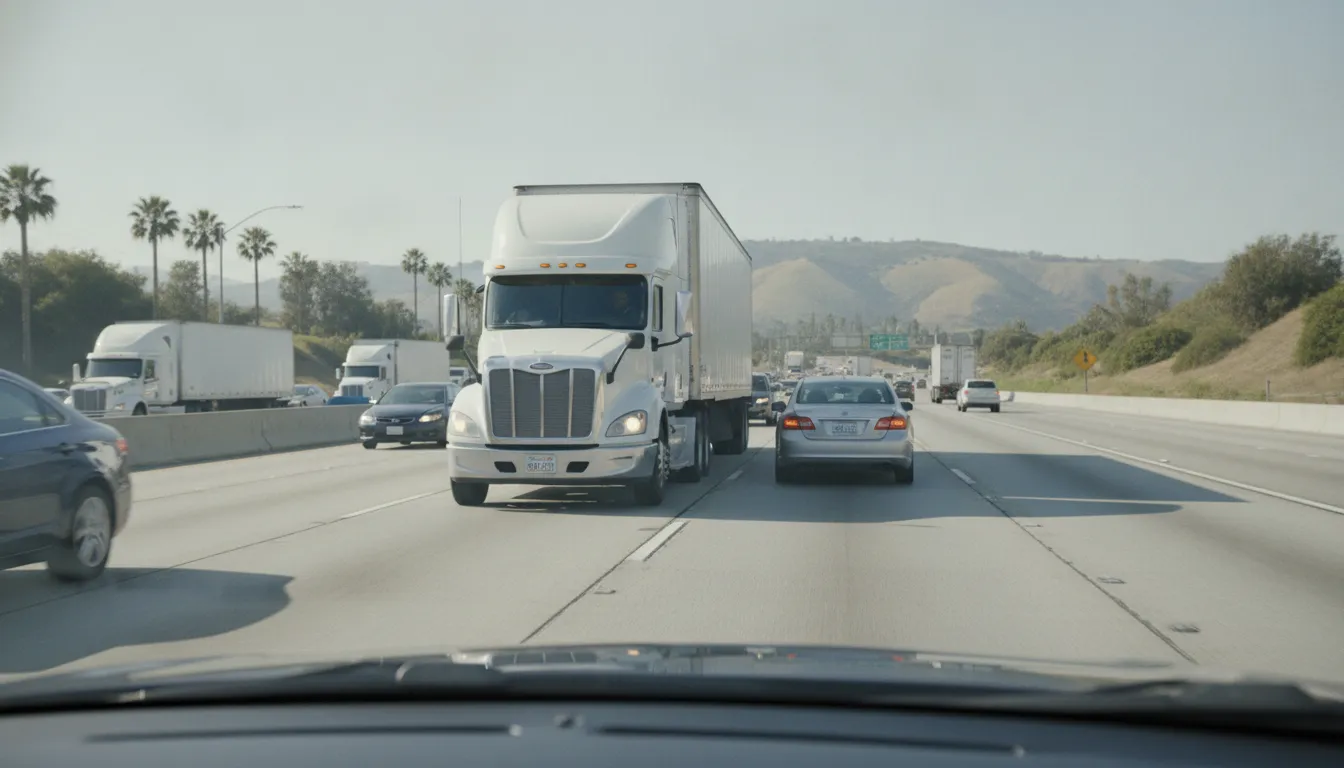
An 18 wheeler blind spot accident lawyer helps people hurt when a tractor-trailer changes lanes, turns, or merges without seeing the smaller vehicle. These crashes often happen in the truck's no-zone, the space around the cab and trailer where the driver cannot see you. If you were hit in California, the useful first step is simple. Save the facts that show where your car was, and talk with a lawyer before evidence from the trucking company disappears.
Request a free consultation with DC Law Group
DC Law Group represents people injured in commercial vehicle crashes across California. A free consultation can help you sort out the carrier, the driver, and the next deadline. This page explains the blind-spot facts. It is not a substitute for advice about your own crash.
What an 18 Wheeler Blind Spot Accident Lawyer Looks For
People search for an 18 wheeler blind spot accident lawyer because the crash feels unfair and the facts are easy to lose. The truck driver may say you were lingering beside the trailer. Your own memory may be a lane change that came without warning. The legal question is not who was more scared. It is whether the driver, and sometimes the company, failed to look before moving into a space they could not see.
Federal safety guidance treats the no-zone as a real driving hazard, not a slogan. The Federal Motor Carrier Safety Administration tells other drivers to assume they are invisible if they cannot see the truck driver in the side mirror. The same guidance warns against lingering beside a truck and against cutting in too close. That advice is about prevention. After a crash, the same idea becomes proof. Where was your car, and could the truck driver have seen it?
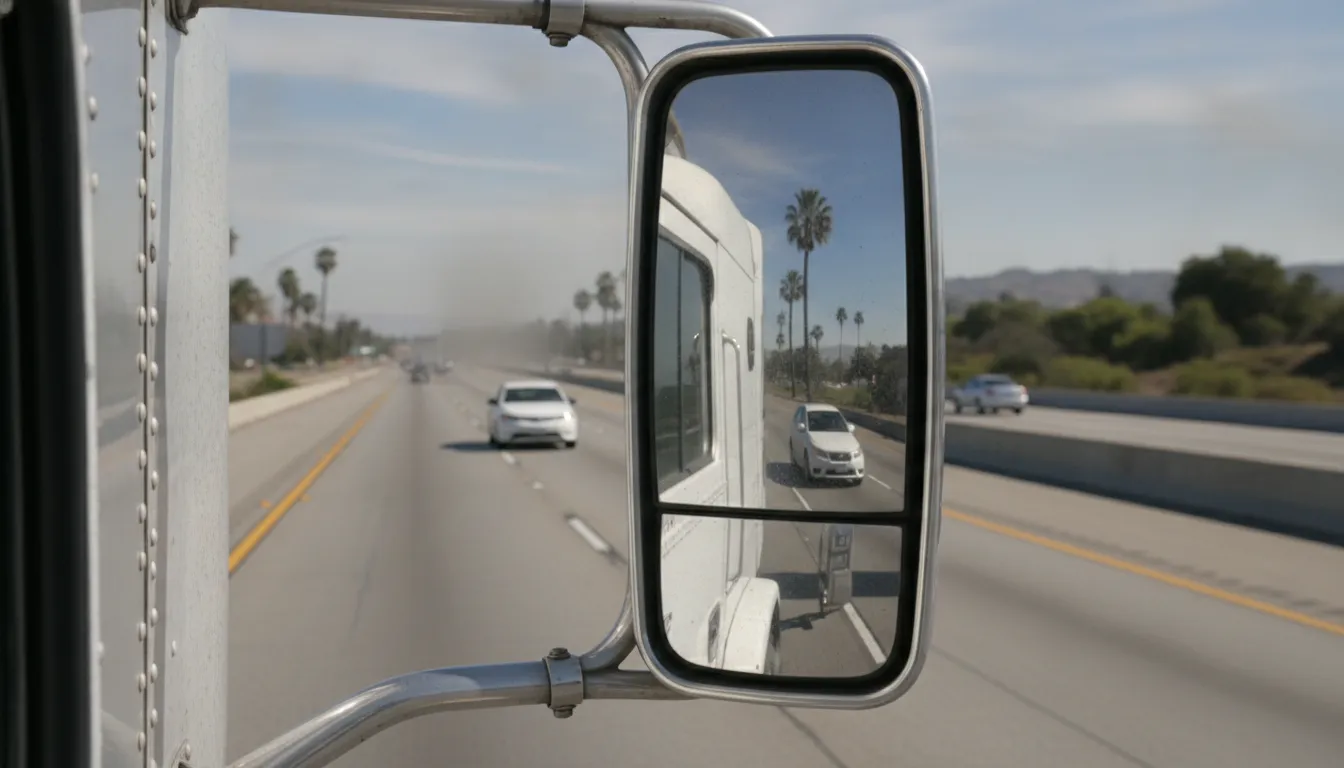
A truck side mirror with a sedan visible far behind the trailer on a freeway
A blind-spot case is narrower than a general truck case. A jackknife, a rear-end on a grade, or a cargo spill can raise different questions. Here, the core facts are the lane position, the mirror check, and the moment the trailer moved. Those facts decide whether a consultation is worth your time.
The four no-zones around a tractor-trailer
FMCSA describes huge blind spots around the front, back, and both sides of a large truck or bus. The practical map looks like this:
- Front. The hood and the height of the cab hide vehicles that pull in too close. Cutting off a truck is dangerous because the truck needs a long distance to stop.
- Rear. A car riding the bumper sits where the driver may not see it, and it can underride the trailer if traffic stops suddenly.
- Right side. The passenger-side no-zone is wide. FMCSA says never pass a truck from the right lane, and to be especially careful when merging.
- Left side. The driver-side blind spot is smaller than the right, but a car can still disappear beside the trailer during a pass.
You do not need to measure these zones at the scene. Photos, lane position, and witness memory do that work later. What matters on the day of the crash is not moving evidence and not guessing at a diagram you cannot verify.
How a Blind-Spot Crash Usually Happens
Most of these collisions are ordinary freeway moves that go wrong because the truck cannot see the whole lane. A few patterns show up again and again.
| Crash pattern | What often happens | Fact that matters later |
|---|---|---|
| Lane change into a car. | The trailer drifts or moves over while a car is beside it. | Which lane you held, and whether you were passing or being passed. |
| Right-side merge. | The truck enters from a ramp or moves right while a car is in the wide blind spot. | Ramp location, turn signal, and mirror visibility. |
| Wide right turn. | The cab swings out, then the trailer cuts back across a car on the right. | Intersection, turn path, and whether you were beside the trailer. |
| Squeeze at a merge point. | Two lanes become one and the truck moves before the car is clear. | Who had the through lane and when the trailer crossed the line. |
FMCSA's driver guidance also says inadequate surveillance is a known crash cause. In the Large Truck Crash Causation Study, about 14 percent of large-truck crashes involved a commercial driver who failed to look, or looked and did not see. The same guidance says about one-third of crashes between large trucks and cars happen in the no-zone. Those figures describe risk. They do not decide your case. They do explain why mirror checks, lane position, and video matter more here than a generic "the truck was big" story.
A wide turn is the city version of the same problem. Trucks need extra room. The cab may start from a middle lane, then the trailer sweeps the curb lane. If you were legally beside the trailer and the trailer came into you, that path is a fact, not a debate about who should have yielded out of fear.
Fault Is Not Automatic on Either Side
California uses comparative fault. More than one person can share blame, and a recovery can be reduced by the injured person's share. That rule cuts both ways in a blind-spot crash.
The truck driver may be at fault for moving without a proper look. FMCSA tells truck drivers to check mirrors every few seconds and before a lane change, turn, or merge. A driver who never looks, or who looks only in the left mirror during a right move, has a surveillance problem. The company may share responsibility when it put that driver on the road, maintained the mirrors poorly, or pressed a schedule that rewarded rushing.
The other side will look at your driving too. Lingering beside a trailer, passing on the right, or cutting back in before the whole truck is in your mirror are the exact moves FMCSA tells passenger-car drivers not to make. If video shows one of those moves, expect the defense to say so. An early, honest read of the video is more useful than a speech about the truck always being wrong.
None of this is a verdict. It is the filter an 18 wheeler blind spot accident lawyer uses before anyone talks about a claim. If the facts support a consultation, DC Law Group can review them with you. If they do not, you should hear that early.
Evidence to Save in the First Days
Trucking evidence moves fast. Carriers record some events, then overwrite them. A practical order helps.
- Get medical care and say what hurts. A delayed record makes a real injury look optional. Tell the provider this was a truck, not a low-speed car tap.
- Photograph the scene before vehicles leave. Lane lines, the trailer side that hit you, debris, and the truck's USDOT number all matter. The number is often on the cab door.
- Save your own video. Dashcam files, phone video, and nearby business cameras disappear. Ask for a copy before the device loops.
- Write the lane story the same day. Which lane, who was passing, whether you could see the driver's face in the mirror, and whether a signal came on.
- Do not give a recorded statement to the truck's insurer. You can report the crash. You do not have to narrate fault while you are still sorting the facts.
- Keep the paperwork. The police report, tow bill, repair estimate, and names of witnesses are the starter file.
Electronic logs and event recorders can show speed, braking, and hours. That technology is covered in more detail in our guide to truck black-box data. In a blind-spot crash, those files are supporting proof. They rarely show the car in the mirror. Video and lane position still have to do that job.
A broader look at carrier duties sits in our California commercial truck liability guide. Use that page for hours, maintenance, and company duties. Use this page for the no-zone facts. If you are still at the scene, the usual first steps still apply. Get care, photograph the truck, and write down the lane position before details fade.
Who May Be Responsible Besides the Driver
The person behind the wheel is the obvious name. The company names on the door are often the ones that matter for insurance.
- Motor carrier. The company that operates the truck may be responsible for the driver's work, hiring, and the condition of the mirrors and lights.
- Truck owner. Ownership and operation are sometimes split. The USDOT and MC numbers help sort that out.
- Maintenance shop. A missing or misaimed mirror is a different fact from a driver who did not look.
- Other road users. A third car that forced the merge can belong in the story. Do not assume the truck is the only vehicle involved.
Wrongful death claims follow a different path when a family member dies. Those cases have their own proof and family questions, which our wrongful death practice page outlines. A surviving injury claim should stay focused on the living person's medical care and the blind-spot facts.
California Deadlines and What a Consultation Covers
California gives an injured person two years to file a lawsuit for injury or death caused by another person's wrongful act or neglect. That limit is Code of Civil Procedure section 335.1. The California Courts self-help guide states the same two-year personal-injury deadline. Waiting until the end is a bad plan. Video, driver logs, and truck-maintenance files are often gone long before a courthouse deadline arrives.
Some crashes use a shorter clock. A claim against a public agency, such as a city or the state for a road condition, usually requires a government claim much sooner. Minors and people who do not discover an injury right away can face different timing rules. If any of those might apply, say so in the consultation instead of guessing.
A consultation at DC Law Group is free. The firm handles serious injury cases on a contingency fee, so you do not pay attorney fees unless there is a recovery. Bring the police report if you have it, photos, the truck's identifying numbers, and a short account of the lane position. The lawyer will look for the no-zone facts, the likely insurance, and any deadline that is already running.
For the wider truck-crash services, start with the truck accident practice page. This article stays on blind-spot proof only.
Talk with DC Law Group before truck evidence is gone
Frequently Asked Questions
Who is at fault in a truck blind-spot crash?
Fault depends on lane position, whether the truck driver looked, and whether the car was passing, merging, or sitting in a no-zone. California can split fault. A truck moving into a lane it did not check is a strong fact for the injured driver. Video of the car lingering on the right side is a strong fact the other way.
Can you sue if an 18-wheeler hits you in California?
Yes, if another person's wrongful act or neglect caused your injury, and you file on time. Many claims settle with the trucking insurer before a lawsuit. A lawsuit is the backstop when the insurer will not pay a fair claim. The two-year injury deadline in CCP 335.1 is the general rule, not a promise that every file can wait that long.
What should I save to prove the truck could not see me?
Save photos of both vehicles, the lane lines, and the truck's door numbers. Keep dashcam video and write down whether you could see the driver in the side mirror. Ask nearby businesses about cameras quickly. Mirror checks and lane position matter more than a speech about truck size.
How is a blind-spot case different from a sideswipe?
A sideswipe can be two cars trading paint. A tractor-trailer blind-spot crash adds no-zones, a carrier, and electronic records. The proof is still about who moved into whose lane. The extra work is identifying the company and keeping its video and logs.
How long does an 18-wheeler injury claim take?
There is no honest single timeline. A clear video and a documented injury can move faster than a disputed lane change with a long medical course. Deadlines still run while treatment continues. A consultation is the right place to map your own clock, not a general average.
Talk With DC Law Group About the Crash
If an 18-wheeler changed lanes or turned into you, you do not need a perfect diagram before you call. You need the photos, the truck number, and a clear account of where your car was. DC Law Group offers a free consultation for California injury cases and reviews commercial vehicle crashes statewide.
Call (310) 571-8860 or request a free consultation. Bring what you saved. The firm will tell you whether the blind-spot facts support a claim.