


Truck accidents on Sacramento's busiest highways leave victims with life-changing injuries, stacked medical bills, and a long road to recovery. If you or a loved one was hurt in a collision involving a commercial truck on Interstate 5 or Highway 99, you need an attorney who understands both the Sacramento corridors where these crashes happen and the federal regulations that govern the trucking industry.
Sacramento sits at the crossroads of two of California's most heavily traveled freight routes. I-5 connects the state from border to border, and Highway 99 runs through the heart of the Central Valley. Thousands of commercial trucks pass through the greater Sacramento area every day, carrying agricultural goods, consumer products, and industrial materials. When a fully loaded semi-truck strikes a passenger vehicle, the results are often catastrophic.
This guide covers the common causes of truck wrecks on Sacramento freeways, the federal safety rules that trucking companies must follow, the injuries that truck accident victims typically face, how commercial truck insurance works, and the steps you should take after a crash.
Why Sacramento's I-5 and Highway 99 Are Dangerous for Truck Accidents
Sacramento County consistently ranks among the top counties in California for traffic fatalities. The convergence of I-5 and Highway 99 near downtown Sacramento creates a high-volume corridor where passenger cars share lanes with big rigs, tanker trucks, and double trailers. This stretch sees thousands of commercial vehicle trips daily, making collisions between trucks and passenger cars an ongoing public safety crisis.
Several factors make these stretches especially risky:
- Heavy freight volume. California handles more commercial truck traffic than any other state. The Port of Oakland and the Central Valley's agricultural industry push a steady stream of heavy trucks through Sacramento on both I-5 and Highway 99.
- Interchange congestion. The I-5/Highway 99/I-80 interchange north of downtown is one of the most congested junctions in Northern California. Stop-and-go traffic combined with large trucks creates rear-end collision risks.
- High-speed rural segments. South of Sacramento on Highway 99 toward Stockton and Modesto, the freeway opens into long, straight stretches where speeds climb. Fatigued truck drivers on these segments can drift across lanes or fail to brake in time.
- Fog conditions. The Central Valley's Tule fog season, typically November through March, creates near-zero visibility. Multi-vehicle pileups involving trucks are a recurring problem on Highway 99 during fog events.
- Construction zones. Both I-5 and Highway 99 see frequent construction projects. Lane shifts, reduced shoulders, and narrowed lanes increase the chance of sideswipe and rear-end collisions with commercial trucks.

Multiple commercial trucks and passenger vehicles traveling on a California freeway corridor
Common Causes of Truck Accidents in the Sacramento Area
Truck crashes rarely happen for a single reason. Investigation often reveals a chain of failures — from driver error to company-level negligence. The most common causes in Sacramento truck accident cases include driver fatigue, distracted driving, improper loading, equipment failure, speeding, and impaired driving.
Driver Fatigue
Drowsy driving is one of the leading causes of commercial truck wrecks nationwide. The Federal Motor Carrier Safety Administration (FMCSA) limits property-carrying drivers to 11 hours of driving within a 14-hour on-duty window, followed by at least 10 consecutive hours off duty. Drivers must also take a 30-minute break after 8 cumulative hours of driving. Despite these rules, pressure to meet delivery deadlines pushes some drivers and their employers to falsify electronic logging device (ELD) records or push past safe limits.
Distracted Driving
Texting, adjusting GPS navigation, eating, or reaching for items in the cab can pull a truck driver's attention from the road for critical seconds. At highway speeds, a distracted truck driver can cover the length of a football field in the time it takes to read a text message.
Improper Loading
Overloaded or improperly secured cargo shifts the truck's center of gravity. This makes rollovers more likely during lane changes and curves, and it increases stopping distance. On the curved ramps connecting I-5 and Highway 99, cargo shifts can be especially dangerous.
Equipment Failure
Worn brake pads, tire blowouts, faulty lighting, and defective coupling systems cause preventable accidents. FMCSA requires pre-trip and post-trip inspections, but some carriers cut corners on maintenance to keep trucks on the road.
Speeding and Aggressive Driving
California's speed limit for commercial trucks on most highways is 55 mph. Trucks that exceed this limit or tailgate passenger vehicles in heavy Sacramento traffic create serious collision risks. A loaded semi-truck traveling at 55 mph needs roughly 400 feet to come to a complete stop, nearly twice the distance a passenger car requires.
Impaired Driving
While less common than fatigue, drug and alcohol impairment remains a factor. FMCSA mandates pre-employment, random, post-accident, and reasonable-suspicion drug and alcohol testing for commercial drivers. Violations of these rules can strengthen a victim's legal claim.
Federal Trucking Regulations That Protect Sacramento Drivers
The trucking industry is regulated at the federal level by the FMCSA, a division of the U.S. Department of Transportation. These regulations matter in truck accident cases because violations can serve as direct evidence of negligence. Key regulations include:
- Hours-of-service (HOS) rules (49 CFR 395). Property-carrying CMV drivers may drive a maximum of 11 hours after 10 consecutive hours off duty. The 14-hour driving window cannot be extended, and drivers must take a 30-minute break after 8 hours of cumulative driving time. A 60/70-hour limit applies over 7 or 8 consecutive days.
- Electronic logging device (ELD) mandate. Since December 2017, most commercial trucks must use ELDs to record driving hours. These devices track engine hours, vehicle movement, miles driven, and location data, making it harder (but not impossible) to falsify records.
- Drug and alcohol testing (49 CFR 382). Carriers must test drivers before employment, randomly during employment, after any reportable accident, and whenever reasonable suspicion exists.
- Vehicle maintenance and inspection (49 CFR 396). Carriers must systematically inspect, repair, and maintain all commercial motor vehicles. Drivers must conduct pre-trip and post-trip inspections and document any defects.
- Driver qualification (49 CFR 391). Drivers must hold a valid commercial driver's license (CDL), pass medical examinations, and meet minimum age and experience requirements.
When a trucking company or driver violates any of these federal regulations, it can support a negligence claim. An experienced truck accident lawyer will obtain the carrier's records, ELD data, maintenance logs, and driver qualification files to identify violations.
Types of Injuries in Sacramento Truck Accidents
The size and weight difference between a commercial truck and a passenger vehicle means that occupants of the smaller vehicle absorb the vast majority of crash forces. A fully loaded tractor-trailer can weigh up to 80,000 pounds, compared to the average passenger car at roughly 4,000 pounds. Common injuries include traumatic brain injuries, spinal cord damage, broken bones, internal organ trauma, burns, and soft tissue injuries.
- Traumatic brain injuries (TBIs). Concussions, contusions, and diffuse axonal injuries can cause lasting cognitive, emotional, and physical impairments. Some TBI symptoms do not appear until days or weeks after the crash.
- Spinal cord injuries. Herniated discs, fractured vertebrae, and spinal cord damage can lead to partial or complete paralysis. Treatment often requires surgery followed by months or years of rehabilitation.
- Broken bones and fractures. High-impact collisions frequently cause fractures to the pelvis, ribs, femur, and wrists. Compound fractures may require multiple surgeries and extended recovery.
- Internal organ damage. The blunt force of a truck collision can rupture the spleen, liver, or kidneys. Internal bleeding is a medical emergency that may not be immediately obvious at the scene.
- Burns. Truck accidents involving fuel spills or hazardous materials can cause severe thermal or chemical burns. These injuries often require specialized treatment at burn centers.
- Soft tissue injuries. Whiplash, torn ligaments, and muscle damage are common even in lower-speed truck collisions. While sometimes dismissed as minor, these injuries can cause chronic pain and limited mobility.
If you were hurt in a truck accident on I-5 or Highway 99, seek medical attention right away, even if you feel fine at the scene. Delayed symptoms are common in truck crash cases, and early documentation strengthens your injury claim. For more on the steps to take after a truck wreck, read our guide on what to do after a truck accident in California.
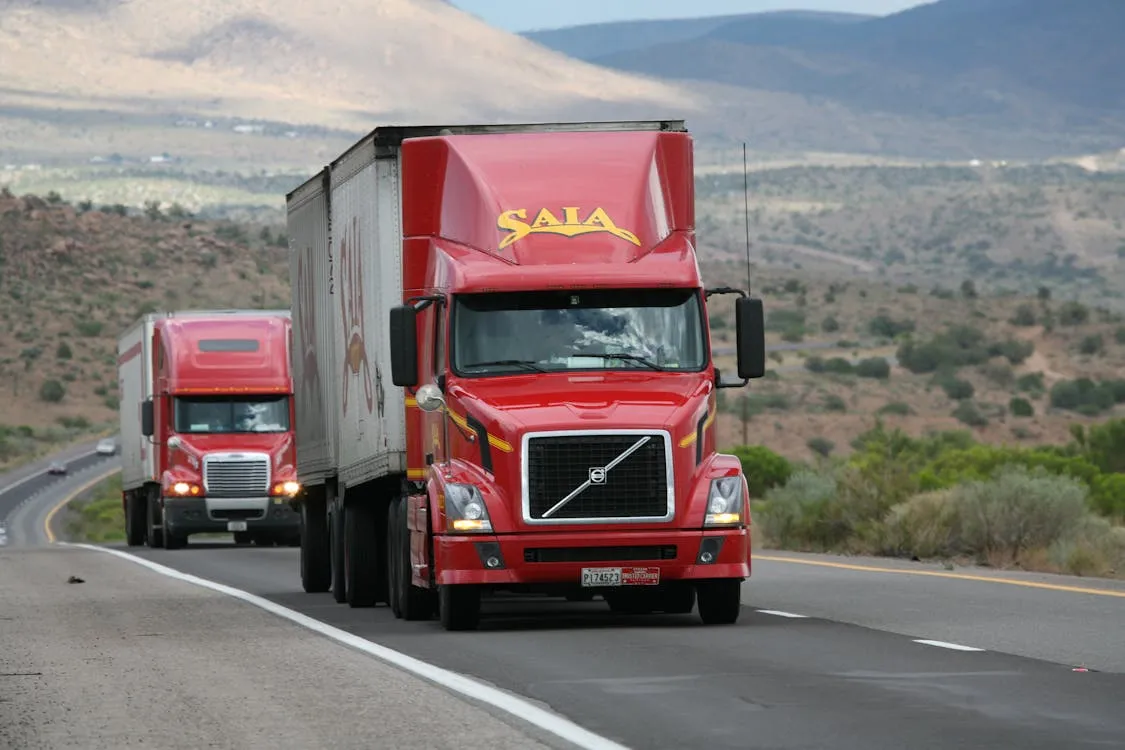
Commercial trucks on a California highway illustrating the size and weight difference versus passenger vehicles
How Trucking Company Insurance Works
Truck accident insurance claims are more complex than typical car accident cases. Multiple layers of coverage, multiple potentially liable parties, and higher policy limits all factor into the process. Federal law requires trucking companies to carry a minimum of $750,000 in liability coverage, and claims often involve several defendants beyond the driver.
Minimum Insurance Requirements
Federal law requires trucking companies to carry significantly more insurance than individual drivers. FMCSA mandates minimum liability coverage of $750,000 for general freight carriers. Trucks hauling hazardous materials must carry between $1 million and $5 million in coverage, depending on the type of cargo. Many large carriers maintain policies well above these minimums.
Multiple Liable Parties
Unlike a standard car accident, a truck crash case may involve several defendants:
- The truck driver
- The trucking company (the driver's employer or the company that leased the truck)
- The cargo loading company
- The truck manufacturer or parts manufacturer (if defective equipment caused the crash)
- A maintenance or repair contractor
Each party may have its own insurance policy, and their insurers will work quickly to minimize payouts. Trucking companies often send investigation teams to the accident scene within hours. Having a lawyer on your side early helps preserve evidence and levels the playing field.
Why Claims Take Longer
The higher stakes in truck accident cases mean insurance companies fight harder. Adjusters may request extensive medical records, challenge the severity of your injuries, or argue that you were partially at fault. California's comparative negligence system allows you to recover damages even if you were partly responsible, but any percentage of fault assigned to you reduces your award. A truck accident lawyer who understands these tactics can counter lowball offers and fight for full compensation.
Steps to Take After a Truck Accident in Sacramento
What you do in the hours and days after a truck accident directly affects the strength of your legal claim. The six most important steps are: call 911, get immediate medical treatment, document the scene, avoid recorded statements to the insurer, preserve expense records, and contact a Sacramento truck accident lawyer.
- Call 911 and report the crash. A police report creates an official record of the accident, including the truck driver's information, witness statements, and the responding officer's observations.
- Get medical treatment immediately. Go to the emergency room or urgent care, even if your injuries seem minor. Medical records that start on the day of the crash connect your injuries to the accident.
- Document the scene if you can. Take photos of vehicle damage, skid marks, road conditions, the truck's DOT number, license plates, and any visible cargo spills. These details disappear quickly.
- Do not give a recorded statement to the trucking company's insurer. Their goal is to reduce your claim. Anything you say can be used against you. Let your attorney handle communications.
- Keep records of your expenses. Save every medical bill, pharmacy receipt, tow bill, and record of missed work. These documents form the foundation of your damages calculation.
- Contact a Sacramento truck accident lawyer. Trucking companies begin investigating immediately after a crash. You need someone protecting your interests just as quickly.
California's statute of limitations for personal injury claims gives you two years from the date of the accident to file a lawsuit. While that may sound like plenty of time, evidence in truck cases can vanish fast. ELD data may be overwritten, dashcam footage may be erased, and witnesses' memories fade. Acting early preserves the evidence your case needs.
Why Hiring a Local Sacramento Truck Accident Lawyer Matters
Not every personal injury attorney has the resources and knowledge to take on trucking companies and their insurers. A local Sacramento truck accident lawyer brings knowledge of the I-5/Highway 99 corridor, experience with FMCSA federal regulations, and the resources to investigate quickly before critical evidence disappears.
- Knowledge of local roads and conditions. An attorney familiar with the I-5/Highway 99 corridor, Sacramento's interchange bottlenecks, and Central Valley fog patterns can build a stronger case by connecting the accident circumstances to known hazards.
- Experience with federal trucking regulations. Truck accident cases involve a layer of federal law that standard car accident cases do not. Your lawyer needs to know which FMCSA records to subpoena and how to interpret ELD data, inspection reports, and driver qualification files.
- Resources to investigate quickly. Trucking companies send their own investigators to the scene within hours. Your attorney should be able to respond just as fast, hiring accident reconstructionists and preserving electronic evidence before it disappears.
- Trial readiness. Insurance companies settle cases more fairly when they know the opposing attorney is prepared to go to court. A local lawyer with courtroom experience in Sacramento County sends that message.
DC Law Group represents truck accident victims throughout the Sacramento region. Managing Attorney David Cohan personally handles cases, so you work directly with your lawyer, not a paralegal or junior associate. The firm operates on a contingency fee basis: you pay no fees unless your case results in a recovery. Our accident attorneys are ready to review your case at no cost.
Frequently Asked Questions About Sacramento Truck Accidents
How much is a truck accident claim worth in Sacramento?
There is no fixed amount. The value of your claim depends on the severity of your injuries, your medical expenses, lost wages, pain and suffering, and whether the truck driver or company violated federal safety regulations. Truck accident settlements tend to be higher than car accident settlements because injuries are typically more severe and insurance policy limits are larger.
Can I sue the trucking company, not just the driver?
Yes. Under California law, an employer can be held liable for an employee's negligence when the employee was acting within the scope of employment. The trucking company may also face direct liability for negligent hiring, inadequate training, poor vehicle maintenance, or pressure on drivers to violate hours-of-service rules.
What if the truck driver was an independent contractor?
California applies a strict test (the ABC test under AB 5) to determine whether a worker is truly an independent contractor or an employee. Many drivers classified as independent contractors are actually employees under this test, which means the carrier may still be liable. Your attorney will investigate the driver's employment relationship to identify all responsible parties.
How long do I have to file a truck accident lawsuit in California?
California's statute of limitations for personal injury is two years from the date of the accident. If a government vehicle or entity was involved, you may have as little as six months to file an administrative claim. Do not delay. Speak with a lawyer as soon as possible to protect your rights.
What evidence is important in a truck accident case?
Key evidence includes the truck's electronic logging device (ELD) data, the driver's logbooks and employment records, vehicle maintenance and inspection records, dashcam or traffic camera footage, the police report, witness statements, and your medical records. A qualified truck accident lawyer will act quickly to preserve this evidence before it is lost or destroyed.
Protect Your Rights After a Sacramento Truck Accident
A truck accident on I-5 or Highway 99 can turn your life upside down in seconds. Medical bills pile up, you may not be able to work, and dealing with a trucking company's insurer on your own puts you at a serious disadvantage. You do not have to face this alone.
DC Law Group fights for Sacramento truck accident victims every day. There are no upfront fees, no hidden costs, and no fees at all unless we win your case. Call (833) DC LAW 4 U or book an appointment online for your free consultation. Let us put our experience to work for you.