
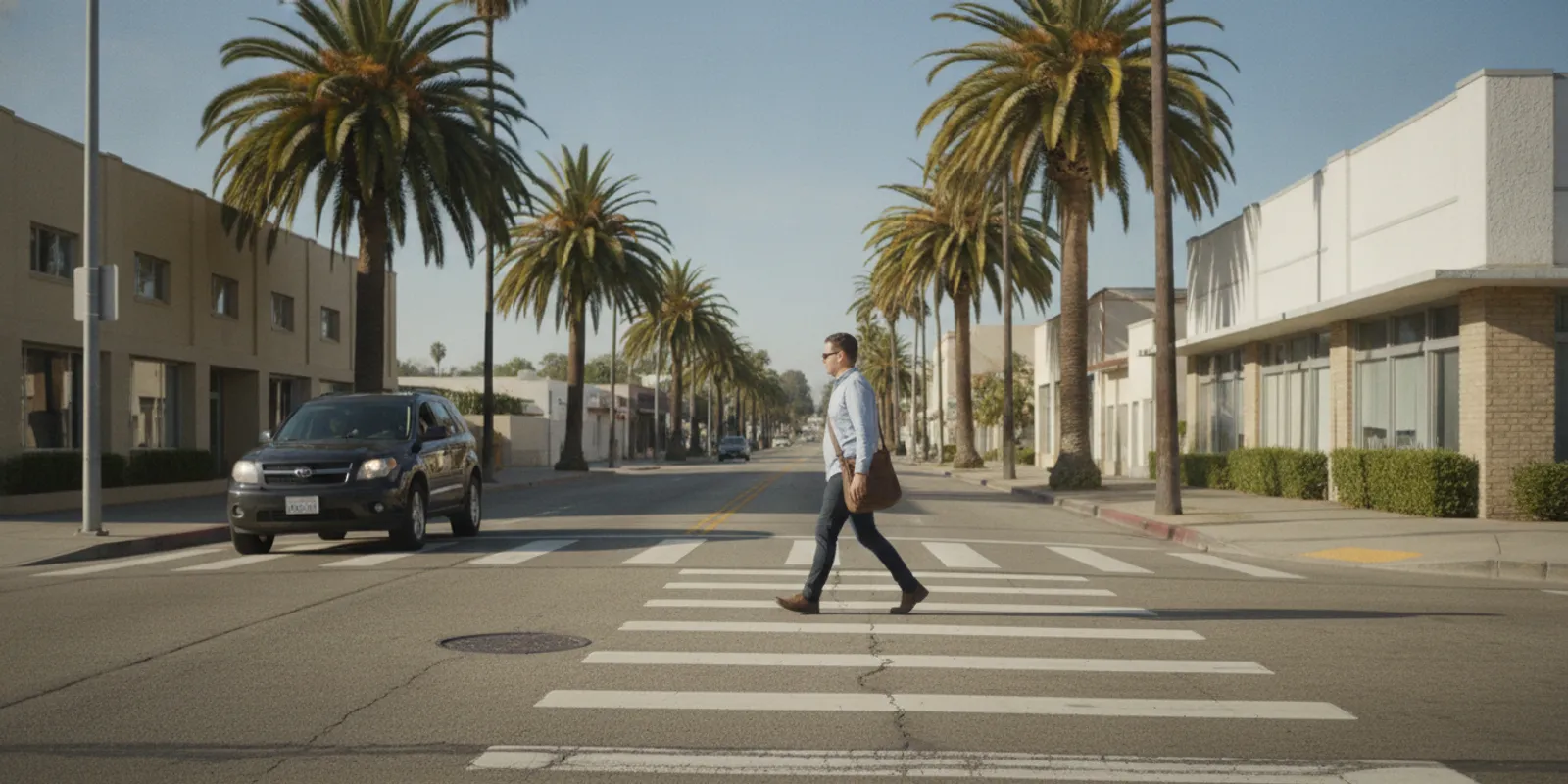
A collision while walking can leave you dealing with pain, medical appointments, missed work, and questions about who had the right of way. A Riverside pedestrian accident lawyer can help assess how the facts, evidence, and available insurance apply to a claim. The steps you take after the event can also make important details easier to document.
Contact DC Law Group to discuss your pedestrian injury
What evidence matters after a Riverside crosswalk collision?
Start with the scene and the timing of the event. A photograph of a crosswalk alone may not explain who had a signal, how a vehicle approached, or where each person was when impact occurred. A careful record can help an attorney, an insurer, or an investigator assess the competing accounts.
If you can do so without risking your safety, preserve images or notes showing:
- The crosswalk lines, curb ramps, traffic signals, and nearby signs.
- The vehicle’s position, direction of travel, and any visible damage.
- Road layout, sight lines, lighting, weather, and conditions that could affect visibility.
- Nearby cameras, businesses, residences, or transit stops that may have recorded the area.
- The location of witnesses and a way to reach them, if they agree to share it.
Make a written account as soon as practical. Record your direction of travel, the signal you saw, the vehicle’s movement, and anything said at the scene. Keep the account factual. Do not guess at a vehicle’s speed or add details you did not observe. If your recollection changes as you recover, note when and why rather than editing an earlier statement without explanation.
Police reports, photographs, emergency-call records, and nearby video may preserve information that is difficult to recreate later. Video systems often overwrite recordings, so an attorney may send a preservation request when appropriate. The report is one source of evidence, not necessarily the final word on fault. For more on reading that document, see how to read a California accident report.
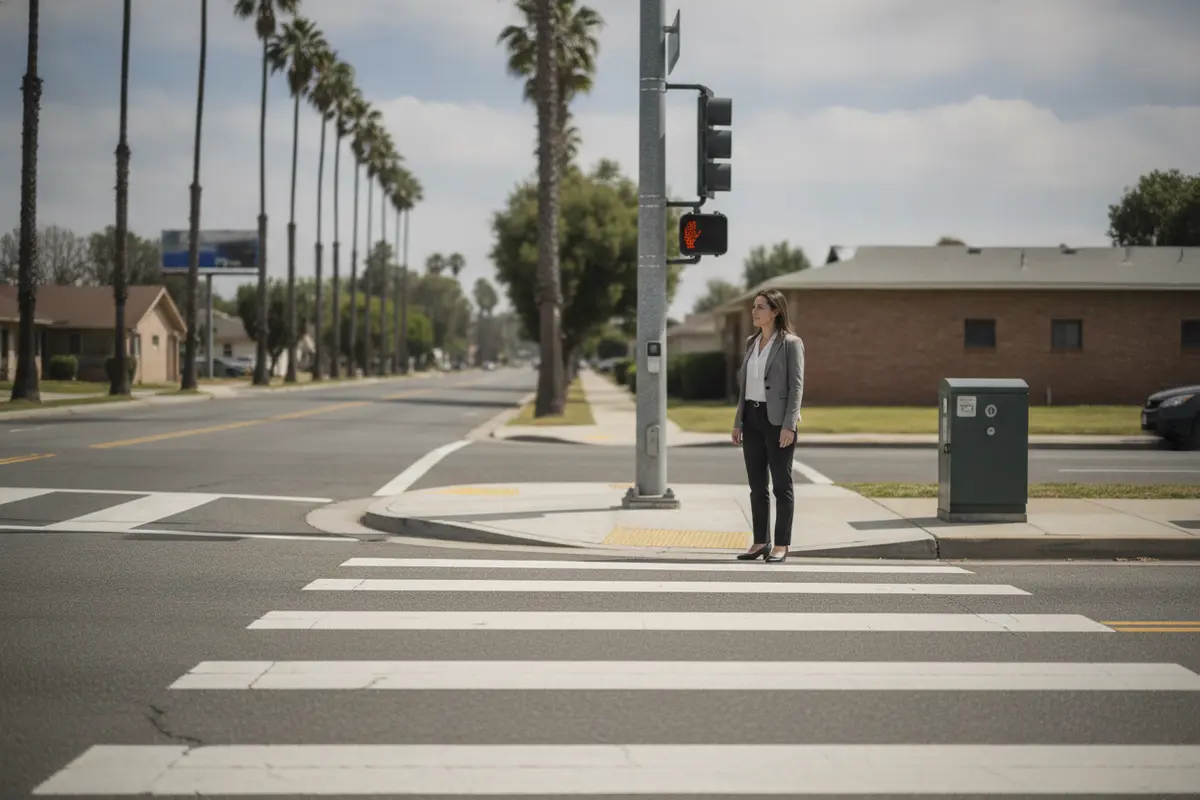
Marked Riverside crosswalk with a pedestrian waiting near the curb ramp
How can the Riverside setting shape evidence collection?
Local context matters because a pedestrian collision can happen at a signalized intersection, near a shopping area, on a residential street, or at a place where vehicles enter or leave a driveway. Those settings raise different evidence questions. An intersection review may focus on signal phases and turning movements. A driveway incident may call for photographs of the vehicle entrance, nearby landscaping, walls, or parked vehicles that affect sight lines. A collision near a transit stop may make it useful to identify witnesses who were waiting nearby.
Do not assume a location is documented just because it is familiar or easily found on a map. Note the nearest cross streets and the direction each person was traveling. Photograph the approach from the pedestrian’s perspective as well as the driver’s, when it is safe and practical. A camera angle from one side may show the vehicle entering a crossing but not reveal what the driver could see beforehand.
Conditions can change after the event. Vehicles move, temporary signs are removed, vegetation is trimmed, construction work changes, and camera recordings may be overwritten. If a feature of the scene may matter, make a dated record and tell the investigating professional where it was. Avoid returning to a roadway to take pictures if doing so could expose you to traffic or interfere with an investigation.
For an account that another person can follow, make a simple location sketch. Mark the curb, crosswalk, traffic lanes, signal poles, and approximate points where you first saw the vehicle and where impact occurred. Label the sketch as your recollection and include the date you made it. It is a memory aid, not a measured survey, so do not present estimates as exact distances.
How do right-of-way disputes affect a pedestrian claim?
Right-of-way questions often turn on details that witnesses describe differently. A driver may say the pedestrian entered against a signal. The pedestrian may recall having the walk indication or being already in the crossing when the vehicle turned. A turning driver may claim the crosswalk was not visible. The relevant evidence can include signal timing, vehicle paths, sight lines, witness statements, and video.
California traffic rules address both driver duties and pedestrian conduct. Whether a rule was followed depends on the specific conditions and evidence. An investigation should consider the whole sequence, not just where the pedestrian was at the moment of impact.
For example, consider a person crossing at a marked intersection as a driver makes a turn. The driver’s view may have been partly blocked, or the person may have been difficult to see in low light. Those facts do not, by themselves, settle responsibility. Investigators may examine parked vehicles, lighting, signal phases, the driver’s path, and whether either party had a reasonable chance to react.
Preserve the original files for photos and video when possible. Keep dates and locations with them, and avoid cropping or adding annotations to the only copy. Ask witnesses to describe what they personally saw rather than encouraging them to adopt a version of events. These steps help keep the record useful and credible.
A witness who saw only the impact may not know what signal was displayed moments earlier. Another person may have observed the pedestrian or vehicle approaching before impact. When collecting names and contact details, note where each witness was positioned and what they say they observed. Do not coach a witness, fill in gaps in their account, or ask them to sign a statement you prepared.
Can more than one person share responsibility?
California follows a comparative fault system. In general, an injured person’s recovery may be reduced by the share of fault assigned to that person. A dispute about a signal or crossing location therefore does not automatically end a claim. The evidence must be evaluated to determine whether each person’s conduct contributed to the collision and how responsibility may be allocated.
For instance, a driver might argue that a pedestrian crossed outside a marked crossing or entered when the signal did not permit it. The pedestrian may respond that the driver was turning without yielding, was distracted, or had time to stop. A factfinder may consider both accounts and all available evidence. The legal effect depends on the case facts; a percentage should not be assumed from a brief description.
Useful records may include scene images, signal and intersection details, witness accounts, vehicle damage, medical records, and any available video. Keep communications with insurers and other parties accurate. Avoid posting speculation about fault or your physical condition online while the facts are being reviewed.
| Issue | Evidence to preserve | Why it may matter |
|---|---|---|
| Crossing signal | Signal timing, witness accounts, and nearby video | May help establish what indications were visible when each person entered the intersection. |
| Driver movement | Vehicle path, damage, roadway images, and camera footage | May clarify whether the vehicle was turning, stopping, or continuing through the crossing. |
| Visibility | Lighting, weather, sight lines, and obstructions | May show what each person could reasonably see before impact. |
| Injury and recovery | Care records, symptom notes, and work records | Can document the nature and effects of the injuries over time. |
The table is a starting checklist, not a substitute for a case-specific review. A missing record does not prove either side’s account. Evidence can be incomplete, and sources may need to be compared for consistency. A disputed detail should be considered alongside the rest of the timeline, not treated as conclusive by itself.
What if the driver is uninsured or cannot be identified?
If the driver has no insurance, or leaves before being identified, do not assume there is no possible source of coverage. Review your own auto policy and ask whether uninsured or underinsured motorist coverage may apply to the circumstances. Some policies may provide coverage for an insured person injured as a pedestrian, but the wording, policy status, reporting duties, and facts matter. A lawyer can review the actual policy and any notice requirements.
When a driver leaves the scene, report the event to law enforcement and provide the details you know. Preserve the vehicle description, direction of travel, plate information if available, and witness contact information. Look for nearby cameras promptly; footage may not remain available for long. Do not pursue a vehicle or put yourself at risk to gather information.
Tell your insurer what happened, but be precise about what you know and what remains uncertain. Ask for copies of policy documents and keep a record of claim communications. Avoid agreeing that coverage applies or does not apply before the policy language and facts have been reviewed.
Coverage review can involve more than checking whether a policy exists. The relevant questions may include who qualifies as an insured, whether the policy was active, which types of events it addresses, and what notice or cooperation provisions apply. Keep the policy declarations, endorsements, and claim correspondence together. If the insurer asks for information, write down the request and response date so you can track what has been provided.
Do not assume that a vehicle description or partial plate number is unimportant because it does not identify a driver immediately. Preserve the original notes and provide them to law enforcement or counsel. If a witness later recalls another detail, record when the new information arose and who provided it. This keeps the chronology clear without overstating what was known at the outset.
DC Law Group represents people injured in pedestrian collisions as part of its California personal injury practice. You can learn more about the firm’s pedestrian injury representation or read about how a pedestrian injury attorney may help.
How should you document injuries and their effects?
Get medical attention promptly when needed, and follow the instructions provided by your treating professionals. Some injuries are not obvious at the scene. A medical evaluation creates a record of reported symptoms, examination findings, and recommended care. Do not delay urgent treatment while trying to gather claim documents.
Keep copies of records and a simple timeline that includes:
- When symptoms began and how they changed.
- Appointments, referrals, treatment recommendations, and follow-up visits.
- Daily activities that became difficult and any assistance you needed.
- Work days missed or changes to your regular duties, with supporting records where available.
- Messages or letters from insurers, providers, employers, or other parties.
Be straightforward with medical professionals about symptoms and prior conditions. If something improves or worsens, explain when the change occurred. Keep appointment and treatment records together, but share sensitive information only through appropriate channels. A personal log can add context; it does not replace medical documentation.
A useful daily note need not be lengthy. For example, record whether you attended a planned appointment, what activity was difficult, whether you needed help with routine tasks, and whether a symptom changed. Separate what you experienced from what another person observed. Use ordinary language and keep entries dated. If you later correct an entry, preserve the original and explain the correction rather than making the record appear to have been written earlier.
Save records that show the practical effects of an injury as well as clinical care. Depending on the situation, that may include appointment confirmations, work schedules, correspondence about missed duties, or notes about assistance provided by family. These materials can help explain the sequence of events, but they should be accurate and limited to what actually occurred. Do not create records solely to strengthen a claim.
For a broader overview of vehicle-related claims, see DC Law Group’s California car accident practice information. Pedestrian claims have their own factual and coverage issues, so advice should be based on the particular incident.
What should you expect when speaking with an insurer?
An insurance representative may ask for a recorded statement, documents, or permission to obtain records. Before responding, understand which insurer is contacting you and what claim it is handling. You can ask for the request in writing and take time to review it. Do not speculate, minimize an injury, or state that you are fully recovered if that is not accurate.
Keep a copy of what you send and note the date, recipient, and method. Avoid signing a release or accepting a resolution before you understand what it covers and how it affects the claim. A release can have lasting consequences. Legal counsel can explain the language and help you evaluate the next steps without promising a particular result.
Before an interview, it may help to review your own dated notes and distinguish direct memory from information learned afterward. If you do not know an answer, say so rather than guessing. If a question is unclear, ask for clarification. Keep copies of documents you provide and make a note of any follow-up the representative requests. A careful process helps reduce confusion as evidence is gathered.
For independent research when evaluating legal help, Cornell’s Legal Information Institute provides a directory of personal injury attorneys in Riverside: Riverside personal injury attorney listings. A directory is one starting point for research. Review an attorney’s experience, communication approach, and fit for your matter directly, and do not treat a listing as an endorsement or assessment of a particular claim.
When can a Riverside pedestrian accident lawyer help?
A lawyer may help identify potential sources of evidence, review disputed right-of-way facts, communicate with insurers, assess applicable coverage, and explain deadlines that may affect a claim. Legal representation may be especially useful when injuries are significant, the driver disputes fault, more than one person may share responsibility, or insurance coverage is unclear.
Bring any documents you already have, such as the police report, photographs, medical records, insurer letters, and a short timeline. You do not need to resolve every uncertainty before asking questions. Organize items by date and note which details remain uncertain. If you have a video file, preserve the original and explain who recorded it and when, if known. If a record is missing, say that plainly rather than delaying an initial conversation while trying to obtain every document.
During an initial discussion, you can ask what information would help assess the circumstances, what evidence may need prompt preservation, and how communications with insurers should be handled. You can also ask how the firm explains its representation terms and what responsibilities you would have if it takes the matter. The answers should be specific to the situation and based on the documents and facts available, not a promised outcome.
DC Law Group is a team of personal injury attorneys serving injured people in California. The firm offers a consultation to discuss the situation and possible next steps. No attorney can guarantee a particular result; an evaluation depends on the evidence and applicable law.
Speak with DC Law Group about your Riverside pedestrian injury claim
Frequently Asked Questions
Does a collision outside a marked crosswalk prevent a pedestrian claim?
Not automatically. Crossing location and conduct may be relevant to comparative fault, but the full circumstances and each person’s actions need to be assessed. Preserve available evidence and seek advice based on the specific event.
What if the driver says I entered the crossing too late?
That is a disputed factual issue, not a conclusion by itself. Signal timing, video, witnesses, vehicle movement, and other scene details may help evaluate the accounts. Keep your own description factual and preserve records.
Can my auto insurance matter if I was walking?
It may. Depending on policy wording and circumstances, uninsured or underinsured motorist coverage may be relevant to an insured pedestrian. Review the policy and promptly ask the insurer about notice or claim requirements.
What if I did not feel injured until later?
Seek medical attention when symptoms arise and explain when they began. Keep follow-up records and describe changes accurately. A later symptom does not answer questions of cause or responsibility on its own.
How long do I have to bring a California injury claim?
Deadlines can depend on who may be responsible and other case details. Some claims involving public entities have special notice rules and shorter time limits. Do not rely on a general article to calculate a deadline; get legal guidance promptly.
Contact DC Law Group to discuss your next steps
This article provides general information, not legal advice. A lawyer must review the facts and applicable law to advise on an individual claim.