

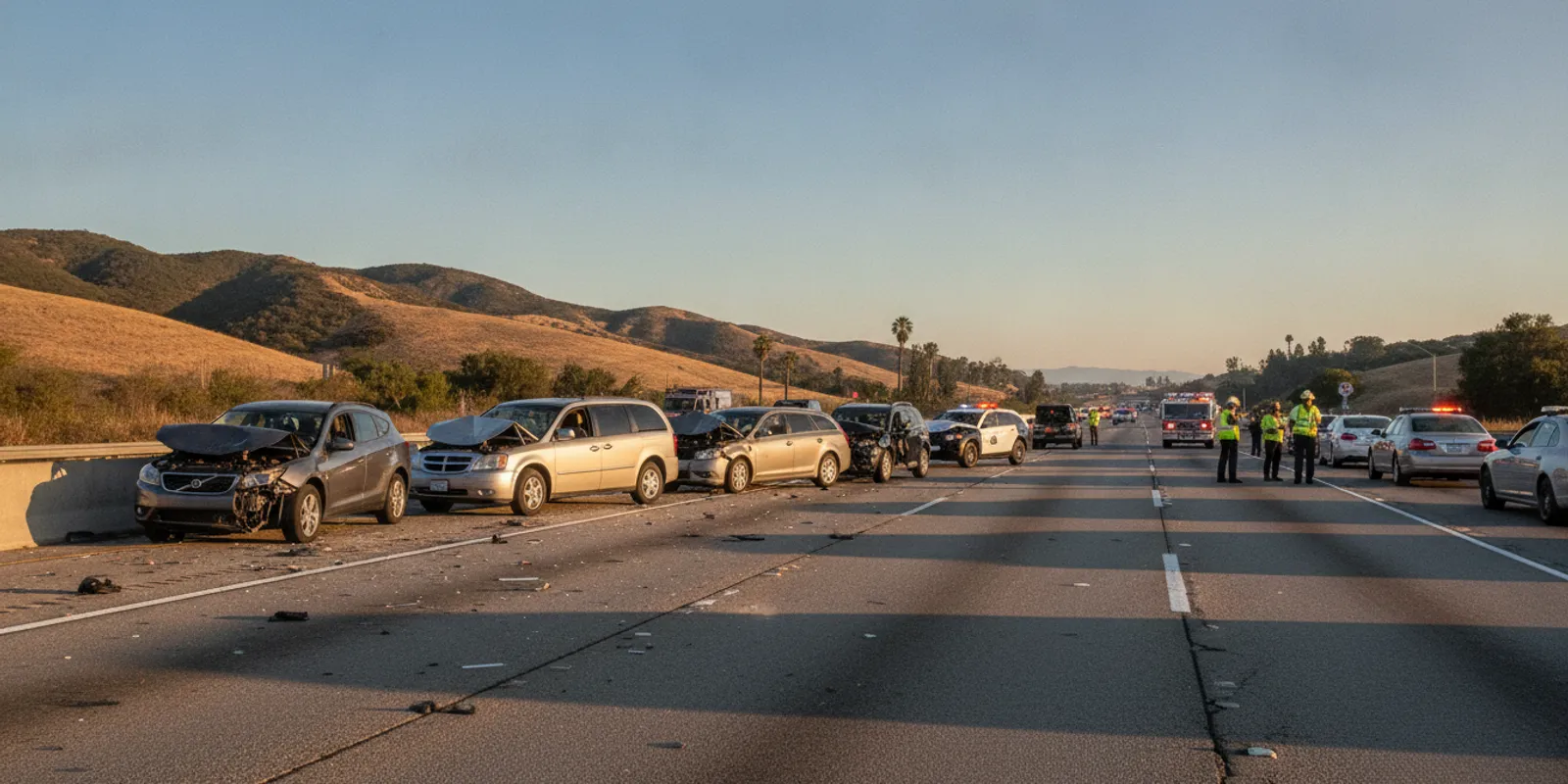
A collision involving several vehicles can leave drivers with sharply different accounts of how the impact began and who had time to react. Understanding multiple vehicle accident liability California injury claim issues starts with reconstructing the sequence, identifying each driver's conduct, and connecting that conduct to a specific injury. A vehicle that was struck from behind may have moved into another lane; a driver arriving moments later may have contributed to a separate impact. The first explanation offered to an insurer is not always the full story.
Ask DC Law Group to review your California collision claim
Call DC Law Group at (310) 571-8860
Why can responsibility be difficult to assign after a multi-vehicle crash?
One crash scene may contain several distinct events. A first impact can trigger a chain reaction, while a later driver may have enough time and distance to avoid an additional collision. In another scenario, two drivers may independently contribute to the initial impact. The fact that vehicles touched one another does not, by itself, establish who acted negligently or which conduct caused a particular injury.
Investigators and insurers may need to distinguish the initial collision from later impacts. They may ask where each vehicle was positioned, when each driver first saw a hazard, whether braking or steering was possible, and whether a driver's action changed the path of another vehicle. A careful liability review looks at the full timeline rather than assuming that the first vehicle contacted is the only source of responsibility.
There can also be different explanations for the same physical evidence. Damage to a rear bumper may be consistent with a rear impact, but it does not alone prove how the vehicles were moving or whether an earlier collision had already pushed the vehicle forward. Scene photographs, vehicle inspections, witness accounts, and available electronic data may help test competing explanations.
How does California divide fault among drivers?
California generally applies comparative negligence. A person's recovery may be reduced by the share of fault assigned to that person. The analysis can include more than one defendant, and the percentages depend on the evidence and the legal issues in the case. A person is not automatically barred from pursuing a claim simply because an insurer alleges some responsibility.
California law also distinguishes economic damages from noneconomic damages in many cases involving multiple defendants. In general, a defendant may be jointly responsible for economic damages, while responsibility for noneconomic damages is several and tied to that defendant's assigned share, subject to legal exceptions and case-specific rules. The labels and allocation can matter, so an estimate based only on a single fault percentage may not describe the complete analysis. See the California Legislative Information home page for access to California statutes and the California Courts home page for court information.
Comparative fault is not a simple arithmetic exercise conducted before the facts are known. Evidence may support different conclusions about the timing and cause of each impact. For example, one driver might have caused the initial collision, while another driver's later conduct may have added to the injuries or damage. A legal review should identify which losses are connected to which event and which parties may have legal responsibility.
Who may be responsible in a chain-reaction collision?
The drivers involved are an obvious starting point, but they may not be the only people or entities whose conduct requires examination. Depending on the circumstances, an employer may be responsible for an employee acting within the scope of work. A vehicle owner may face a distinct legal issue from the driver's conduct. A business responsible for vehicle maintenance or a public entity responsible for a roadway condition may also require review if evidence supports that theory. These possibilities are not automatic; each depends on specific facts and applicable law.
Consider a hypothetical sequence: a driver changes lanes without adequate space and strikes a car; the struck car is pushed into another lane; a following driver then collides with it. The first lane change may have initiated the sequence, but evidence might show the following driver was traveling too fast for conditions or had time to avoid the later impact. Alternatively, the evidence may show the second impact was unavoidable. The point is not to assign fault from a short description, but to investigate each driver's opportunity to perceive and respond.
Commercial vehicles can add records and parties to the inquiry, such as an employer, maintenance provider, or vehicle owner. The presence of a work vehicle alone does not prove employer liability. For a separate discussion of commercial collisions, see DC Law Group's California truck accident information and its guide to steps after a truck collision.
Which evidence can clarify the sequence of impacts?
Evidence can disappear quickly. Vehicles get repaired or moved, surveillance recordings may be overwritten, and witnesses may become difficult to locate. Preserve what is available without putting yourself in danger or interfering with an investigation. A useful record often combines several sources rather than relying on one photograph or one person's memory.
- Scene photographs and video: Images of vehicle positions, damage, debris, roadway marks, traffic controls, weather, and sight lines can help show the conditions and relative positions. Keep original files when possible.
- Witness information: Record names and contact details for people who saw the impacts or the moments before them. Ask what they observed, without coaching or pressuring anyone to adopt a particular account.
- Police and emergency records: A collision report may record statements, observations, diagrams, and identified witnesses. It is useful evidence, but it is not necessarily a final legal decision about fault.
- Vehicle inspection: Damage location, transfer marks, and mechanical condition may help assess impact direction or whether a vehicle had a relevant defect. Inspections should be coordinated before repairs where practical.
- Electronic information: Some vehicles or devices may preserve event data, navigation information, or video. Availability, retention, access, and meaning vary. A qualified person may need to preserve and interpret it.
- Medical documentation: Prompt evaluation and consistent records help document symptoms, diagnosis, treatment, and how the condition affects daily activities. Tell providers about each area of pain or limitation.
- Work and other loss records: Keep schedules, employer notices, wage records, receipts, and other documents that show how the injury affected work or required services.
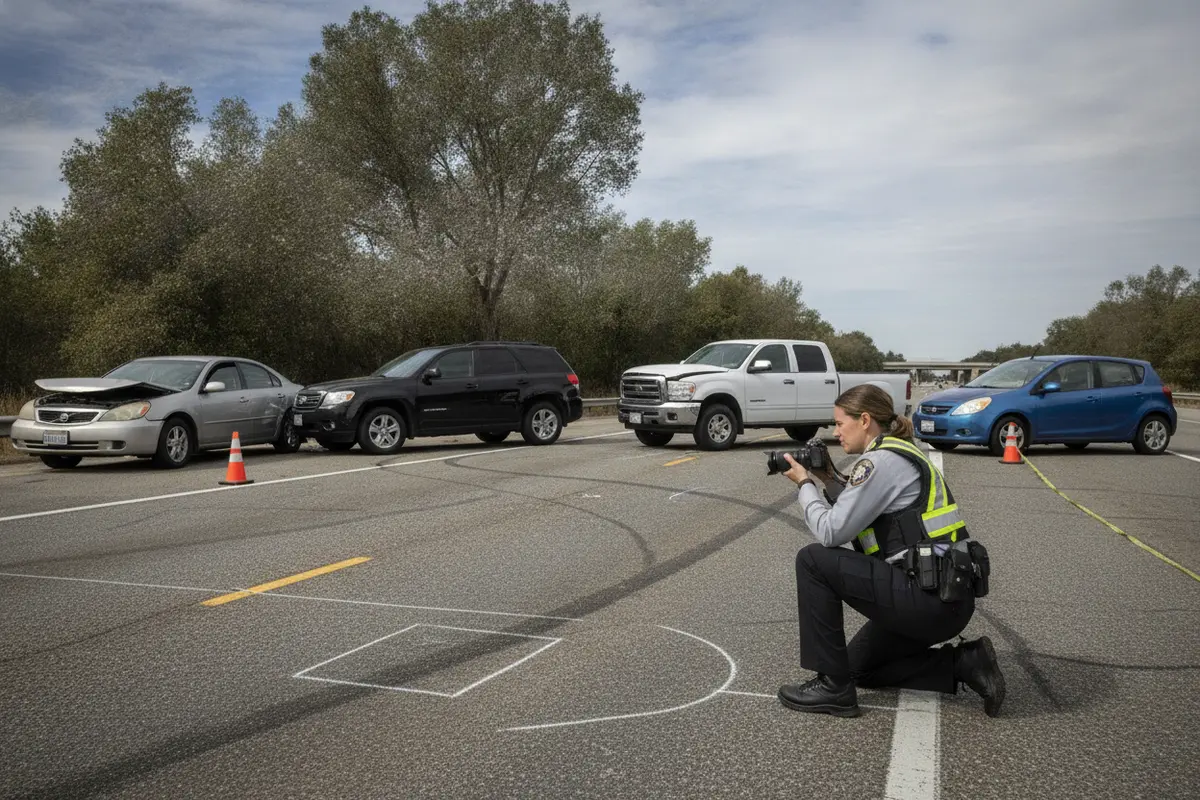
An investigator documents vehicle positions after a multi-car collision
Keep a dated account of what you remember, including travel direction, lane, approximate timing, weather, and the order of impacts. Mark which details you personally observed and which you learned later. If your memory changes as you recover or see new records, do not try to force it into a fixed version. Accurate notes can identify questions that require follow-up.
For a broader overview of evidence and claim preparation after a car collision, read DC Law Group's California car accident help. The firm's car accident claim process guide also describes common stages of a legal review.
What should you do in the days after the collision?
- Prioritize safety and medical care. Follow emergency responders' directions and seek appropriate medical evaluation. Symptoms can change over time. Tell a clinician how the event occurred and describe each symptom accurately.
- Preserve basic records. Save photographs, video, contact details, report information, medical documents, and communications. Back up digital files and keep originals when possible.
- Write down the timeline. While your memory is fresh, note the direction of travel, lane changes, traffic, signals, impacts, and what you observed. Do not speculate about details you did not see.
- Be careful with recorded statements. You may need to report an incident to an insurer, but a recorded interview can invite firm conclusions before the complete sequence is known. Give truthful answers, avoid guessing, and understand who is asking and why before agreeing to a recorded account.
- Do not sign a broad release without review. A release can resolve claims or rights. Read documents carefully and seek legal guidance if you do not understand what they cover.
- Track the claim and deadlines. Keep a log of claim numbers, adjuster contacts, requests, and responses. Legal time limits can depend on the parties and facts; claims involving a public entity can have different, shorter claim procedures. Do not assume that an insurer's investigation extends a filing deadline.
If you were driving, riding as a passenger, or using a rideshare vehicle, the applicable insurance and liability questions can differ. DC Law Group also provides information about California Uber and Lyft collisions and personal injury claims.
How can the insurance review differ from the legal analysis?
Several insurers may investigate the same collision, but each insurer evaluates its insured's potential responsibility and coverage. Their conclusions can differ, particularly when the accounts conflict or the impact sequence is not yet clear. An insurer's initial position is not the same as a court's final determination, and a police report may not answer every legal question.
Insurance representatives may request statements, authorizations, photographs, or medical information. Ask what each request covers, keep copies, and avoid assumptions about the effect of signing a document. A broad medical authorization, for example, may seek records beyond those relevant to the collision. You can ask for a narrower request and get advice before signing if the scope is unclear.
Do not speculate to fill gaps in the timeline. If you do not know whether a second impact occurred before or after your vehicle moved, say so. If you need to check a document before answering, request time to review it. Consistent, accurate communication is more useful than a confident guess.
A consultation can help organize which parties, records, and deadlines need attention. To discuss the circumstances with DC Law Group, use the California injury consultation page or contact the firm.
How do the main evidence sources compare?
| Evidence source | What it may help establish | Important limitation |
|---|---|---|
| Scene images and video | Vehicle positions, roadway context, visible damage, and conditions | A still image captures only one moment and may not show the full sequence |
| Witness accounts | What a person saw or heard before, during, or after the impacts | Viewpoint, attention, distance, and memory can affect detail |
| Vehicle and electronic data | Damage patterns or recorded information that may inform timing and movement | Availability and interpretation vary; preservation may be time-sensitive |
| Medical and work records | Injury, treatment, functional effects, and documented work disruption | Records should be accurate and connected to the relevant event and period |
| Collision report | Initial observations, statements, diagram, and witness leads | It may not resolve disputed fault or include every later-discovered fact |
What can affect the value of a claim?
Injury claims are evaluated using evidence about responsibility, causation, and harm. In a multi-impact event, it may be important to identify whether an injury resulted from the initial impact, a later impact, or a combination. Medical records, provider opinions, prior health history when relevant, and the timing of symptoms can all matter. A person should not assume that every symptom is attributable to one driver simply because the symptoms began on the day of a collision.
Evidence may also describe the effect on daily activities, work, and future care needs. Keep records that already exist and follow appropriate medical advice. Do not exaggerate or minimize symptoms to fit an insurance position. If a condition changes, tell the treating provider and keep the updated information.
When several parties may be involved, each may dispute responsibility or argue that another event caused some portion of the harm. A sound analysis organizes the evidence by issue: how the collision unfolded, which conduct may have contributed, whether that conduct caused injury, and what the records show about the resulting harm. Legal advice can help assess how those issues interact under California law.
Which deadlines should you check?
California deadlines are not identical for every claim. The general limitation period for many personal injury actions is commonly two years, but exceptions and other rules may change the analysis. A claim involving a public entity can require a claim to be presented much sooner, often within six months, before a lawsuit may proceed. Minors, delayed discovery, contractual issues, and other circumstances can affect the applicable rules. These examples are not a substitute for checking the deadline that applies to a particular claim.
Do not wait for all insurers to agree before asking about legal time limits. Keep any notice, claim form, or letter that states a deadline, and obtain advice promptly if a public agency, government vehicle, or public roadway condition may be involved. The guide to timing a California car accident lawyer consultation offers additional context, but individual dates must be evaluated on their own facts.
How can you prepare for a legal consultation?
You do not need to solve the liability question before asking for a review. A concise set of records can help an attorney understand the event, identify missing evidence, and discuss next steps.
- Prepare a short timeline, including each impact you recall and any uncertainty about the order.
- Bring photographs, witness details, the collision report number, and any available video.
- List every insurer or representative who has contacted you, with dates and claim references.
- Bring medical records or appointment details that you have, and note how symptoms affect ordinary activities.
- Include work-related documents or other records of losses you are asking to have reviewed.
- Write down questions about fault, evidence preservation, insurance communications, and deadlines.
Be direct about facts that may not favor your position, including a possible traffic violation or a prior condition. An attorney needs an accurate account to evaluate the case, not a polished version designed to answer every question in advance. DC Law Group's California injury law firm page and consultation page provide ways to learn about requesting a review.
Contact DC Law Group to discuss a multi-vehicle collision
Call DC Law Group at (310) 571-8860
Frequently asked questions
Does the driver who struck another vehicle from behind automatically bear all responsibility?
No. A rear impact is relevant evidence, but responsibility depends on the complete circumstances, including what happened before the contact and whether another driver's conduct contributed. A chain reaction can involve more than one negligent act.
Can I bring a claim if an insurer says I share some fault?
An insurer's position does not by itself decide your legal rights. California comparative negligence may reduce recovery according to assigned fault, and the evidence should be reviewed before accepting an allocation. The effect depends on the facts and the damages involved.
What if I do not know which impact caused my injury?
Do not guess. Describe the event and symptoms accurately to medical providers and preserve available records. Medical documentation and a careful review of the impact sequence may help evaluate causation.
Should I speak with every insurer involved?
Promptly report the event as required by your policy, but be careful about recorded statements or broad document releases before you understand the request. Answer truthfully, avoid speculation, and consider getting legal guidance about communications with another party's insurer.
How long do I have to start a California injury claim?
Many personal injury actions are subject to a two-year limitation period, but exceptions apply, and claims against public entities can involve much earlier notice requirements. Have the specific deadline checked promptly rather than relying on a general time period.
Request a consultation with DC Law Group
Because multi-vehicle claims can involve disputed timelines, several insurers, and different legal rules, preserving records early and obtaining advice about your specific facts can help you make informed decisions.