

The Pacific Coast Highway through Malibu and Santa Monica offers some of California's most breathtaking coastal views. For motorcyclists, the same road that draws sightseers from around the world also ranks among the state's deadliest stretches of asphalt. A tourist braking suddenly for a photo, a driver pulling out of a blind beachfront driveway. Or a left-turning car that simply did not see the rider approaching can end a ride in an instant.
Get a free case evaluation with an experienced motorcycle accident lawyer Pacific Coast Highway riders trust. Contact DC Law Group today at (310) 571-8860 to discuss your case and learn how we can help you recover the compensation you deserve.
A motorcycle accident lawyer Pacific Coast Highway is essential because PCH collisions involve high speeds, complex fault rules, and severe rider injuries. California's pure comparative negligence law allows injured riders to recover damages even when partially at fault. DC Law Group provides direct attorney handling, 24-hour cash advances, and contingency fee representation so you pay nothing unless we win.
Motorcycle Accident Lawyer Pacific Coast Highway: What Makes Pacific Coast Highway So Dangerous for Motorcyclists?
State Route 1, known as the Pacific Coast Highway, holds unique dangers that riders face every day. Over 800,000 motorcycles are registered in California, more than any other state in the country. In 2023, 583 motorcyclists died on California roads, accounting for 14 percent of all traffic fatalities. Per mile traveled, the death rate for riders is 22 times higher than for car occupants. These numbers paint a sobering picture of the risks riders accept every time they head out.
Tourist Traffic and Distracted Drivers
The PCH draws millions of visitors each year. Many drivers are unfamiliar with the road, distracted by ocean views, or looking for beach parking instead of watching for motorcycles. A driver may stop abruptly to take a photo, swing wide into a shoulder where a rider is passing. Or pull out from a beachfront driveway without checking for oncoming bikes. These driveways, especially through Malibu, create frequent T-bone and side-swipe collision risks that car drivers rarely encounter on other highways.
Blind Curves and Narrow Shoulders
Where the Santa Monica Mountains meet the Pacific, the PCH twists through sharp, blind curves. Riders cannot see what lies around a bend, and oncoming drivers may cross the center line without warning. Sand and salt spray from the ocean reduce tire grip, especially in early morning or after fog. Narrow shoulders leave riders with no escape path when a car drifts into their lane. A high-speed crash on one of these curves often produces catastrophic injuries.
Road Design and Lighting Deficiencies
The PCH transitions abruptly between high-speed rural highway and congested city street. In Santa Monica, dense cross-streets and stop-and-go traffic create frequent intersection conflicts. Left-turning drivers are the leading cause of motorcycle crashes, and the PCH's many unmarked intersections amplify this danger. Night riding adds another layer of risk, as long stretches of the Malibu coastline lack street lighting entirely. Reduced visibility makes road hazards and turning vehicles harder to spot.
What Are the Most Common Motorcycle Crash Scenarios on the PCH?
Certain collision patterns occur repeatedly on the Pacific Coast Highway. Understanding these scenarios helps riders recognize danger and helps victims build stronger legal cases when a crash does occur.
Left-Turn Collisions at Intersections
The most frequent motorcycle crash on the PCH involves a driver turning left across a rider's path. The driver either misjudges the motorcycle's speed or fails to see it entirely due to the vehicle's narrow profile. These crashes are typically the turning driver's fault under California Vehicle Code 21801. Which requires a driver to yield the right-of-way to oncoming traffic before making a left turn. Because motorcycles are harder to see than cars, these collisions happen in broad daylight as often as at night.
Rear-End Collisions in Congested Traffic
Stop-and-go traffic near Santa Monica pier and along the Malibu corridor puts riders at risk of rear-end impacts. A distracted driver looking at navigation or the ocean may not notice a motorcycle stopped ahead. The consequences are severe: a rear-end collision can throw a rider from the bike or crush them against the vehicle in front. Riders who lane split in these conditions also face doors opening suddenly or drivers changing lanes without checking their mirrors.
Blind Driveway and Shoulder Hazards
Beachfront homes and businesses along the PCH create hundreds of driveways that empty directly onto the highway. Drivers pulling out often have obstructed sightlines due to hedges, parked vehicles, or the road's natural curve. A rider traveling at the 45 to 55 mph speed limit approaches these driveways with minimal reaction time. Dooring accidents along beachside parking areas add another layer of risk when drivers open their doors into a rider's path.
| Crash Scenario | Primary Cause | Typical Location | Common Injuries |
|---|---|---|---|
| Left-turn collision | Driver fails to yield | Intersections, Santa Monica | Broken bones, road rash |
| Rear-end impact | Driver distraction | Stop-and-go traffic zones | Whiplash, spinal injury |
| Blind driveway pull-out | Obstructed sightlines | Malibu beachfront | T-bone impact, head trauma |
| Lane-splitting crash | Driver unaware of rider | Congested PCH corridor | Side-swipe, limb fractures |
Lane Splitting on the PCH: Legal Rights and Safety Rules
California is the only state that explicitly legalizes lane splitting. Vehicle Code 21658.1 recognizes a motorcyclist's right to ride between rows of stopped or moving vehicles in the same lane. This law helps riders avoid rear-end collisions and reduce traffic congestion, but it also creates unique liability questions after a crash.
What the Law Requires
While the statute does not set a maximum speed for lane splitting. The California Highway Patrol recommends that riders not exceed 30 mph and maintain a speed differential of no more than 10 mph relative to surrounding traffic. A rider who splits lanes at high speed or in an unsafe manner may be found partially at fault for a resulting collision under California's pure comparative negligence rule. However, a driver who changes lanes without signaling or checking a blind spot bears significant fault regardless of whether the rider was lane splitting.
Insurance Company Bias Against Lane-Splitting Riders
Insurance adjusters frequently try to blame the rider simply for lane splitting, even when the other driver caused the crash. An experienced motorcycle accident lawyer Pacific Coast Highway knows how to counter this bias with traffic camera footage, Caltrans road data, and witness statements that establish the other driver's negligence. Never accept an insurance company's initial valuation after a lane-splitting crash without legal review.
What Should You Do Immediately After a PCH Motorcycle Crash?
The moments after a crash determine both your physical recovery and your legal options. Follow these steps to protect your health and your claim.
Prioritize Safety and Medical Care
Move to the side of the road if you are able. Traffic on the PCH moves fast, and a rider on the pavement is vulnerable to secondary impacts. Call 911 immediately and report your exact location using nearby landmarks or mile markers. Accept medical evaluation at the scene even if you feel fine. Adrenaline masks pain, and a delayed diagnosis of internal injuries or traumatic brain injury can weaken your claim. A medical record created at the scene directly links your injuries to the crash.
Document the Crash Scene
Use your phone to photograph both vehicles, their license plates, the road surface, skid marks, debris fields, and any visible injuries. Collect the names and phone numbers of witnesses who are not involved in the crash. These neutral accounts carry significant weight when fault is disputed. Do not discuss fault at the scene or apologize for anything, as these statements can be used against you later.
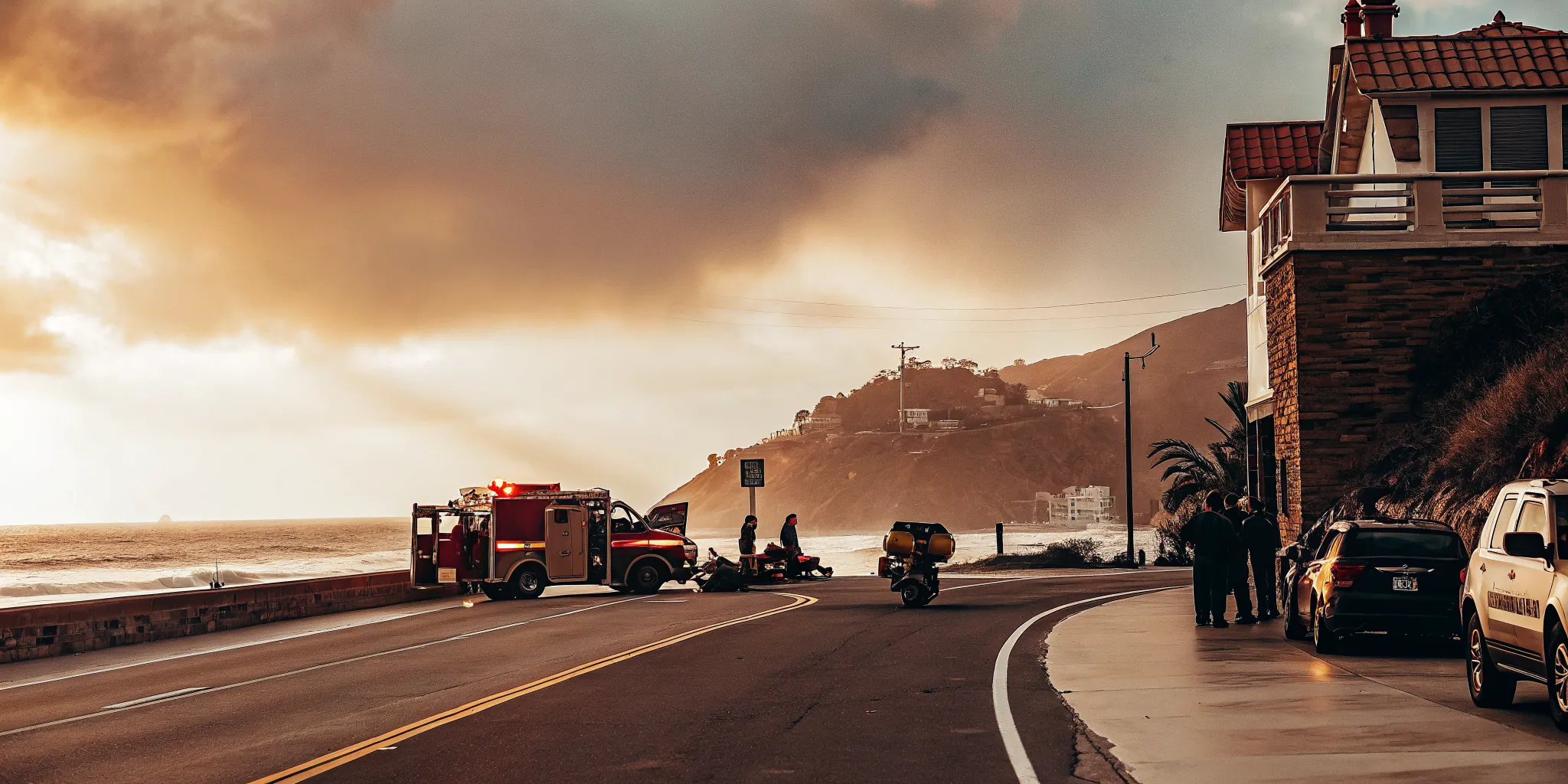
Emergency response scene on Pacific Coast Highway showing a motorcycle accident near the Malibu coastline
Preserve Evidence and Notify Your Insurer
Keep your helmet, protective gear, and motorcycle exactly as they are. Do not wash, repair, or dispose of any item. These physical artifacts demonstrate the force of the impact and the safety equipment you were wearing. Notify your insurance company of the crash but provide only basic facts: date, time, and location. Do not give a recorded statement or accept a settlement offer until you have spoken with a motorcycle accident lawyer who understands PCH collision dynamics.
Know Your Legal Deadline
California Code of Civil Procedure 335.1 gives you two years from the date of injury to file a personal injury lawsuit. This statute of limitations is a strict deadline. Evidence degrades, witnesses forget details, and insurance companies use delay as a negotiation tactic. Contact a lawyer promptly to begin building your case while the evidence is fresh and witnesses are easy to locate.
How Is Fault Determined in a PCH Motorcycle Accident?
Proving fault on the Pacific Coast Highway requires a detailed investigation that accounts for the road's unique geography and traffic patterns. California's pure comparative negligence system allows injured riders to recover compensation even when they bear some responsibility, but the fault percentage directly affects the final award.
Pure Comparative Negligence in California
Under California Civil Code 1714, a plaintiff's recovery is reduced by their percentage of fault. A rider found 20 percent at fault for a crash receives 80 percent of the total damages. This rule makes it critical to present strong evidence that minimizes the rider's share of fault. Insurance companies routinely exaggerate a rider's responsibility to reduce their payout. A skilled motorcycle accident lawyer Pacific Coast Highway fights to ensure the fault calculation reflects the true facts.
Evidence Sources for PCH Crashes
Caltrans operates traffic cameras along the Malibu and Santa Monica coastline that may have captured the crash. Police reports document the responding officer's observations at the scene. Accident reconstruction experts can analyze skid marks, vehicle damage patterns, and road conditions to determine how the crash occurred. Cell phone records may reveal whether the other driver was texting or using navigation at the time of impact. Witness testimony from other motorists or nearby residents provides additional perspective on the events leading up to the crash.
Types of Compensation Available
* Medical expenses: emergency treatment, surgery, rehabilitation, and future care costs
* Lost income: wages missed during recovery and reduced future earning capacity
* Property damage: motorcycle repair or replacement, damaged gear
* Pain and suffering: physical pain, emotional distress, and reduced quality of life
* Punitive damages: available in cases involving gross negligence or drunk driving
Motorcycle crashes in the United States generated over $65 billion in lifetime economic costs in 2022, according to the CDC. This figure includes medical care, lost productivity, and legal costs, underscoring the immense financial impact these collisions impose on victims and their families.
Why Choose DC Law Group for Your PCH Motorcycle Accident Case?
Not every personal injury firm understands the unique legal and factual landscape of Pacific Coast Highway motorcycle collisions. DC Law Group combines direct attorney involvement, deep knowledge of California motorcycle law, and financial programs designed to support clients during the recovery process.
Managing Attorney David Cohan personally handles every case. He does not delegate to junior associates or paralegals. This direct involvement means your case receives the attention of a Super Lawyers Rising Star 2025-2026 honoree, a distinction earned by only 2.5 percent of California attorneys. The firm's 5.0-star Yelp rating from past clients reflects consistent results and genuine client care.
DC Law Group's 24-hour cash advance program provides immediate financial relief while your case proceeds. Medical bill coordination, vehicle repair assistance, and lost wage recovery support ensure that a crash does not devastate your financial stability while you heal. The firm operates on a strict contingency fee basis: you pay nothing unless we win your case.
Call (310) 571-8860 or schedule your free consultation online to speak directly with an attorney who understands what it takes to win a PCH motorcycle accident case.
Frequently Asked Questions
How much does a motorcycle accident lawyer cost on the PCH?
DC Law Group handles all motorcycle accident cases on a contingency fee basis. You pay no upfront fees, no retainers, and no hourly charges. Attorney fees are collected only from a successful settlement or verdict. If we do not win your case, you owe nothing.
Can I still recover compensation if I was lane splitting when the crash happened?
Yes. Lane splitting is legal in California under Vehicle Code 21658.1, and doing so does not automatically make you at fault. Insurance companies may try to blame the rider, but an experienced lawyer can use evidence and accident reconstruction to prove the other driver's negligence.
How long do I have to file a lawsuit after a PCH motorcycle crash?
California Code of Civil Procedure 335.1 allows two years from the date of injury to file a personal injury lawsuit. Missing this deadline permanently bars your claim. Contact an attorney well before this deadline to ensure your case is properly prepared.
What compensation can I recover after a Malibu motorcycle accident?
Injured riders can seek compensation for medical expenses, lost income, property damage, pain and suffering, and in some cases punitive damages. The total value depends on injury severity, medical costs, lost earning capacity, and the degree of fault assigned to each party.
How does California's comparative negligence law affect my case?
Under California's pure comparative negligence system, you can recover damages even if you are partially at fault. Your compensation is reduced by your percentage of fault. For example, a rider found 25 percent at fault would receive 75 percent of the total damages award.
What should I do if the insurance company offers me a quick settlement?
Do not accept any settlement offer before consulting an attorney. Initial offers are typically far below the full value of your claim and do not account for future medical costs or long-term pain and suffering. A lawyer can negotiate for a settlement that reflects the true scope of your losses.