


A Lyft collision can leave you trying to solve several problems at once. You may be dealing with injuries, medical appointments, vehicle damage, lost work, insurer calls, and uncertainty about which policy applies. The details of the Lyft trip can also affect the legal and insurance questions that must be examined.
Contact DC Law Group to request a free consultation and discuss the facts of your California Lyft accident with a legal team.
A free consultation lyft accident attorney can help you organize the crash timeline, identify potentially relevant insurance layers, preserve evidence, and discuss claim deadlines. A consultation is an opportunity for a fact-specific review, not a promise of a particular result.
This guide explains what to gather before an initial meeting and why the driver's app status matters. It covers which questions to ask and how to prepare for a discussion about medical records, liability, and timing. You do not need a complete file before seeking legal guidance. Bring what you have and identify what is still missing.
How to Prepare for a Free Consultation With a Lyft Accident Attorney in California
The most useful preparation is a clear, chronological account supported by the records you already possess. Begin with the date, time, and location of the collision. Write down where each vehicle, pedestrian, or cyclist was positioned, what you observed immediately before impact, and what happened afterward. Keep the description factual. Do not fill gaps in memory with guesses.
Next, identify your role in the incident. You may have been a Lyft passenger, Lyft driver, pedestrian, cyclist, or driver of another vehicle. Your role can affect which people, businesses, insurers, and legal theories need to be considered. Also note whether anyone else reported an injury and whether a vehicle owner differed from the driver.
* Save Lyft trip information. Keep the ride receipt, pickup and drop-off details, route, driver name, vehicle description, messages, and screenshots. If you were the driver, note whether the app was off, active while waiting, connected to an accepted ride, or directing you to a passenger.
* Preserve scene evidence. Keep photographs or video of vehicle damage, roadway conditions, traffic controls, visible injuries, nearby property, and the surrounding area. Record when and where each image was taken.
* Collect contact information. List the names and contact details of drivers, passengers, witnesses, responding officers, medical providers, and insurance representatives when known.
* Build a short timeline. Include the collision, police report, emergency care, follow-up treatment, insurer contacts, work absences, and any communication from Lyft or another party.
* Keep original files. Do not crop, overwrite, or edit original photographs, videos, app screenshots, messages, or recordings. Make copies for review while preserving the original versions.
Bring the materials in a folder organized by crash evidence, medical care, work impact, vehicle damage, and insurance communications. If you cannot obtain a record, write down who has it and when you requested it. A missing document is easier to address when it is identified rather than silently omitted.
DC Law Group's California accident and personal injury information provides additional context about collision claims. It does not replace a review of the facts and documents from your particular incident.
Why the Lyft App Status Matters to Insurance Questions
The driver's status in the Lyft app at the time of the collision can affect the coverage questions that require investigation. The presence of a rideshare decal, the fact that a driver uses Lyft. Or the fact that a passenger booked a trip does not by itself answer which policy applies. The analysis should focus on what the driver was doing at the moment of impact and who caused the collision.
| App status at impact. | Issues to raise during the consultation. |
|---|---|
| App off. | Review the driver's personal policy and the ordinary liability analysis. |
| Logged in and waiting. | Determine what rideshare-related coverage and policy conditions may apply. |
| Ride accepted or en route. | Use trip details and route information to establish the assignment and timing. |
| Passenger in the vehicle. | Examine the passenger's role, the driver's conduct, other vehicles, and potentially relevant policies. |
California Department of Insurance guidance addresses transportation-network-company insurance issues involving drivers, passengers, pedestrians, and others affected by a crash. Review the California Department of Insurance rideshare guidance as general information, then ask how the facts of your incident change the analysis.
When the driver was offline or waiting for a request
If the driver was offline, the driver's personal auto coverage and ordinary negligence questions may be central. If the driver was logged in and waiting for a request, additional rideshare-related questions may arise. The distinction can matter whether you were a passenger, a pedestrian, a cyclist, a third-party motorist, or the Lyft driver.
Preserve any available app screenshots, trip history, messages, and records showing the driver's activity. Do not assume that a remembered app status is complete. Ask the attorney what evidence may confirm or challenge that account and which insurers should receive notice.
When a ride was accepted or a passenger was in the car
An accepted ride or an active passenger trip creates a different factual setting. The ride receipt, accepted request, route, pickup information, and timing may help establish what the driver was doing before the crash. The passenger's claim may involve the Lyft driver's conduct, another driver's conduct, or both. A cyclist, pedestrian, or third-party motorist injured in the same collision may have a related but separate analysis.
The driver's own injury or property-damage claim can raise different questions about fault and available coverage. A consultation should identify each person's role, each potentially responsible party, and the records needed to evaluate the claim. No single app-status category determines the outcome of every California Lyft accident.
What Medical and Crash Records Should You Bring?
Medical and crash records help create a timeline from the collision through treatment and the practical effects of the injury. They also help an attorney identify gaps that may need follow-up. Bring the records you have, even when treatment is ongoing or a provider has not yet sent a complete file.
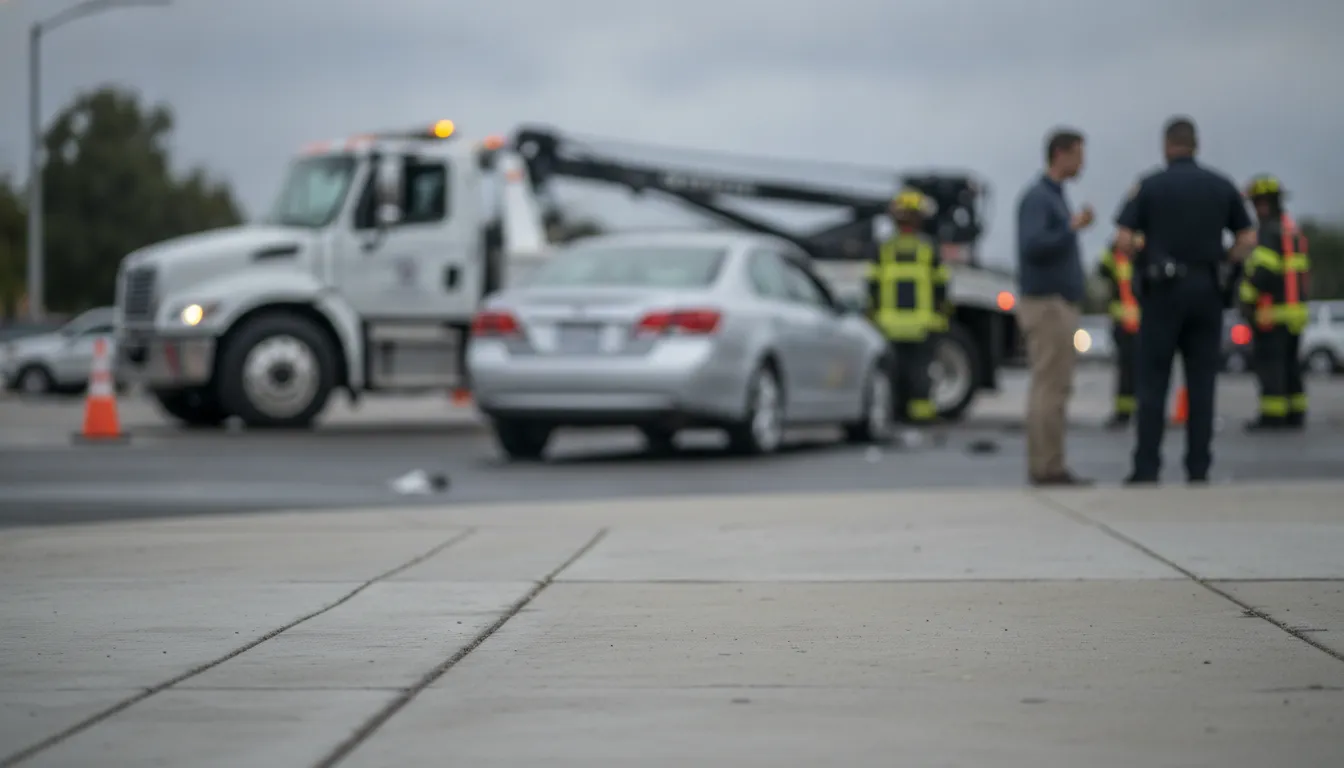
California rideshare crash scene viewed from a safe sidewalk
Medical treatment and symptoms
Collect emergency department records, urgent-care paperwork, diagnostic reports, referrals, prescriptions, bills, discharge instructions, and provider contact information. Include follow-up visits, specialist appointments, physical therapy, and other ongoing care. Keep a simple symptom log with dates, factual descriptions, activities affected, and related appointments.
Do not attempt to diagnose yourself or change treatment because of a potential claim. Follow your medical provider's instructions and ask medical questions of the appropriate clinician. A legal consultation can address documentation and claim issues, but it is not medical advice.
Work, transportation, and daily-life effects
If the injury affected your work, preserve schedules, time records, leave communications, pay documentation, and messages about missed or modified duties. Record the dates and nature of the effect without estimating a legal recovery. Also preserve vehicle repair records, towing information, rental or transportation records, and photographs of property damage.
Describe practical changes in ordinary activities. Examples may include difficulty driving, lifting, walking, sleeping, caring for family, or completing household tasks. Keep these notes accurate and consistent with your treatment records. Do not exaggerate or minimize symptoms to make the account fit a legal theory.
Insurance and communications
Save claim numbers, letters, emails, text messages, recorded-statement requests, and other communications from Lyft, insurers, vehicle owners, or representatives. Note the date of every call and the name or department of the person who contacted you. Do not assume an insurer's ongoing conversation changes a filing deadline.
Keep the original messages and attachments. If an insurer asks for a recorded statement, signs a release, or requests broad records, ask what the request means before responding. A consultation can help identify which documents are relevant and what questions should be addressed first.
Which California Deadlines Should You Discuss at the First Meeting?
Timing should be discussed early because legal deadlines depend on more than the date of a crash. The type of claim, identity of the defendant, claimant's circumstances, and involvement of a public entity or business may change the analysis. Evidence can also become harder to obtain as time passes.
California Code of Civil Procedure section 335.1 generally addresses actions for injury to or death of an individual caused by another person's wrongful act or neglect. Read the statute directly at California Code of Civil Procedure section 335.1. The statute should not be treated as a universal deadline for every Lyft-related matter.
Why the claim and defendant matter
A personal injury claim, property-damage claim, wrongful-death claim, and claim involving a public entity may follow different procedures. A rideshare company, driver, vehicle owner, employer, public agency, or other defendant may require separate analysis. Some matters can involve a claim presentation or notice requirement before a lawsuit may proceed.
The driver's app status may also affect which parties and insurance policies must be investigated. A passenger, Lyft driver, pedestrian, cyclist, and third-party motorist can face different questions even when they were involved in the same collision. Ask the attorney to identify the potentially applicable deadlines based on the complete fact pattern.
Information that helps with the deadline review
Bring the crash date, location, police report information, medical records, insurer communications, claim numbers, and any contact with a government office. Mention delayed symptoms, earlier injuries, prior claims, or facts that may affect who is responsible. Do not wait until every record arrives before asking about timing.
Early review gives counsel more opportunity to identify parties, preserve evidence, request records, and determine what procedures may apply. A consultation cannot guarantee that a claim will succeed, but it can clarify which timing questions require immediate attention.
What Questions Should You Ask Before Choosing an Attorney?
An initial meeting should help you understand how the attorney would evaluate the collision, what information is missing, and how communication would work. Listen for answers connected to the facts of your crash rather than broad promises about an outcome.
Who will investigate and communicate with insurers?
Ask who will be your primary contact and who will investigate liability, obtain records, communicate with insurers, and explain major decisions. Ask how the legal team handles evidence from Lyft, the police, witnesses, vehicle owners, and medical providers. If another person performs much of the work, ask how the attorney supervises that process.
How will you determine the driver's app status?
Ask what information may establish whether the driver was offline, waiting for a request, traveling to a passenger, or carrying a passenger. The answer may involve trip details, app records, messages, ride receipts, witness accounts, and the police report. App activity should be treated as an issue to investigate rather than a fact to assume.
Which insurance layers and parties will you examine?
Ask how the attorney will assess the driver's personal policy, rideshare-related coverage, other involved drivers, vehicle owners, employers, and potentially relevant business or platform relationships. The answer should account for your role in the crash and the conduct of every person who may have contributed to it.
What should I preserve right now?
Ask which app screenshots, vehicle photographs, messages, medical records, bills, wage documents, and insurer communications are most important. Confirm how to preserve electronic records and whether you should avoid deleting accounts or changing devices before relevant information is saved. Also ask whether the attorney plans to request evidence from another party.
How will you evaluate injuries, work effects, and deadlines?
Ask how the legal team will organize treatment records, medical bills, missed work, vehicle damage, transportation problems, and changes in daily activities. Ask which limitation periods and claim-notice rules may apply to your specific claim. Do not rely on a general online deadline without discussing the defendant and legal theory.
What is the communication and case-evaluation process?
Ask how updates are provided, how questions are answered, when settlement discussions may begin, and what factors could lead toward litigation. Ask how confidential information is handled. The goal of these questions is to understand the process and decide whether the attorney's approach fits your needs.
If you are ready to discuss the circumstances of a California rideshare collision, contact DC Law Group through its contact page. Provide the information you have and explain what remains uncertain.
How Can the Consultation Clarify Your Next Step?
A first meeting can turn a confusing collision into an organized decision process. The attorney may review the crash timeline, your role, the driver's app activity, insurance communications, medical treatment, work effects, and potential deadlines. The discussion can also identify records that need to be requested or preserved.
Bring your questions and be candid about facts that may be uncomfortable or incomplete. Tell the attorney about prior injuries, delayed symptoms, statements to insurers, social-media posts, and any other information that could affect the analysis. A reliable evaluation depends on a complete account, not a polished version of events.
Do not sign a release, accept an insurer's position, or discard evidence simply because the next step feels urgent. Ask what a document means and what deadline applies. The right next step depends on the facts, and no article can determine liability, coverage, or the value of an individual claim.
Contact DC Law Group to discuss your California Lyft accident claim and ask what records may be useful for a fact-specific consultation.
Frequently Asked Questions
What should I do immediately after a Lyft accident?
Address urgent medical needs and call emergency services when appropriate. After reaching a safe location, preserve the ride receipt, driver and vehicle details, photographs, witness information, police report details, medical records, and insurer communications. Avoid guessing about fault or giving a recorded statement before understanding what is being requested.
What records should I save before an attorney consultation?
Save a crash timeline, scene photographs or video, the Lyft trip receipt, route and driver information, messages. Medical records, bills, work records, vehicle-damage records, police report information, and every communication from an insurer or rideshare platform. Bring incomplete records and identify what is still being requested.
Can Lyft insurance apply to a California crash?
It may, depending on facts such as whether the driver was logged into the app, waiting for a request, traveling to a passenger, or carrying a passenger. The driver's personal policy, rideshare-related coverage, another driver's insurance, and the roles of the parties may all require review. Coverage is fact-specific and should not be assumed from the existence of a Lyft account.
Should I speak with an attorney after a Lyft collision?
A consultation can help organize liability, insurance, medical documentation, evidence-preservation, and deadline questions. It may be useful whether you were a passenger, driver, pedestrian, cyclist, or another motorist. Bring the records available and ask how the attorney would investigate the app status and the conduct of each potentially responsible party.
How long do I have to bring a California injury claim?
California Code of Civil Procedure section 335.1 states a general rule for certain actions involving injury or death caused by another person's wrongful act or neglect. Other deadlines and claim-notice rules can vary by claim type and defendant. Discuss the crash date and complete fact pattern promptly rather than relying on one general deadline.
Take the Next Step After a California Lyft Crash
A fact-specific review can help organize the available evidence, clarify potential insurance issues, and identify questions about medical records and deadlines. Call DC Law Group at (310) 571-8860 to request a consultation about your California Lyft accident.