
A collision with a commercial truck can leave you dealing with serious injuries while the trucking company begins reviewing its own records and defenses. In Lakewood, the location of the crash matters, but so do the truck's route, loading, maintenance, driver schedule, and the identities of every business involved.
If you are looking for a lakewood truck accident lawyer near california, the most important early step is preserving evidence before it disappears. Photos, witness information, medical records, police reports, electronic logging data, and vehicle-maintenance records may help establish negligence, causation, and liability. Call DC Law Group at (310) 571-8860 to discuss your next steps.
Truck claims often involve more than the driver. A carrier, vehicle owner, loading contractor, maintenance provider, or another party may bear responsibility depending on the facts. Understanding why these cases require a broader investigation begins with the legal differences between a truck collision and an ordinary passenger-vehicle crash.
What Makes a Lakewood Truck Crash Legally Different?
A collision involving a commercial truck is not evaluated like an ordinary two-car accident. A large commercial truck may weigh up to 80,000 pounds, creating different forces and a greater potential for severe injury when it strikes a passenger vehicle. That physical difference can affect the medical evidence, accident reconstruction, and damages analysis. It does not, however, establish liability by itself. The claim still depends on proof of negligence, causation, and the parties responsible for the crash.
That distinction matters for anyone researching a *lakewood truck accident lawyer near california*. The location of a collision may guide the investigation, but it does not determine the legal theory or the right defendant. A crash in Lakewood may involve California traffic law, federal motor-carrier requirements, roadway conditions, and the contractual relationship between the driver, carrier, and truck owner. A statewide California investigation may be necessary even when the impact occurred at one local intersection or roadway.
Truck-versus-passenger vehicle dynamics
Commercial trucks have substantial mass, longer stopping distances, wide turning paths, and areas that are difficult for drivers to see. Investigators may need to examine vehicle damage, roadway evidence, available video, witness accounts, and the timing of each driver's movements. A reconstruction specialist may also assess speed, braking, visibility, lane position, and whether the truck's configuration affected the collision. These issues can help distinguish an unavoidable event from a preventable act of carelessness.
More than one party may be involved
Commercial truck cases frequently present multi-party liability. The truck driver may be responsible for negligent operation. A motor carrier or employer may bear responsibility when the driver was acting within the scope of employment. Separate allegations may involve negligent hiring, training, or supervision if those failures contributed to the collision. The truck owner and the carrier may also be different entities, with distinct records, insurance arrangements, and responsibilities. Identifying each role requires more than relying on the name displayed on the truck.
That is why an investigation should preserve records and identify the entities connected to the vehicle, shipment, and operation. The evidence may show that one party, several parties, or no particular party can be held legally responsible. A claimant's own conduct can also enter the analysis. California uses comparative fault, so a proven percentage of the claimant's negligence may reduce an award. DC Law Group's accident practice can provide general information about pursuing an injury claim, but the facts of each truck crash must be evaluated individually.
Where Truck Crashes Happen Around Lakewood and What to Document
Truck collisions around Lakewood can occur in several roadway settings, and each setting may leave different evidence. A crash on a freeway may involve lane changes, merging, blind spots, or changing traffic speeds. An interchange can raise questions about visibility, turning space, signage, and the sequence of vehicles entering or leaving the roadway. On an arterial street, investigators may need to examine traffic signals, crosswalks, driveway access, delivery activity, and the truck's path through an intersection. The location alone does not establish fault, but it helps define what should be documented.
Do not assume that a familiar road was safe or that the truck driver's account tells the entire story. Potential investigation issues can include fatigue, inadequate maintenance, or cargo that shifted during transit. Road design and maintenance, including lighting or limited intersection visibility, may also contribute to a collision in some circumstances. These are questions for evidence-based investigation, not assumptions about crash rates or any particular Lakewood intersection.
Photograph the scene when it is safe
If your injuries and the traffic environment allow, take photographs from several perspectives. Capture the vehicles before they are moved, visible damage, debris, skid marks, lane markings, traffic controls, lighting, sight lines, shoulder conditions, and nearby roadway defects. Include wide-angle images that show the relationship between the truck, your vehicle, and the surrounding roadway. If you cannot take photographs, ask a passenger or another trusted person to do so. Do not enter traffic or delay emergency treatment to gather evidence.
Obtain the incident or police report when it becomes available, and preserve any photographs or video in their original form. Dashcam footage, nearby business surveillance, and phone video may be overwritten quickly, so note where cameras were located and when the collision occurred. A prompt preservation request may later be important.
Identify witnesses and document your injuries
Ask witnesses for their names and contact information if doing so is safe. A witness may have seen a signal change, a lane movement, a load shift, or the truck's position before impact. Objective witness statements can be especially important when liability is disputed or more than one party may be involved. Write down what you personally remember, including the weather, roadway condition, direction of travel, point of impact, and symptoms that began after the crash. Keep the account factual rather than guessing about speed or fault.
Seek medical evaluation and follow the recommended treatment plan. Preserve physician notes, diagnostic results, prescriptions, work restrictions, and bills. Medical documentation connects the collision to diagnosed injuries and records how those injuries affect daily activities. If pain, anxiety, sleep disruption, or other symptoms develop later, tell the treating provider and keep a consistent record. A truck accident lawyer can evaluate the scene evidence, witness information, and medical records together rather than relying on one photograph or statement.
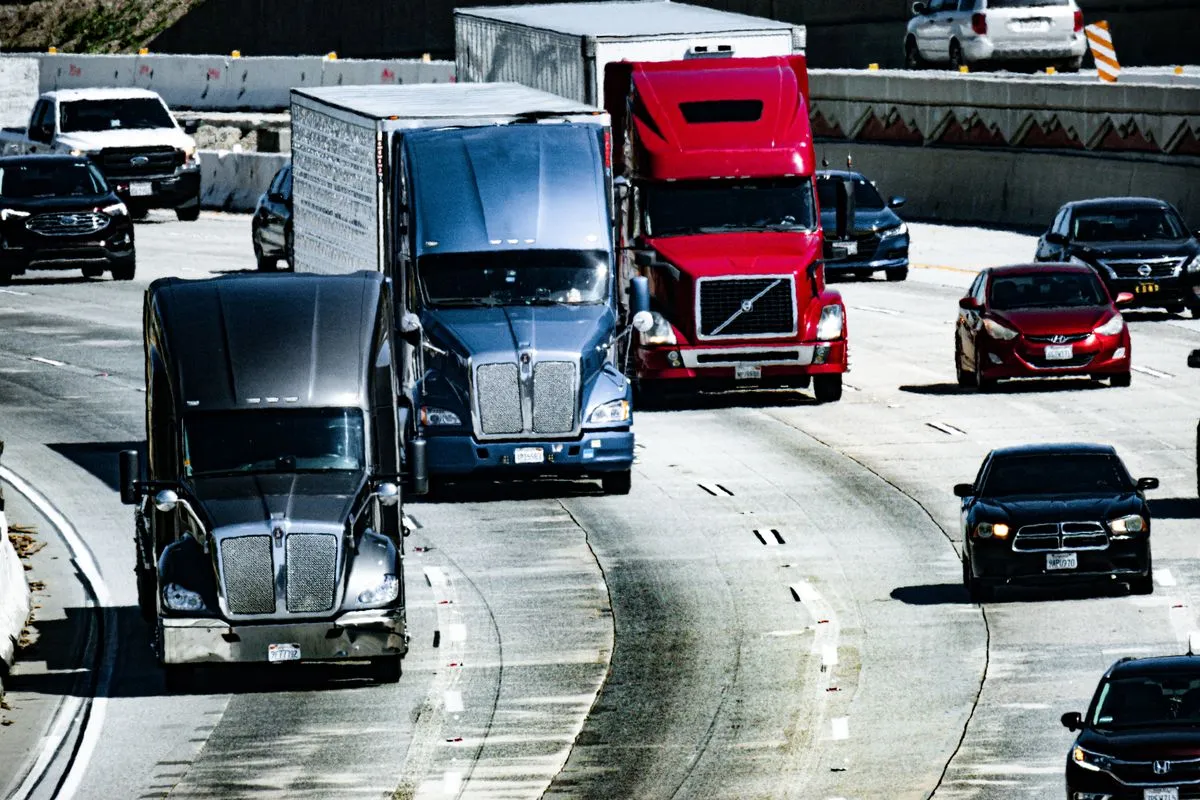
Trucks and passenger vehicles traveling on a congested Southern California highway
Who May Be Liable After a Commercial Truck Collision?
A commercial truck collision does not always point to one responsible person or company. The driver, motor carrier, vehicle owner, maintenance contractor, loading company, and even a public entity may each warrant investigation. Potential liability depends on evidence showing that a party owed a duty, breached that duty, and caused the harm. The presence of a truck, by itself, does not establish who is legally responsible.
These cases can also involve overlapping theories of negligence. For example, a carrier may be responsible for a driver's conduct while the driver was acting within the scope of employment. Separately, the carrier may face a direct claim if negligent hiring, training, or supervision contributed to the collision. A careful investigation should distinguish those theories instead of assuming that the driver's conduct is the only issue. Truck-liability principles can vary with the facts and the parties' roles.
| Party | Issues an investigation may examine | What must be proven |
|---|---|---|
| Driver | Speed, distraction, fatigue, lane changes, following distance, and compliance with traffic duties. | That the driver's act or omission breached a duty and was a substantial factor in causing the collision and resulting injuries. |
| Carrier or employer | Whether the driver was working within the scope of employment, and whether hiring, training, supervision, or policies were deficient. | Vicarious liability may apply to an employee's negligent conduct within the scope of employment. A direct negligence claim requires proof that the carrier's own conduct contributed to the crash. |
| Owner or lessor | Ownership, leasing agreements, control of the vehicle, and responsibility for placing a safe truck into service. | The legal relationship and the owner's or lessor's specific duty must connect to the collision. The truck owner and operating carrier may be different parties. |
| Maintenance or loading entity | Inspection, repairs, tires, brakes, cargo securement, weight distribution, and whether a defect or shifting load affected vehicle control. | Records and expert analysis must link the maintenance or loading failure to the crash, rather than merely showing that the entity worked on or loaded the truck. |
| Public roadway entity | Road design, signage, lighting, pavement, drainage, or an unsafe condition that may have contributed to the event. | Applicable public-entity rules, notice requirements, and evidence of a dangerous condition or negligent maintenance must be evaluated along with causation. |
California's comparative-fault rules may affect the final allocation of responsibility. If an injured person is found partly at fault, the fact finder may assign a percentage of negligence to that person, reducing the recovery by that percentage. The California Civil Jury Instructions explain this analysis in CACI No. 405. That possibility does not eliminate a claim, but it makes accurate evidence and a complete analysis important.
Preserving driver records, vehicle records, witness accounts, photographs, and collision-reconstruction evidence can help identify which party's conduct caused the harm. A Lakewood truck accident lawyer near California can review those relationships and evidence, but no liability conclusion should be made before the facts and causation are tested.
What Evidence Should a Truck Accident Lawyer Preserve?
Evidence preservation is the process of identifying, securing, and protecting information before it is lost, overwritten, altered, or discarded. It is not the same as proving liability. A record may show what happened, but a claim still requires an analysis of duty, breach, causation, and damages. In a commercial truck collision, early preservation can help a *lakewood truck accident lawyer near california* evaluate those issues from reliable evidence rather than incomplete recollections.
Electronic and operational records
Electronic logging device data and driver logs may show the driver's hours, duty status, and rest periods before the collision. These records can help investigators assess whether fatigue or an unrealistic schedule may have played a role. Motor carriers may also have driver qualification files, inspection records, maintenance histories, dispatch communications, and accident reports. The Federal Motor Carrier Safety Administration identifies records concerning driver qualifications, vehicle inspections, and maintenance as part of motor-carrier compliance documentation. Those records may be relevant to the investigation, but their existence alone does not establish negligence.
A truck's electronic control module, sometimes called the black box, may contain event data such as speed, braking, throttle application, or other vehicle information, depending on the equipment and the data available. Preservation is important because the module may be overwritten, altered during repairs, or affected when a vehicle is sold or salvaged. A qualified investigator may also examine inspection and maintenance records for tires, brakes, steering components, lighting, and other equipment connected to the crash.
Cargo, scene, and witness evidence
Cargo records can show what was loaded, how it was secured, who handled the loading, and whether the shipment changed during transit. This information matters when shifting or unsecured cargo is a possible factor. The FMCSA's cargo securement rules provide an authoritative reference for the safety requirements that may frame that review.
Scene photographs should capture vehicle positions, property damage, skid marks, debris, roadway conditions, traffic controls, lighting, and visible cargo or equipment damage, when it is safe to do so. A police report, nearby surveillance video, dash-camera footage, and photographs taken by other motorists may preserve details that disappear after vehicles are moved or the roadway is cleared. Witness names and contact information should be recorded promptly. Objective witness testimony can be particularly important when the parties disagree about speed, lane position, signaling, or the sequence of impact.
Medical records and preservation requests
Medical records connect the collision to the injuries being claimed. Keep discharge instructions, imaging reports, physician notes, treatment referrals, therapy records, and work restrictions. Consistent documentation helps show the injury's progression and the care recommended by medical professionals.
An attorney may send preservation requests, sometimes called spoliation or litigation-hold notices, to the carrier, driver, vehicle owner, maintenance provider, loader, or other entity that may control evidence. The request can identify ELD data, ECM data, inspection and maintenance files, cargo records, video, photographs, communications, and personnel records. It does not guarantee that every item will support the injured person's position. It helps put potentially relevant custodians on notice while the facts are investigated.
How California and Federal Trucking Rules Affect a Claim
Trucking regulations can provide an important framework for investigating a collision, but a rule violation does not automatically establish liability. The central questions remain whether someone owed a duty, breached that duty, and caused the injuries and losses being claimed. A careful investigation may compare the driver's conduct, the carrier's records, the vehicle's condition, and the circumstances of the crash.
Hours of service and fatigue evidence
Federal hours-of-service requirements regulate how long commercial drivers may operate and when they must take rest periods. The purpose is to reduce fatigue-related risks. When fatigue may have played a role, investigators can examine electronic logging device data, driver duty-status records, dispatch communications, and delivery schedules. The applicable FMCSA rules are available in the agency's hours-of-service regulations.
A log discrepancy or an hours-of-service violation may support an argument that the driver or carrier failed to follow a safety requirement. It still must be connected to the collision. For example, the evidence should help show how fatigue affected reaction time, lane control, speed, or another aspect of the driver's conduct before impact.
Cargo securement and vehicle safety
Improperly loaded or secured cargo can shift, fall, or change a truck's handling. That makes loading records, bills of lading, inspection documents, photographs, and statements from people involved in the loading process potentially important. The FMCSA's cargo-securement rules provide the federal framework for evaluating whether cargo was secured appropriately.
Maintenance and inspection records may also reveal whether a mechanical condition developed before the crash or whether a known problem went unaddressed. The FMCSA requires motor carriers to maintain records involving driver qualifications, vehicle inspections, maintenance, and accident reporting. Those records can help identify which entity had responsibility for a safety decision, although they do not by themselves prove that the condition caused the collision.
Post-crash testing and California safety principles
Post-crash alcohol and controlled-substance testing may be required in qualifying commercial-vehicle accidents involving death or injury. The requirement is fact-specific, and the existence or result of a test should be verified through official records. The FMCSA explains the applicable framework in its guidance on a commercial motor vehicle operator involved in an accident.
California safety analysis can involve ordinary traffic duties, roadway conditions, visibility, speed, following distance, and the conduct of each person involved. A reconstruction expert may assess physical evidence, vehicle data, photographs, and witness accounts to determine what happened. California also uses comparative-fault principles, so a claimant's own conduct may be considered if it substantially contributed to the harm.
Timing matters as well. California Code of Civil Procedure section 335.1 generally provides a two-year period for an action seeking relief for an injury or death caused by wrongful act or neglect. Read the statute at California Code of Civil Procedure section 335.1. Exceptions and claim-specific deadlines may apply, so an injured person should not assume the general period answers every timing question.
How a Lakewood Truck Accident Lawyer Near California Can Help After a Crash
The first decisions after a commercial truck collision can affect your health, evidence, and ability to evaluate a claim.
If you are able, take these steps while avoiding speculation about fault:
1. Get emergency help and report the crash. Call 911 when anyone may be injured, request medical assistance, and cooperate with the responding officers. Obtain the police report information before leaving if circumstances permit.
2. Document the scene safely. Photograph vehicles, visible injuries, road conditions, debris, traffic controls, and the truck's identifying information. Ask witnesses for their names and contact details. Do not enter traffic or interfere with emergency operations.
3. Follow through with medical care. Seek an evaluation even if symptoms appear manageable, then follow the treatment plan and keep records of visits, diagnoses, prescriptions, bills, and restrictions. Prompt documentation can help connect the injuries to the collision.
4. Preserve information and communications. Save photographs, messages, receipts, employment records, and notes about symptoms or missed work. Do not post about the crash or provide a recorded statement to a trucking insurer before understanding what is being requested.
5. Arrange a focused legal review. Gather the crash report, medical information, insurance correspondence, and witness details for a consultation with counsel familiar with commercial-vehicle investigations.
Be careful when speaking with insurers
Insurance representatives for trucking companies may contact an injured person quickly and seek an early statement or release. Answer basic identification questions honestly, but avoid guessing about speed, visibility, injuries, or responsibility. A lawyer can handle claim communications and help protect the investigation while the insurer evaluates its position.
Track the full impact of the collision
Keep records of medical treatment and related limitations. Depending on the evidence, a claim may include documented medical expenses, lost earnings or future earning capacity, and non-economic harm such as emotional distress. See this overview of truck-accident damages for general information. Describe how symptoms affect work, sleep, mobility, family responsibilities, and ordinary activities.
Do not wait to investigate deadlines
California Code of Civil Procedure section 335.1 generally provides a two-year period for an action seeking damages for injury or death caused by another's wrongful act or neglect. Read the California statute, and ask counsel to assess any facts that could change the deadline. A timely review also gives counsel a better opportunity to preserve records, including driver logs, maintenance material, and other evidence.
When choosing a California truck accident lawyer serving the Lakewood area, look for someone who can investigate the driver, carrier, vehicle owner, maintenance history, cargo, roadway conditions, and available trucking records.
That review should not rely only on the initial police report. Liability and comparative fault depend on the evidence in the particular case.
Call DC Law Group at (310) 571-8860 to discuss your truck-crash claim.
\n
Frequently Asked Questions
What are common causes of truck accidents in Lakewood?
Potential causes include driver fatigue, inadequate maintenance, improperly secured cargo, unsafe lane changes, and roadway conditions. The cause must be evaluated against the available evidence, including vehicle data, records, witness accounts, and the scene.
Who can be held liable in a California truck accident case?
Depending on the facts, a claim may involve the truck driver, carrier or employer, vehicle owner, maintenance provider, loading company, or a public entity responsible for roadway conditions. California's comparative-fault rules can also affect each party's responsibility and any recovery.
What evidence is crucial for a commercial truck accident claim?
Useful evidence may include photographs, the police report, witness contact information, medical records, electronic logging device data, inspection and maintenance records, cargo documents, and electronic control module data. A prompt preservation request can help prevent relevant records from being lost.
What is the statute of limitations for personal injury in California?
California generally provides two years to bring an action for injury or death caused by wrongful act or neglect, subject to exceptions that may change the deadline. California Code of Civil Procedure section 335.1 states the general rule: read the statute. A prompt case review is important when a government entity or other special circumstance may be involved.
Can you sue a truck driver after a collision?
A truck driver may be personally liable if evidence supports negligence or another actionable violation. The claim may also involve the carrier, employer, owner, or other entities, so identifying all responsible parties requires reviewing the driver relationship, company records, vehicle ownership, maintenance, and loading arrangements.
Contact DC Law Group About Your Truck Collision
The details of a commercial-truck collision can affect which parties and records deserve investigation. A focused review may help clarify practical next steps based on the available evidence.
Call DC Law Group at (310) 571-8860 to discuss the facts of a Lakewood-area collision and your situation.
The information in this article is general and does not replace case-specific legal advice.