
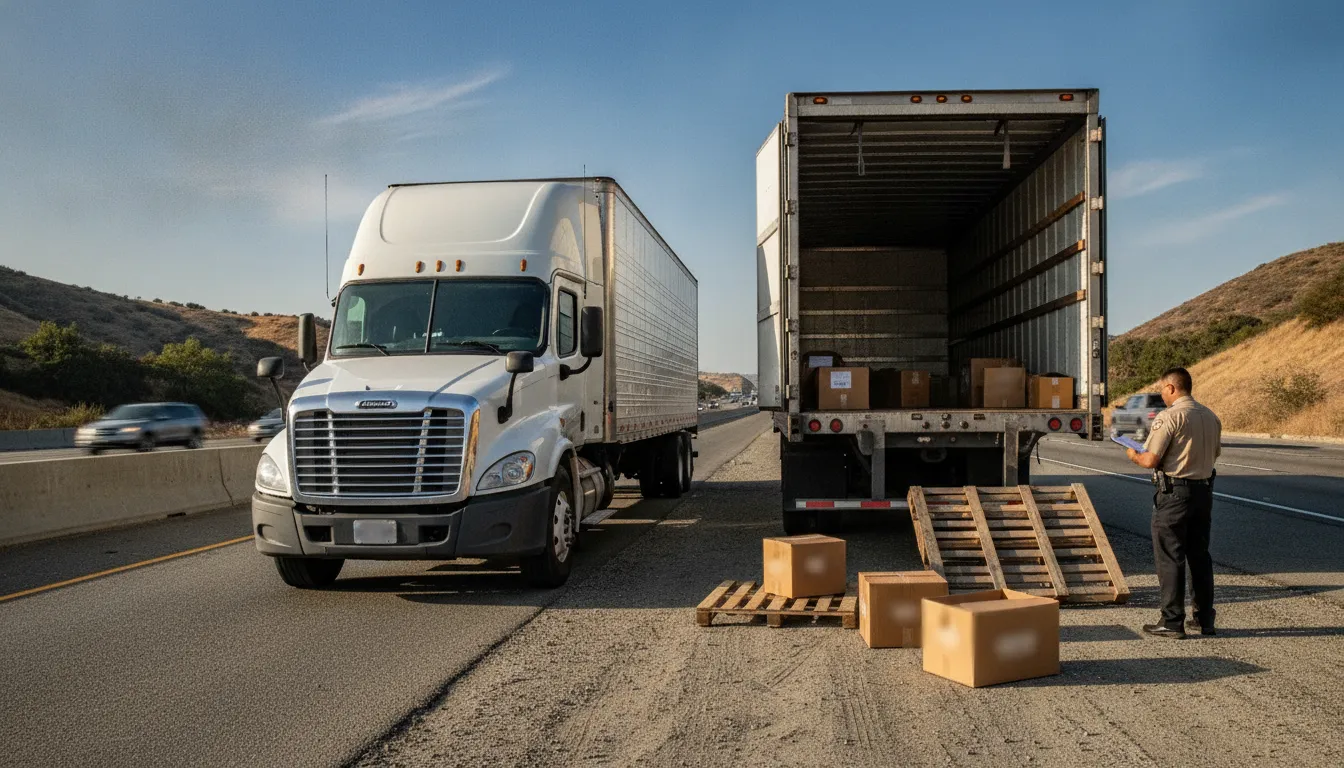
When cargo escapes from a commercial truck, the danger may continue after the initial impact. Debris, liquid, or unsecured materials can create a collision involving several vehicles and leave important questions about loading, securement, the truck, and the companies involved.
Contact DC Law Group at (310) 571-8860
A cargo truck accident lawyer California victims consult can help assess whether the evidence supports a claim, including which parties may need investigation and what deadlines or insurance issues could affect the case. California law addresses measures intended to prevent a vehicle's load from dropping, leaking, blowing, spilling, or otherwise escaping. Whether that rule applies and who may be legally responsible depends on the facts.
Start by preserving what can still be documented safely, including photographs, medical records, witness information, the police report, and communications from insurers. The legal differences in these crashes become clearer when you examine how cargo escape, truck operations, and potential liability intersect.
What Makes a Cargo Truck Crash Legally Different?
A cargo-related truck crash can require a different investigation from a collision involving only the vehicles themselves. The condition of the load, the way it was secured, the truck's route, and the timing of the cargo escape may all help explain what happened. These questions can matter even when the initial collision scene appears straightforward.
The load may be part of the safety issue
California Vehicle Code section 23114 addresses the movement of vehicles carrying materials on a highway. In general, a vehicle cannot be moved unless it is constructed, covered, or loaded in a way that prevents its contents or load from dropping, leaking, blowing, spilling, or otherwise escaping, subject to statutory exceptions. The full text is available from the California Legislature.
This rule does not automatically establish responsibility for every crash involving cargo. Investigators may still need to determine what material escaped, how it was contained, whether the roadway conditions contributed, and whether the event caused or contributed to the collision. Photographs, video, inspection records, dispatch information, and the condition of the truck and cargo may become important in answering those questions.
Different truck operations can create different evidence
A tractor-trailer, dump truck, delivery vehicle, or other commercial vehicle may carry cargo under different loading and securement arrangements. The relevant records may therefore vary. Depending on the facts, an investigation could examine the driver's observations and actions, the carrier's procedures, the loading or securement process, the equipment used to contain the material, and communications made before or after the trip.
That does not mean every person or business connected with a shipment is legally responsible. It means the investigation may need to look beyond the passenger vehicle and the driver who was immediately present. Commercial insurance and company records can also make the claims process more involved than an ordinary private-vehicle collision.
Liability remains fact-dependent
Evidence that cargo escaped is a significant fact, but it is not by itself a final case conclusion. A legal analysis must connect the conduct or condition at issue to the crash and the injuries claimed. It may also need to account for disputed facts, comparative responsibility, vehicle damage, medical evidence, and statements made to insurers.
This general information is not a determination of liability in any particular case. A California commercial truck accident representation review can help identify which evidence may matter and which potential parties should be investigated, based on the available facts.
Who May Be Responsible When Cargo Leaves a Truck?
A cargo-related crash can involve more than one potentially responsible party. The evidence may raise questions about who controlled the truck, who loaded or secured the cargo, whether the equipment was maintained, and what each person or company knew before the incident. Those questions do not establish liability by themselves. Responsibility depends on the specific facts, applicable legal duties, and proof connecting a party's conduct to the injuries or property damage.
The driver and motor carrier
The driver may be examined for conduct such as operating unsafely, failing to respond to an unsecured load, or continuing to drive after recognizing a cargo problem. The motor carrier may also be relevant because it can have responsibilities involving dispatch, supervision, inspection procedures, training, and vehicle operations. A carrier is not automatically responsible for every cargo incident, however. The relationship between the driver and company, the driver's work status, and the evidence of what occurred all matter.
The shipper, loader, or cargo handler
The shipper or another party that loaded the truck may become part of the investigation if the cargo was placed, distributed, covered, or restrained improperly. California Vehicle Code section 23114 addresses highway travel when a vehicle's contents or load can drop, leak, blow, spill, or otherwise escape, subject to the statute's stated exceptions. The condition of the load before departure, loading records, photographs, inspection notes, and testimony may help determine which party performed each task and whether the problem could have been detected.
In some shipments, loading and securement are divided among several businesses or workers. A bill of lading may identify the shipment, but it may not answer every question about who physically loaded the cargo or inspected the restraints. That is why the investigation should distinguish contractual roles from the actions actually taken.
Maintenance, equipment, and other parties
A cargo escape may also prompt review of the trailer, tie-downs, gates, tarps, locks, or other equipment. If a component failed, evidence may be needed to determine whether the issue involved ordinary wear, inspection or maintenance, a repair decision, or a manufacturing or design concern. The owner, lessor, maintenance provider, repair facility, or equipment manufacturer could be relevant depending on the facts. These possibilities require technical evidence and should not be treated as conclusions based only on the crash scene.
Shared fault and evidence
More than one party may have contributed to the same event, while the injured person or another road user may also be accused of contributing. California fault analysis is fact-dependent, and an allegation of shared fault is not proof that it applies. Preserve photographs, medical records, the police report, witness information, vehicle and cargo condition, and insurance correspondence when safely and reasonably possible. A careful review can help separate assumptions from evidence before responsibility is assigned.
What Evidence Should You Preserve After a Cargo Truck Crash?
Evidence can disappear quickly after a commercial truck crash. Preserve what you can without putting yourself or anyone else in danger. Do not enter traffic lanes, approach an unstable vehicle, climb onto a truck, or handle spilled cargo. If the scene is hazardous, leave documentation to emergency personnel and investigators. A careful record can help counsel evaluate what happened, which parties may be involved, and what information may need to be requested.
- Photograph or record the scene from a safe location. If you can do so without approaching traffic or cargo, take photographs or video of the roadway, lane positions, visible debris, vehicle damage, skid or fluid marks, weather, lighting, traffic controls, and the truck's overall position. Capture wide views as well as closer images from a safe distance. Do not move objects or attempt to clean the roadway. If your injuries or emergency treatment make documentation impossible, note that limitation and ask whether another person can preserve available images.
- Obtain medical care and keep the related records. Follow the recommendations of emergency personnel and medical providers. Keep discharge papers, visit summaries, diagnostic reports, prescriptions, bills, work restrictions, and records of follow-up care. Write down when symptoms began, how they changed, and how they affect ordinary activities. Prompt medical attention is important for your health, while consistent records help document the injuries and treatment connected to the crash.
- Request or identify the police report. Record the responding agency, report or incident number, officer information if available, and the date the report was requested or received. Preserve any exchange-of-information sheet and photographs provided by authorities. A police report may contain observations, statements, diagrams, and identification information, but it is one piece of evidence rather than a final determination of legal responsibility.
- Collect witness information. Write down the names, phone numbers, email addresses, and brief observations of people who saw the crash or the cargo before and afterward. Include nearby drivers, pedestrians, passengers, and business or property owners who may have security footage. Do not pressure a witness to adopt a particular description. Preserve original messages or contact notes so the information remains clear.
- Document the truck, cargo, and visible condition without handling them. Note the truck's company name, unit number, license plate, trailer information, and any visible markings. If cargo is exposed, displaced, leaking, or scattered, describe what you observed from a safe position. Do not inspect, remove, resecure, or discard cargo. Loading and securement questions may require photographs, inspection records, shipping documents, and testimony from people who handled the load.
- Preserve communications and digital evidence. Save texts, emails, claim numbers, letters, recorded-message notices, and correspondence with insurers, trucking companies, employers, or other involved parties. Keep the original files and note when each communication occurred. If you know of dashcam footage, traffic-camera video, phone video, nearby surveillance, electronic logging information, or vehicle data, identify the likely source promptly. Do not alter or overwrite recordings, and do not assume another party will preserve them without a request.
- Organize the materials for legal review. Keep a dated timeline with the crash, medical care, insurance contacts, and evidence you received or requested. A lawyer can explain the steps in an accident claim and help identify preservation issues. DC Law Group can review commercial truck collision evidence for California accident victims, but responsibility depends on the available facts and applicable law.
How Do Insurance and Damages Work in a Cargo Crash?
Insurance questions often begin before responsibility is established. A claim may involve several policies, but each policy serves a different function. Your own auto insurer may address certain vehicle-related losses under the terms of your policy. The trucking carrier's insurer may investigate whether the driver, carrier, or another responsible party caused the collision. A shipper or cargo-related policy may become relevant when loading, securement, packaging, or cargo handling is disputed. Medical records and health coverage help document treatment, while they do not by themselves establish who caused the crash.
Liability and coverage are separate questions. Liability asks who may be legally responsible based on the evidence. Coverage asks whether a particular insurance policy may respond, and under what terms. The existence of an insurance policy does not prove fault, and an insurer's position is not a final determination of your legal rights.
| Source | Possible role | What to document |
|---|---|---|
| Injured person's auto insurer | May address vehicle damage or other covered losses under the policy, depending on the circumstances and available coverage. | Policy information, claim number, damage photographs, repair records, and every communication. |
| Trucking carrier's insurer | May investigate the driver's conduct, the carrier's responsibility, vehicle maintenance, and the circumstances of the cargo escape. | Adjuster contact information, recorded-statement requests, inspection requests, and written communications. |
| Cargo or shipper-related insurance | May become relevant to questions about loading, packaging, securement, ownership, or handling before transport. | Cargo condition, straps or restraints, packaging, bills of lading when available, and scene photographs. |
| Medical records or health coverage | Documents the diagnosis, treatment, restrictions, and relationship between the crash and claimed injuries. Health coverage may process treatment according to its own terms. | Emergency records, follow-up notes, prescriptions, referrals, work restrictions, and treatment-related correspondence. |
Keep records organized and avoid guessing when answering questions about the crash. Do not discard damaged property or repair evidence before it has been documented when preservation is reasonably safe. If an insurer requests a recorded statement or asks you to sign a release, consider obtaining legal guidance first, particularly when injuries remain under evaluation or the cargo and loading evidence may change over time.
Speak with DC Law Group at (310) 571-8860 about your cargo crash.
What Is the California Deadline for a Cargo Truck Injury Claim?
California personal-injury claims generally require prompt attention. Under California Code of Civil Procedure section 335.1, an injured person typically has two years from the date of injury to file a personal-injury lawsuit. The statute is available at California Code of Civil Procedure section 335.1. A deadline is not a reason to wait. Evidence can become harder to locate, vehicle data may not remain available, and an insurer may evaluate the claim before the full extent of the injury is clear.
Why the general two-year rule may not answer every claim
The applicable deadline can depend on the people and entities involved, the type of claim, and the circumstances of the collision. For example, a claim involving a government-owned vehicle or public entity can involve different notice and filing requirements. Claims brought by or for a minor may also be governed by rules that differ from the ordinary adult personal-injury timeline. A wrongful-death claim has its own legal framework as well. These are examples, not an exhaustive list of exceptions.
Other facts can affect the analysis, including when the injury was discovered, whether multiple claims are being pursued, and whether the truck was operated for a public agency or private business. The date of the collision is important, but it may not be the only date that matters. Missing a required deadline can seriously affect the ability to pursue a claim. So the timeline should be reviewed based on the specific facts rather than assumed from a general online rule.
Use the time before the deadline to build the claim
While a claim is being evaluated, preserve the collision report, medical records, treatment documentation, photographs, and witness information. Also preserve insurance correspondence and details about the truck company or vehicle owner. Keep notes about symptoms and appointments, and avoid making statements to an insurer that speculate about fault or the full extent of your recovery. For practical guidance on the immediate response, review these steps after a California truck crash.
Speaking with a California cargo truck accident lawyer well before a possible deadline can help identify which parties, policies, and rules require investigation. A lawyer can assess whether the ordinary two-year personal-injury period applies or whether another deadline needs attention. This section is general information, not a legal determination for any particular collision.
When Should You Contact a Cargo Truck Accident Lawyer in California?
Consider speaking with counsel promptly when a cargo-related collision causes serious injuries, fault is disputed, or the circumstances suggest that more than one person or company may be involved. A driver, motor carrier, shipper, loader, vehicle owner, maintenance provider, or another road user may raise different factual and legal questions. An early review can help identify which facts matter before important evidence becomes harder to locate.
It is also sensible to seek a fact-specific review before giving a detailed recorded statement, signing a release, or accepting an insurer's position about responsibility. Insurance communications do not necessarily resolve who caused the collision or which policy may respond. Counsel can help separate those issues and assess the available records without assuming that any particular party is liable.
Situations that deserve prompt attention
- Serious or changing injuries: When treatment is ongoing, the medical picture may not yet be complete. Preserve medical records and treatment documentation, and follow appropriate medical guidance.
- Disputed fault: If the truck driver, carrier, insurer, or another involved party gives a different account, preserve photographs, the collision report, witness information, and other available evidence.
- Multiple parties or policies: Commercial-vehicle collisions can involve several entities and insurance questions. Determining whether a party is potentially responsible is separate from determining which policy may apply.
- Requests from an insurer: Before making statements or signing documents, consider obtaining advice about what the request means and whether it addresses liability, coverage, medical treatment, or another issue.
- Evidence that could disappear: Delivery records, vehicle information, surveillance footage, electronic data, and other records may require timely preservation. Keep copies of documents and note when and how evidence was obtained.
DC Law Group handles commercial truck accident matters for California accident victims. You can review its commercial truck accident representation services while gathering information for a case-specific discussion.
Call DC Law Group at (310) 571-8860 before evidence or deadlines become harder to address.
Frequently Asked Questions About Cargo Truck Crashes in California
Who may be responsible when cargo leaves a commercial truck?
Depending on the evidence, an investigation may consider the driver, motor carrier, shipper, loader, cargo handler, vehicle owner, maintenance provider, or equipment-related parties. Cargo escape alone does not establish liability. The analysis must connect a party's conduct or condition to the collision and claimed injuries.
What should I photograph after a cargo truck crash?
From a safe location, photograph the roadway, vehicle positions, visible debris, cargo condition, vehicle damage, traffic controls, weather, and lighting. Do not enter traffic, approach unstable vehicles, handle spilled materials, or move evidence. If you cannot document the scene safely, prioritize emergency care and ask whether another person can preserve available images.
Does cargo escaping from a truck matter under California law?
It can matter. California Vehicle Code section 23114 addresses preventing a vehicle's contents or load from dropping, leaking, blowing, spilling, or otherwise escaping on a highway, subject to statutory exceptions. Whether the provision applies to a particular event, and what it proves, requires review of the material, the truck, the loading and securement, and the crash sequence.
How long do I have to bring a California cargo truck injury claim?
California Code of Civil Procedure section 335.1 generally states a two-year period for an action for injury or death caused by wrongful act or neglect. Other rules may apply based on the parties, claim type, public-entity involvement, injury facts, or other circumstances. Do not rely on the general period without reviewing the specific timeline.
When should I speak with a cargo truck accident lawyer in California?
Prompt legal guidance may be useful when injuries are serious or changing, fault is disputed, more than one company may be involved, an insurer requests a recorded statement or release, or evidence may disappear. A case review can help identify relevant records and questions without assuming a particular result.
Discuss Your California Cargo Truck Crash
Cargo-related truck collisions can involve evidence about the roadway, load, securement, driver, carrier, and other entities. The right next step depends on the injuries, available records, insurance communications, and applicable deadlines. DC Law Group handles commercial truck accident matters for California accident victims and can discuss the facts you have preserved.
This article provides general educational information, not a case-specific legal opinion. Call DC Law Group at (310) 571-8860 to discuss your cargo truck crash.