

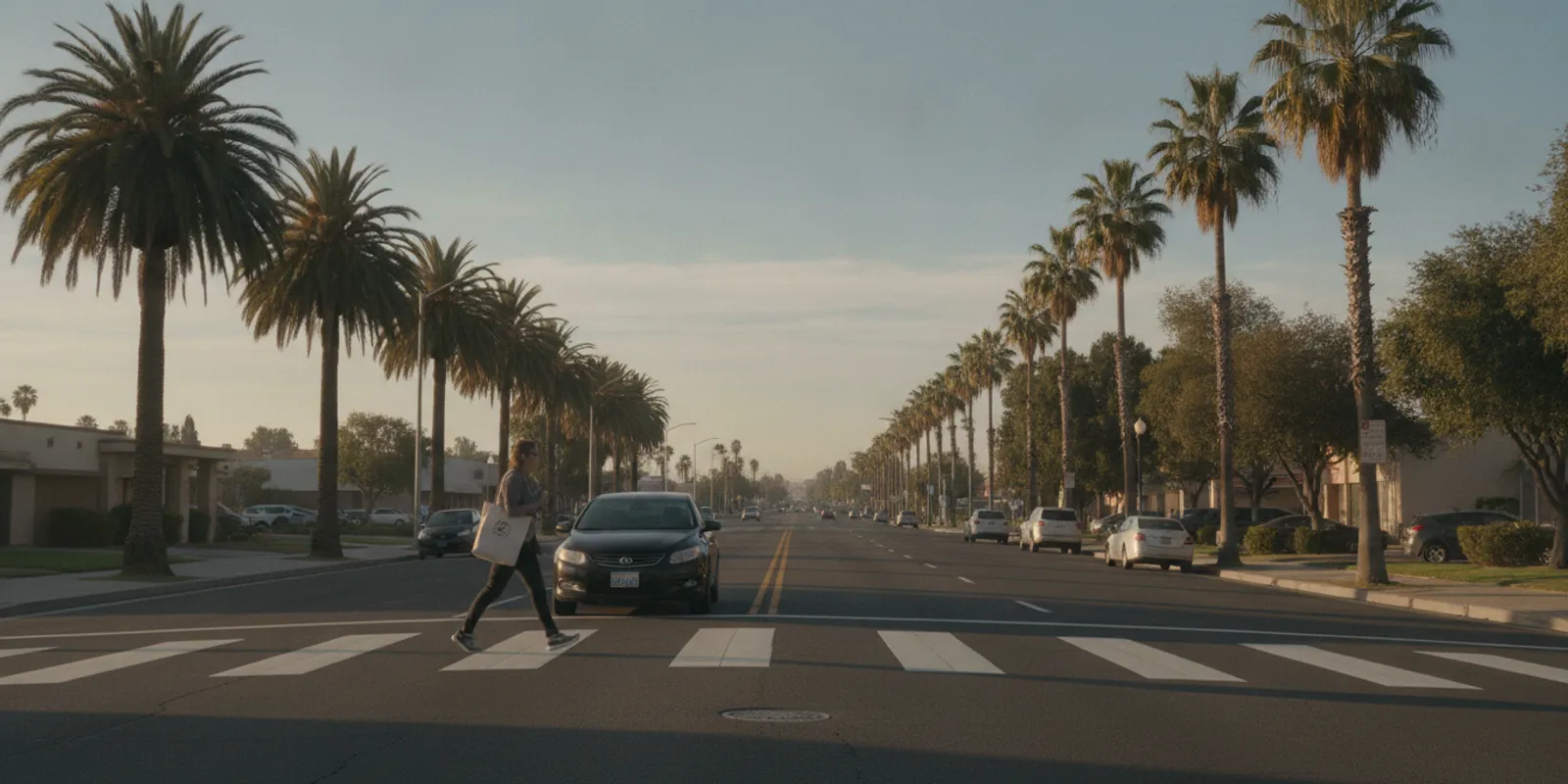
A Bakersfield pedestrian accident lawyer may review the crossing, vehicle movements, available witnesses, and records showing how an injury affected daily life. If a collision just happened, get to a safe place and seek emergency care when needed. Preserve details only when it is safe.
Contact DC Law Group to discuss a pedestrian collision
What should a Bakersfield pedestrian accident lawyer document first?
As soon as you can, write a timeline in your own words. Begin with the date and approximate time, then describe where you were going, where you entered the roadway, the direction you walked, and what you remember immediately before impact. Identify the nearest cross street or landmark rather than writing only “near Highway 99.” If the event was near the highway, distinguish an adjacent local street, frontage road, ramp area, parking access, or freeway route. Those are different settings, and a clear description helps people find the right place on a map.
Record conditions that you personally observed: daylight or darkness, weather, pavement condition, traffic flow, and anything that obstructed your view. Note what you do not remember. It is better to write “I am unsure which signal was showing” than to fill a gap with a guess. Keep your first account intact; if you add details later, date the addition rather than silently changing the earlier note.
- Photograph the crossing, signs, signal heads, curb ramps, lane markings, lighting, and visible obstructions from a safe location.
- Write down the vehicle’s color, type, make or model if known, license plate if visible, and direction of travel.
- Ask witnesses for names and contact details. Record their words as accurately as you can, without suggesting what they should say.
- Keep the responding agency name and incident or report number, then make a separate personal timeline.
- Save original photos, video, messages, and location records. Preserve the unedited files and make a backup.
Do not place yourself in traffic, approach an unsafe vehicle, or trespass to collect evidence. If you are injured or shaken, concentrate on care and safety. A family member or another trusted person may be able to note visible details for you, while marking which observations are theirs and which you later supplied.
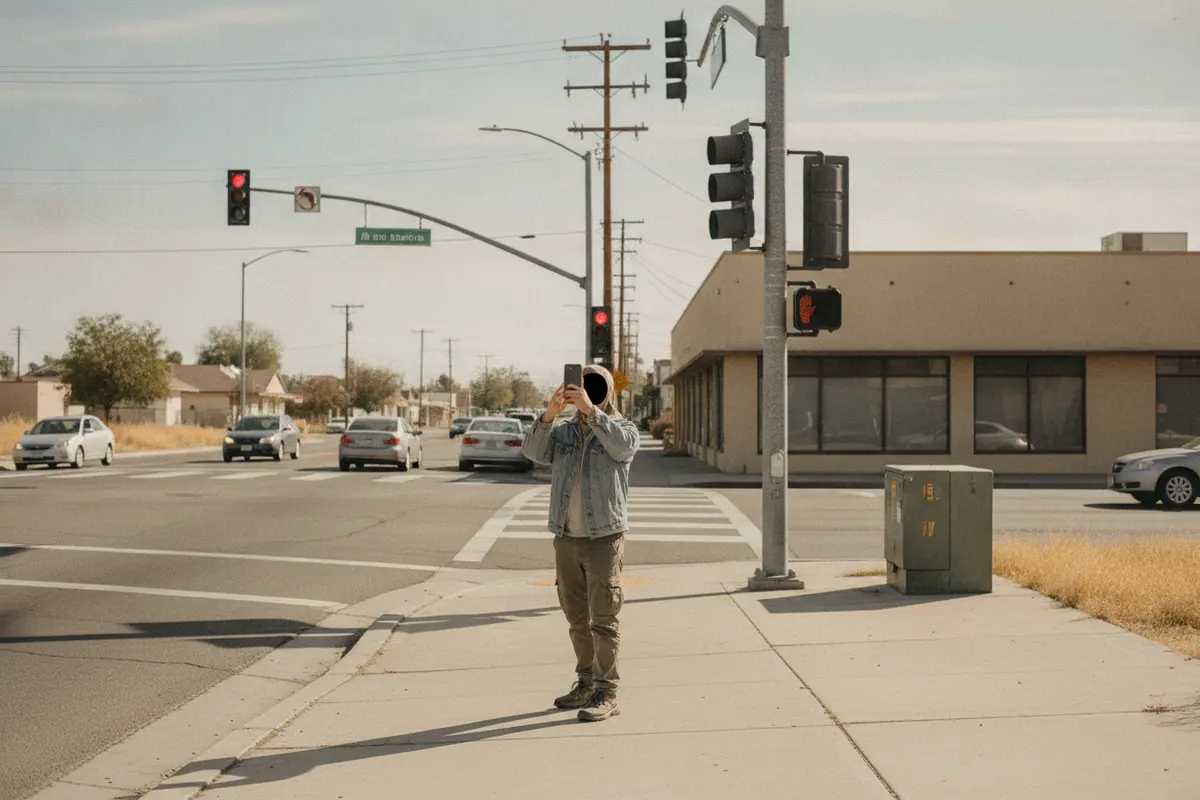
A person safely records a Bakersfield intersection from the sidewalk
Which crossing and turning-driver details may matter?
A painted crosswalk is important context, but it is not the whole account. Note whether the crossing was marked, whether a pedestrian signal or traffic light was present, where the stop line sat, and which lane the vehicle used. For a turning vehicle, record whether it turned left or right, whether it appeared to stop, and whether the pedestrian was already crossing. Describe what you saw; do not convert an impression into a definite claim about speed, distance, or timing unless you can support it.
At a signal-controlled intersection, write down the pedestrian indication if you saw it, the direction of the vehicle, and whether the signal changed during the crossing. If you cannot recall a signal phase, say so. At an unsignalized crossing, note the traffic gaps, parked vehicles, hedges, signs, construction, and other objects that could affect what a driver or pedestrian could see. The same details can help explain why two people remember an event differently.
Make a simple diagram while the layout is fresh. Draw the curb lines and lanes, mark your walking path, show the vehicle approach, and label the point of contact if known. Add a north arrow or a fixed landmark, such as a store entrance or bus stop. Keep the sketch simple and identify uncertain locations with a question mark. A map screenshot can help identify the block, but it should supplement, not replace, your own description.
California traffic statutes address driver conduct around crossings and pedestrian right-of-way. Which provision applies depends on facts such as the crossing, signal, and actions of the people involved. A collision outside a painted crosswalk does not by itself resolve every responsibility question. The current California Legislative Information code library is an official place to review statutory text; a general article cannot determine how a statute applies to a specific event.
How should you describe a Bakersfield road location?
Local road context can make the sequence easier to understand without assuming that any particular road caused a collision. Near Highway 99, separate a freeway ramp or shoulder from a frontage road, nearby intersection, business entrance, or neighborhood street. A pedestrian struck on an access street beside the highway was not necessarily on the freeway itself. Record the nearest cross streets, the side of the road, the direction you were walking, and any visible route marker.
On a neighborhood or commercial street, note driveways, parked vehicles, bus stops, school access, loading areas, and landscaping if they relate to what someone could see. Where there are several possible entrances or crossings, photograph a wide view and a closer view from a safe place. Include the direction each image faces, either in a note or in the filename. Avoid describing a feature as obstructive unless you saw how it affected the view or can explain why it may matter.
Do not assume that a location’s appearance today is identical to its appearance on the collision date. Temporary construction, parked vehicles, foliage, lighting, and signs can change. Record the date you take each photograph. If the scene has changed, note the difference and preserve any earlier images or records you already have. DC Law Group’s personal injury practice information and its pedestrian collision guide provide additional firm resources, but neither page determines responsibility for an individual event.
What if the driver leaves the scene?
Call 911 if someone needs urgent help or the scene presents an immediate danger. Give the dispatcher the location, a brief description of the vehicle, and the direction it went. Do not chase the driver or step into moving traffic to follow it. If witnesses are present and it is safe to ask, request their names and contact details or ask whether they can remain for responding officers.
Report the collision to law enforcement and retain the incident number and agency details. If you later recall a new fact, note when you recalled it and share it through an appropriate channel. Do not present something heard from another person as your own observation. A witness might have seen a plate or vehicle feature you did not, so keep the source of every detail clear.
Nearby homes, businesses, vehicles, or public facilities may have cameras. Write down possible camera locations and the time window as soon as you can; recordings may not be kept indefinitely. Do not enter private property or try to access a restricted recording. An attorney may be able to assess how a preservation request should be made. Save clothing or damaged personal belongings in their original condition when practical, and photograph them without altering them.
If you were unable to gather information at the scene, do not assume the opportunity is gone. Ask a family member to help reconstruct a timeline from messages, appointments, travel records, photographs, or other material created near the time. Label the source for each item: firsthand recollection, witness account, or later record. For more on organizing an official account, see DC Law Group’s guide to reading a California collision report .
How can injury and treatment records create a clearer timeline?
Seek medical evaluation as appropriate, even if symptoms seem manageable at first. Tell the clinician how the event occurred and describe symptoms accurately, including when each began and whether it changed. Follow the clinician’s instructions and keep visit summaries, imaging information, prescriptions, referrals, and bills. If a symptom changes or new symptoms appear, report that to the provider rather than trying to diagnose the cause yourself.
A brief daily log can help you remember effects that may otherwise blur together. Record the date, symptom, activity affected, and any help you needed. For example: “On Tuesday, I needed help carrying groceries up the stairs because walking increased pain.” That is more useful than a broad statement that you could not do anything. Include improvements as well as difficult days, and distinguish what you experienced from a clinician’s diagnosis.
If you missed work or changed duties, keep schedules, pay records, leave notices, and communications with your employer. Describe the practical effect without exaggeration: which shifts you missed, what tasks you could not perform, or what restrictions your provider gave. If a family member helped with cooking, transportation, or household tasks, note the dates and assistance provided. Those ordinary details can help tell a complete story of recovery.
Keep photographs of visible injuries only if you are comfortable doing so. Use dated originals and store them with the rest of the records. A simple file system works: one folder for scene evidence, one for care and work records, and one for correspondence. Name digital files with the date and a neutral description, such as “east-side-crossing-view.” Keep a backup and do not edit the original images. If a family member assists, ask them to preserve the original file and record who took it.
How can responsibility be evaluated?
A legal review may consider the driver’s actions, the pedestrian’s conduct, the roadway layout, signal operation, visibility, and other evidence. Depending on the facts, questions may extend beyond the driver to another potentially responsible party. This is not a conclusion that any particular person or entity is liable. A review requires reliable evidence about what happened and the law that applies.
California applies comparative responsibility principles in civil injury matters. In broad terms, responsibility may be assessed among parties rather than treated as an all-or-nothing issue, but the legal effect depends on the facts and applicable law. Do not assume that crossing outside a marked crosswalk automatically decides a claim, or that a driver’s involvement alone answers every question. Preserve specific observations, and ask a California attorney to assess how the rules may apply.
A collision report can provide observations, statements, and other useful information, but it is not necessarily a final decision about civil liability. Review it for factual details such as date, location, names, and vehicle descriptions. If you see an error, identify the exact entry and the information that supports your concern. Keep a copy of the report and any written request or response related to correcting or supplementing information.
| Record group | Examples to preserve | Question it may help clarify |
|---|---|---|
| Scene and crossing | Signals, markings, lighting, sight lines, road layout, dated photographs | What did the location and controls look like? |
| People and vehicles | Witness contacts, vehicle description, direction of travel, damage images | Who may have observed the sequence, and what vehicles were involved? |
| Care and daily life | Appointment summaries, symptom notes, work records, activity changes | What care followed, and how did the injury affect routine activities? |
| Official and claim records | Agency name, report number, letters, emails, call notes | What follow-up occurred, and what requests or dates need attention? |
The table is an organizing aid, not a checklist of proof that guarantees any outcome. A record can be useful even if it does not answer every question. Keep documents in context, preserve the date and source, and avoid writing conclusions into a photograph caption or witness note.
What should you do with insurance questions and documents?
Keep claim letters, emails, claim identifiers, and notes of calls together. For each contact, write down the date, the person or organization, what was requested, and any response date stated in writing. If a question is unclear, ask for clarification rather than guessing. Keep your account factual and concise. You can say that you do not know or do not remember a detail instead of offering a speed estimate or medical conclusion.
Before signing a release or sending records, understand what information is requested and what the document covers. A release may have consequences beyond a routine information request. Ask a California attorney to explain a document or deadline you do not understand. Do not assume that an insurance discussion changes a court or administrative deadline. Save the version you received and the version you sign, along with any related correspondence.
If different people contact you about the same event, keep their identities and requests separate. Do not rely on memory alone to track a spoken deadline: ask for it in writing and add it to a calendar. Maintain copies of anything you submit, including the date and method of delivery. These steps keep a clear record without requiring you to speculate about liability.
Ask DC Law Group to review the information you have gathered
Which California deadlines should a Bakersfield pedestrian accident lawyer check?
Legal deadlines depend on the parties and the type of claim. California generally has a filing period for civil personal injury lawsuits, while a claim involving a public entity can require an earlier administrative claim. Special rules and exceptions may apply, including in matters involving minors. Do not rely on a general article to calculate a deadline, and do not assume that an insurance exchange or informal conversation extends one.
The California Courts Self-Help Center is an official starting point for general court information. Its materials are not a deadline determination for a particular pedestrian collision. Contact a California attorney promptly to identify whether a public agency, private party, minor, or other circumstance affects the procedure or timing. Keep the date of the collision and any official notices at hand when asking.
If a road feature or public property condition may be relevant, record the exact location, the condition you observed, and when you observed it. The City of Bakersfield official website is a municipal starting point for local departments and resources. Confirm any road or reporting information with the appropriate office. A municipal web page does not establish who caused an individual collision or which deadline applies.
When preparing to discuss timing, gather the collision date, location, report number, any written notice, and the name of each party or agency involved if known. Make a list of questions rather than waiting until every record is assembled. If you learn about a possible deadline, write down who provided it and ask counsel to verify it against the facts.
How can you prepare a useful case chronology?
A concise chronology can help an attorney identify missing information. Start with the collision, then list the first care visit, follow-up appointments, communications with insurers, work changes, and any later discovery about witnesses or cameras. Use a separate line for each date. Attach or identify the source for each event, such as a visit summary, phone note, photograph, or personal recollection.
Mark each entry as firsthand memory, another person’s account, or a document. If accounts conflict, retain both rather than editing one to match the other. Write down what remains unknown: signal phase, exact location of contact, or a vehicle detail, for example. Questions and gaps are useful because they show what needs checking rather than allowing assumptions to become part of the narrative.
Before a meeting, place essential records within easy reach: a one-page timeline, scene photographs, witness contacts, report information, medical records, and claim correspondence. You need not create a polished legal argument or determine who was at fault. The purpose is to provide a clear factual starting point. DC Law Group’s appointment page offers a way to contact the team, and the firm’s California personal injury information describes its practice area.
For additional context on pedestrian-specific issues, see the firm’s pedestrian accident resource . If a vehicle was involved in a broader roadway event, its Bakersfield car collision page may also be relevant background. These pages are general resources, not a substitute for an individual review.
Frequently asked questions
Should I get medical attention if symptoms seem minor?
Seek appropriate medical evaluation, especially if symptoms begin or change. Describe the collision and your symptoms accurately, follow the clinician’s instructions, and retain records of care. A clinician, not an online article, can assess your health.
Does a collision outside a marked crosswalk decide responsibility?
No single fact necessarily resolves every responsibility question. The location, signals, visibility, roadway, and conduct of each person may matter. Preserve what you observed and seek case-specific legal guidance.
Can a police report determine civil responsibility?
A report may contain useful observations and recorded statements, but it is one source of information rather than necessarily a final civil decision. Keep a copy, note any specific factual concern, and preserve other records such as photographs and witness details.
What if a public agency may be connected to a road condition?
Public-entity claims can involve special procedures and shorter deadlines. Preserve the exact location and condition details, and promptly ask a California attorney to assess the rules that may apply.
What if I could not collect evidence at the scene?
Make a timeline from your own recollection and identify possible witnesses, camera locations, messages, and records created near the time. Clearly label information learned later and the person or record that supplied it.
Call DC Law Group at (310) 571-8860 to discuss your situation
Organize what you know, preserve original records, and mark details that remain uncertain. A Bakersfield pedestrian accident lawyer can review the available information and explain possible next steps based on the facts.