

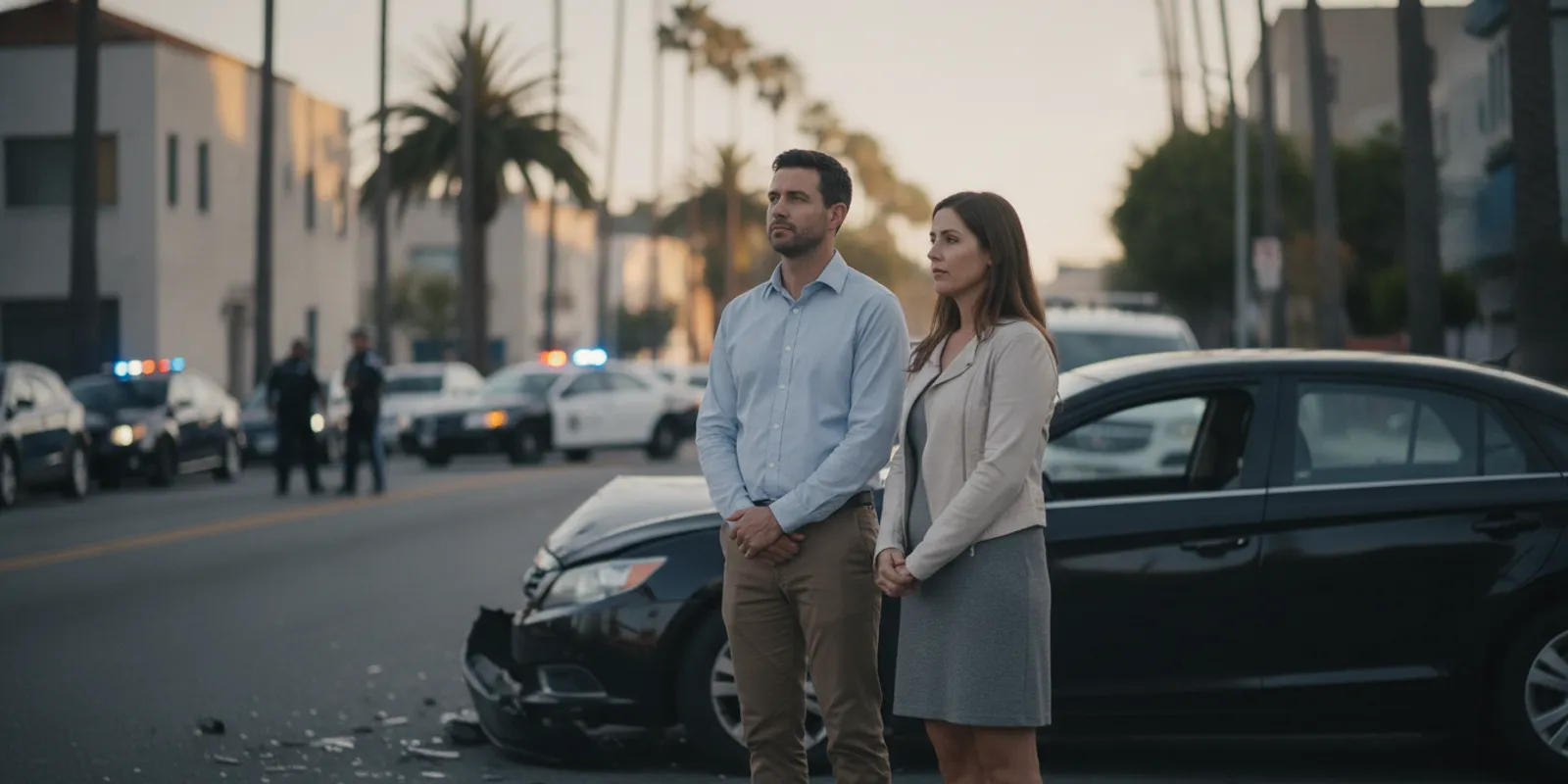
If you are searching for an uber driver hit by car lawyer california, you may be trying to sort out several urgent questions at once: how to protect your health, what to do for the rider, and which insurance policies may apply. The details of the trip in the app and the evidence from the scene can matter. This guide explains practical next steps and what a lawyer may review.
Contact DC Law Group to discuss your rideshare collision
What should you do right after the collision?
First, get to a safe place if you can. Call 911 when anyone may be seriously hurt, a vehicle blocks traffic, or emergency help is needed. Do not leave the scene simply because the rider appears uninjured or the vehicles have little visible damage. Some injuries are not obvious immediately.
Check on the passenger and follow the dispatcher’s instructions. Keep the conversation focused on safety. Do not guess about fault, make promises about payment, or argue with another driver. Exchange required identifying and insurance information, and cooperate with responding officers. If you need medical attention, prioritize it over taking photographs or collecting witness details.
- Ask the rider and other involved people whether they need emergency assistance.
- Get the names and contact details of drivers and witnesses, when safe and appropriate.
- Photograph vehicle positions, visible damage, road conditions, traffic controls, and relevant surroundings.
- Save the responding agency’s name and incident or report number, if one is provided.
- Make a prompt report through the rideshare app and follow its instructions for reporting a crash.
Keep your account factual. A brief statement that you were struck does not establish every issue in a later claim. Fault may depend on how the collision happened, what each person did, and what the available evidence shows.
Separate immediate safety from later claim questions
At the scene, it can be difficult to know whether a symptom will persist, which insurer will handle a particular issue, or whether the other driver will accept responsibility. You do not have to resolve those questions beside the road. Focus on safety, medical attention, exchange of information, and a timely crash report. Later, organize the records and answer claim questions carefully.
If the passenger is able, ask them to confirm their contact details and whether they have reported the event through their own account. Do not ask the rider to adopt your description of fault or to sign a statement at the scene. Their account is their own, and their potential injury claim is separate from yours. Keep communications civil and limited to practical needs.
Why does the trip’s app status matter?
Rideshare insurance questions can depend on the driver’s activity in the app at the time of impact. A driver who was offline may face a different coverage analysis from one who was available for a request, traveling to pick up a rider, or carrying a passenger. The precise facts, policy terms, and applicable law matter; a label in the app does not by itself resolve who caused the crash or what coverage applies.
Here, the driver says they were carrying a rider. Preserve evidence that can establish that status rather than relying on memory alone. Save the trip receipt or trip details, the ride’s start and end times, the pickup and destination information, and any crash-reporting confirmation. If the app shows a timeline or trip status, take screenshots and keep the original records where possible. Do not edit or delete relevant messages.
An injured driver may have a potential claim against a driver whose negligence caused the collision. Depending on the circumstances, questions may also arise about coverage associated with the rideshare trip or another responsible party. A lawyer can examine the policies and facts; the existence of a rideshare trip does not automatically mean a particular insurer will accept responsibility.
For example, imagine a driver has accepted a trip and a passenger is in the vehicle when another car enters an intersection. The driver’s account, the passenger’s account, the app timeline, intersection images, vehicle damage, and any available signal or roadway evidence may each help establish what happened. An insurer may also ask whether the ride was active at the precise time of impact. Saving the trip record promptly can help avoid relying on an incomplete recollection later.
| Trip situation at impact | Records to preserve | Questions for an insurance review |
|---|---|---|
| Driver was not using the app for a trip | App activity history, messages, and time-stamped scene evidence | Which personal or other policy may respond, and what exclusions or conditions apply? |
| Driver was available for a ride request | App status, request notifications, and any trip activity shown | How does the exact app period affect potentially applicable coverage? |
| Driver had accepted a request or was traveling to pick up a rider | Accepted-trip details, route, pickup information, and report confirmation | Which policy terms apply to this stage, and who is investigating the collision? |
| Driver was carrying a passenger | Trip receipt, passenger details, trip timestamps, and crash report | How will the driver’s injury claim and any passenger claim be handled separately? |
The table is a starting point, not a coverage determination. Insurers may ask for information from different sources, and their conclusions can depend on the policy language and evidence. Do not assume that a claim is covered or denied just because an adjuster describes the trip in a particular way.
Build a trip-status timeline
Write down the sequence while it is still clear: when you logged in, whether you received or accepted a request, when the passenger entered the vehicle, the approximate collision time, and when the ride ended or was interrupted. Compare your notes with the app history and receipt. If two records show different times, preserve both and note the discrepancy rather than changing one to match the other. The difference may have a simple explanation, but it should be reviewed, not concealed.
Keep a copy of any in-app messages and the confirmation that you reported the collision. If a record is available only temporarily, save it promptly in a secure location. Do not post private trip details, passenger information, or photographs of the crash on social media. Preserve the unaltered original files and make a separate working copy if you need to mark up an image or timeline.
Who may be responsible for the crash?
Being hit while carrying a rider does not automatically make the other driver legally responsible. A claim generally requires evidence supporting negligence and a connection between the conduct and the injury. For example, relevant facts may include whether a driver failed to yield, changed lanes unsafely, followed too closely, or ignored a traffic signal. The circumstances must be investigated rather than presumed.
More than one person or entity may need to be considered. The other motorist may dispute fault, and an investigation may raise questions about another vehicle, road conditions, or the conduct of multiple drivers. If the rideshare driver’s actions are also examined, comparative fault may become an issue. California claims can involve a division of responsibility, so a disagreement about fault is not resolved solely by the fact that one vehicle struck another.
Keep any statements to insurers accurate and limited to what you know. You can say that you need to review records before answering a detailed question. Avoid speculating about speed, distance, or what another driver saw. If you receive a release, recorded-statement request, or settlement proposal while still learning about your injuries, consider getting legal advice before responding.
What evidence may clarify disputed responsibility?
Look for facts that can be checked independently. The point of preserving evidence is not to prove a conclusion in advance; it is to make it possible to evaluate competing accounts. A photograph of a damaged bumper may show the location and direction of impact, but it cannot by itself establish which driver had the right of way. A witness may recall a traffic signal but not the exact speed of either vehicle. Each item has limits, and the pieces should be considered together.
- Intersection and roadway details: Note lane markings, signs, signals, sight lines, road work, lighting, and anything that may have obstructed a view.
- Vehicle positions: Record where each vehicle stopped, if known, and photograph debris or skid marks before they are disturbed, but only from a safe location.
- Independent witnesses: Save contact information and a brief note about what each person says they observed. Do not coach or pressure a witness.
- Video sources: Identify nearby businesses, residences, transit vehicles, or other potential cameras. Ask promptly how to preserve footage; some systems overwrite recordings.
- Damage patterns: Photograph all sides of each vehicle and keep repair or inspection documents. Avoid treating a damage pattern as a complete reconstruction of the event.
If the other driver leaves before information is exchanged, report that fact to law enforcement and the rideshare platform. Write down the vehicle description, direction of travel, and any partial plate information you remember, clearly distinguishing what you saw from what someone else reported. Do not chase the vehicle or put yourself or the passenger at risk.
What evidence can help document an Uber driver’s injury claim?
Evidence is easier to preserve close to the collision. It can also help clarify how the crash occurred, whether the driver was carrying a rider, and how the injuries affected daily life. Keep a copy of records in a place you control, not only within an app that could change or become inaccessible.
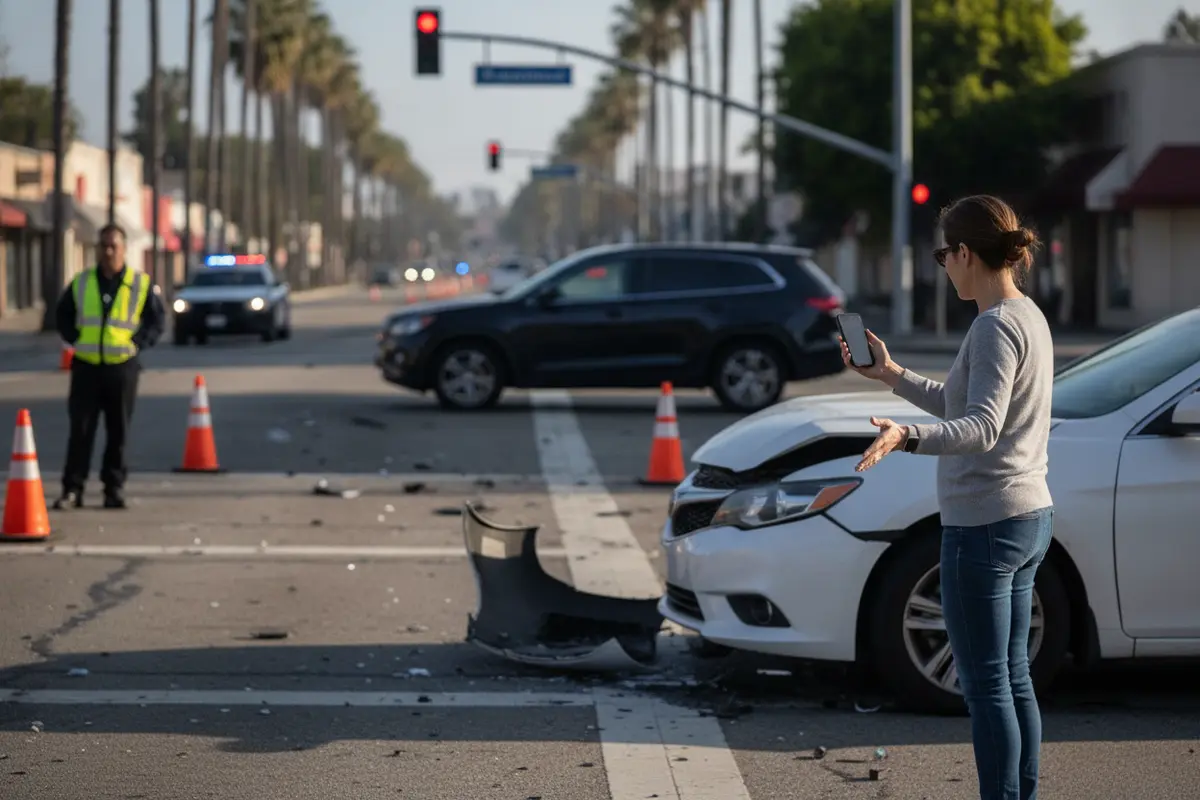
Rideshare driver documenting vehicle damage and the collision scene
- Trip records: Preserve the app status, ride receipt, trip timeline, pickup and drop-off details, and communications about the ride.
- Scene evidence: Keep photographs, witness contact details, nearby camera information, and notes about weather, visibility, traffic, and road layout.
- Official records: Save the incident number and request information about obtaining the collision report. A federal appellate court filing describes allegations that another vehicle struck an Uber vehicle during a ride; it is an example of a recorded collision account, not a statement of California law or a decision about your claim. Read the court filing.
- Medical documentation: Get appropriate medical evaluation and follow the provider’s instructions. Retain visit summaries, referrals, and records of symptoms or limits on activity.
- Work and daily-life records: Keep schedules, earnings records, and notes showing missed work or tasks you could not perform. Do not alter records or estimate details you cannot verify.
- Vehicle and device records: Preserve repair or inspection documents, dashcam footage, and relevant communications. Back up original files and note when and where they were created.
A short, consistent log can help you remember changes in pain, appointments, work interruptions, and daily limitations. Write down dates and concrete effects rather than trying to diagnose yourself. Tell a medical provider about symptoms, even if you are unsure whether they came from the collision.
Organize records so the timeline is understandable
Use separate folders for trip data, collision evidence, medical care, work records, and insurance correspondence. Give each file a clear name that includes its date and type, such as the date of the scene photograph or the date of an appointment. Keep original photos and messages intact. If you add explanatory notes, save them as a separate document so an original record is not confused with a later annotation.
For a work interruption, preserve the schedule or dispatch record that shows what you were expected to do, along with any available earnings statements and a record of the hours you missed. Do not assume a single day’s record explains a longer period away from work. If you returned with restrictions or reduced hours, save the corresponding records and note who issued the restriction. A lawyer can help identify which materials may be relevant without asking you to create evidence that does not exist.
Medical records and your own symptom notes serve different purposes. The treatment record documents what you told a provider and the care given. A personal log can help you recall changes between visits, such as difficulty lifting, sitting, sleeping, or driving. Keep it factual and dated. Never change a prior entry to make your account appear more consistent; add a dated correction or clarification instead.
Talk with DC Law Group about your Uber collision
How should you handle calls from insurance companies?
Several insurers may contact you: the other driver’s insurer, a rideshare-related insurer, or your own carrier. Ask who is calling, which company they represent, and what claim they are discussing. Record the caller’s name, contact information, claim number, and any requested documents.
Provide required information truthfully, but do not fill gaps with guesses. You may ask for a request in writing and take time to understand it. Be cautious about signing broad medical authorizations or releases before you understand their scope. A recorded statement can become part of the claim file, so it is reasonable to ask what the statement concerns and to seek legal guidance before giving one.
Keep the claims and requests separate
Different claims can involve different people and evidence. The driver’s bodily-injury claim is not the same as a passenger’s claim, and a vehicle-damage matter is not the same as an injury claim. If the rider was hurt, they may need to make their own report and obtain independent guidance about their situation. Avoid speaking on the passenger’s behalf or assuming their interests and yours are identical.
When a caller asks for documents, ask which claim the request concerns and whether copies will be sufficient. Keep a dated record of what you sent, to whom, and how. Do not send another person’s medical information or personal data unless you understand why it is requested and have authority to provide it. If two adjusters give inconsistent instructions, note both instructions and seek clarification rather than choosing one at random.
Be cautious with early settlement discussions if the nature or duration of your injuries is not yet clear. A release may affect rights, so read it and understand its scope before signing. Do not treat a request for quick paperwork as proof that a claim is simple. You may ask for time to review documents and get advice.
What should you know about deadlines and claim steps?
Legal deadlines depend on the type of claim, the parties, and the facts. A claim involving a public entity may follow a different and shorter procedure than a claim against a private driver. Insurance reporting requirements can also be separate from court filing deadlines. Do not rely on a general online article to calculate a date for your case. Preserve the relevant documents and ask a California personal injury attorney to identify deadlines that apply to your circumstances.
A lawyer reviewing a rideshare collision may gather the app records, crash report, photographs, witness accounts, medical documentation, and insurance information. The review can help identify disputed facts, potentially responsible parties, and questions to raise with insurers. DC Law Group represents people in California personal injury matters, including rideshare accident cases. Learn more about the firm’s Uber and Lyft accident representation or read about issues that can arise after an Uber collision.
A consultation is an opportunity to explain what happened and ask what information may help evaluate the matter. You can organize a short timeline before the conversation: when the trip began, where the collision occurred, what you observed, who responded, and when you sought care. Bring the documents you already have; do not delay urgent medical care or ignore an approaching deadline while gathering a perfect file.
You may also find it useful to compare the collision report with your own notes. Check the listed date, time, location, vehicle descriptions, and parties for apparent errors. A report is an important record, but it is not necessarily a complete account of every fact or a final determination of legal responsibility. If a detail appears inaccurate, ask the appropriate agency about its process for correcting or supplementing the record and keep a copy of any response.
DC Law Group’s car accident practice information may also help explain the firm’s broader motor-vehicle representation. The right review should account for the distinct facts of a rideshare trip rather than treating every crash as identical. To prepare, list the questions you want answered: which records matter, what steps remain, which insurers are involved, and whether any deadline requires prompt attention.
When can a California Uber driver hit by a car lawyer help?
Legal assistance may be useful when the other driver disputes fault, an insurer questions whether a ride was active, several policies may apply, or injuries affect your ability to work and manage daily tasks. A lawyer can review the evidence, explain the issues that may need investigation, and communicate about the claim. The facts of each collision differ, and no article can predict the outcome of a particular case.
Bring what you have rather than waiting until every record is complete. A basic timeline, trip receipt or screenshots, report number, photographs, medical paperwork, and insurer correspondence can provide a starting point. If a document is missing, note that fact and when you requested it. A clear list of unknowns can be just as useful as a file of completed records because it helps identify what may need follow-up.
Before a call, consider writing down a concise account in chronological order. Separate what you personally saw from what the passenger, another driver, or a witness told you. Include the point when you first noticed symptoms and the date you sought care, if applicable. This approach helps keep the discussion focused without forcing you to guess at details you cannot recall.
Ask DC Law Group about a California rideshare injury claim
Frequently Asked Questions
Can an Uber driver make an injury claim if another vehicle hit them?
Possibly. The driver may have a claim against a person whose negligence caused the collision, but liability and available coverage depend on the evidence, injuries, and policy terms. Being hit does not by itself establish fault or guarantee a particular result.
Does carrying a passenger automatically determine which insurance applies?
No. The trip status is important evidence, but coverage depends on the exact circumstances and policy language. Preserve the trip record and have the relevant policies reviewed rather than assuming a particular insurer must pay.
What if I do not feel injured until later?
Seek medical evaluation when symptoms arise and explain that they followed a collision. Keep a record of when symptoms began and how they change. Do not wait to get care solely because the vehicle damage appears minor.
Should I give the other driver’s insurer a recorded statement?
Do not guess or agree to a statement without understanding the request. Ask who the adjuster represents and what the statement will cover. Consider speaking with an attorney before providing a recorded account, especially when fault or the extent of injury is disputed.
What records should I bring to a lawyer?
Bring the trip receipt or app screenshots, collision report information, photographs, witness details, insurer correspondence, and medical records you have. A timeline of events and symptoms can also help. An attorney can tell you what additional documents may be relevant.
Contact DC Law Group to discuss your next step
If you were struck while carrying a rider, preserving the trip details and getting appropriate medical attention can help protect a clear record of what happened. The specific evidence and insurance terms should be reviewed in light of your circumstances.