
A slick tile floor in a busy California shopping mall can change a life in a single second. When you step into a puddle or trip over a loose rug, the pain is sharp and the recovery is long. You need to know your rights.
A slip and fall lawyer California shopping mall expert can help you show that a store is at fault if you get hurt on their site. In California, store owners owe a duty of good care under the Verdugo v. Target rule. This means mall owners must find and fix dangers like spills or broken tiles before they cause a fall. If a store has notice of a risk but fails to warn you, they are liable under the Ortega v. Kmart case. This proof is key to your case. A firm led by David Cohan that works for no fees unless we win helps your rights stay safe while you heal.
REQUEST A FREE CONSULTATIONIf you or a loved one has been injured at a California shopping mall, contact DC Law Group for a free case evaluation. Our experienced premises liability team will fight to hold the property owner accountable.
When you fall in a large retail center, you may wonder who will pay for your care. You must know which party is at fault so you can file a claim. The key question is who controlled the area where the accident occurred.
Who Is Legally Responsible for a Slip and Fall at a California Shopping Mall?
California premises liability law holds shopping mall owners and operators legally responsible when a customer is injured due to a hazardous condition on the property. The mall owner owes a duty of reasonable care to all visitors, which includes regularly inspecting the premises, cleaning up spills promptly, and warning guests about known dangers. Liability depends on proving the owner had actual or constructive notice of the hazard and failed to address it within a reasonable time.
When you walk into a shopping center, you should not have to worry about your safety. California law places a clear duty on those who own and run these sites. If you get hurt, the first question is who had control over the area where you fell. A slip and fall lawyer California shopping mall expert can help you find the right party to hold at fault.
The duty of care for mall owners
California follows a rule of care that applies to all business owners. This rule says that people who open a site to the public must keep it safe. In the case of Verdugo v. Target Corp., the court held that owners owe a duty of fair care to their guests. This means the mall must take active steps to find and fix risks.
They cannot just wait for someone to report a spill. They must look for leaks on their own. This duty covers many parts of the mall, such as the stairs and bathrooms. If the mall owner knows about a broken rail or a slick floor, they must act fast. They need to fix the issue or warn you about it.
If they leave a hazard in place, they may be at fault for your harm. This is the main point of most mall injury claims. If you have been hurt, a slip and fall lawyer can help you build a case. They can look at the facts and see if the owner met their duty.
Common areas and store units
Blame at a big mall can be tricky. This is because a mall has many different parts. Most malls have a main owner who handles the "common areas." These are the spaces that all shoppers use. Think of the main hallways, the lifts, and the parking lot.
If a light is out in the parking lot and you trip, the mall owner is likely to blame. But the rules change once you walk through a store's front door. Most shops at the mall are tenants. They sign a lease that gives them control over their own space.
If you slip on a spilled drink inside a cafe, that cafe owner is usually at fault. They have a duty to keep their shop floor clean and safe for you. Sometimes, you might even hold both the mall and the shop at fault. This can happen if a leak from above causes a spill in a shop below. Learning about premises liability legal requirements helps you see how these roles work.
Notice and mall owner fault
To win a claim, you must prove that the owner failed in their duty. The law says the owner must have "notice" of the danger before they can be held at fault. In Ortega v. Kmart Corp., the state's highest court set the rule for this point. They held that an owner must have notice of a risk to be liable for an injury.
This rule prevents owners from being sued for accidents that no one could have stopped. Actual notice means the mall staff saw the spill or someone told them about it. Constructive notice is different. It means the hazard was there for such a long time that the staff should have found it.
Malls are expected to run regular checks of their floors. If they go hours without looking at a busy walkway, they may be at fault for any leaks that occur. A slip and fall lawyer California shopping mall specialist can use mall logs and video to show how long a hazard was present. This proof is vital for your claim.
What Must You Prove to Hold a Mall Owner Liable?
To hold a California shopping mall owner liable for a slip and fall injury, you must prove four key elements: the owner owed you a duty of care, they breached that duty by failing to maintain safe premises, their breach directly caused your fall, and you suffered actual damages as a result. The most critical element is showing that the owner had notice of the dangerous condition and enough time to fix it or warn you before you fell.
When you are hurt at a shopping mall, you cannot just say that you fell. To get help with your medical bills and other losses, you must show that the owner or manager was at fault. In California, this means you need to prove that the property owner knew or should have known about the danger that caused your fall. A slip and fall lawyer can help you gather the facts to meet these legal requirements.
Your burden of proof in California
The person who is hurt has the duty to prove their case. This is called the burden of proof. You must show that the mall owner failed to act with reasonable care. According to the California Supreme Court in Ortega v. Kmart Corp., a plaintiff must prove the owner had notice of the defect in time to fix it. If you cannot show this, the mall might not be held responsible for your injuries.
There are two types of notice you can prove. The first is actual notice. This means the owner or a mall worker saw the spill or hazard before you fell but did not clean it up. The second is constructive notice. This means the danger was there for so long that the owner should have found it during a normal check. Proving premises liability legal requirements often depends on these details about time and awareness.
Constructive notice and reasonable inspections
In many mall accidents, the owner claims they did not know about the spill. However, California law does not let owners ignore their property. If a mall fails to inspect its floors for a long time, the law may assume they had notice of the risk. This comes from the idea that a lack of regular checks supports an inference that the hazard was there long enough to be found.
The court in the Ortega case made it clear that failure to inspect the premises within a reasonable time is enough evidence for a jury to find the owner at fault. This helps people who get hurt because it places a duty on the mall to stay alert. If a mall goes hours without checking a food court for spills, they may be liable even if no worker saw the specific mess that caused your fall.
Time to discover vs. time to warn
There is a key difference between the time it takes to find a hazard and the time it takes to warn people. Once a mall worker finds a spill, they must act fast to warn shoppers. They might put out a yellow sign or block off the area. If they wait too long to warn you after they know about the danger, they have failed in their duty.
The time to discover is also vital. A mall owner must have enough time to find and fix the problem before they are at fault. For example, if a shopper drops a drink and you slip one second later, the mall may not be liable. But if that spill stays there for twenty minutes, the mall owner should have found it during a routine walk. A lawyer will look at security tapes and cleaning logs to see how long the danger was present.
Actual Notice vs. Constructive Notice at a Glance
- Type of Notice: Actual Notice; Definition: The mall owner or staff directly knew about the hazard before your fall.; Example in a Mall Setting: A food court employee saw a spilled soda near the drink station but did not clean it or place a warning sign.; How You Prove It: Security camera footage showing the spill and staff walking past it; incident reports; witness statements.
- Type of Notice: Constructive Notice; Definition: The hazard existed long enough that the mall owner should have discovered it through reasonable inspection.; Example in a Mall Setting: A puddle of water from a leaking ceiling tile in a corridor remains for over 30 minutes during business hours with no staff inspection.; How You Prove It: Cleaning logs with gaps between rounds; testimony showing no floor checks occurred; evidence the condition was visible and ongoing.
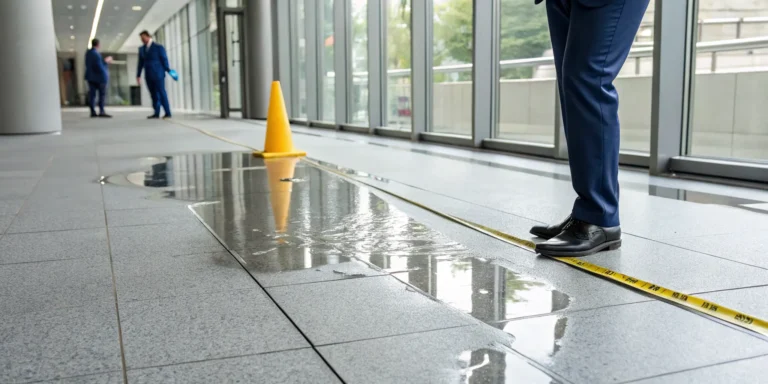
Wet floor with a caution cone at a California shopping mall
Wet floors in mall food courts are a leading cause of slip and fall accidents across California.
Understanding which type of notice applies to your case is essential. A skilled premises liability lawyer will examine the evidence to determine which theory of liability gives you the strongest path to recovery.
Common Slip and Fall Hazards in California Shopping Malls
California shopping malls contain numerous hazardous conditions that commonly cause slip and fall accidents, including wet floors from spills or tracked-in rainwater, uneven pavement in parking lots, loose or torn carpeting, poor lighting in stairwells and corridors, and cluttered walkways from merchandise displays. Mall owners have a legal duty to identify these dangers through regular inspections and take prompt corrective action to protect shoppers from harm.
Large retail centers face constant foot traffic. This creates many chances for unsafe spots to form on the land. Mall owners must keep their space safe for all guests. Under California law, store owners owe a duty of reasonable care to their guests. When they fail to fix known risks, people get hurt. A skilled slip and fall lawyer can help you find who is at fault for these risks.
Spills and wet floors in food courts
Food courts are some of the most risky spots in a mall. Liquid spills from soda or soup often hit the tile floors. Grease from cooking can also make floors very slick. If a worker does not clean a spill fast, a guest may slip. This often happens near drink stations or trash cans. You might also find wet spots near mall doors on rainy days. When rain water tracks inside, the smooth floors become like ice.
Mall staff must check these areas often. If they mop a floor, they must put up a bright yellow sign. A wet floor with no sign is a major risk. Many shoppers do not see clear liquids on the ground until they fall. Think of a busy lunch hour at a mall in Santa Anita. A spilled drink near the trash can go unseen for a long time. These falls can cause broken bones or head harm.
Walking path dangers and store displays
The paths between stores should stay clear and flat. But many malls have uneven spots in the floor or pavement. Parking lots often have cracks or raised edges in the cement. In the dark, these small lips are hard to see. Poor lighting in stairwells or parking decks makes it even worse. A person can trip on a curb they did not see while walking to their car at a Costa Mesa mall.
Inside stores, displays can also cause trips. Shops often put low racks or boxes in the aisles to grab your eye. Some common hazards include:
- Low racks that stick out into the walking path.
- Stacked boxes left in the aisles for restocking.
- Loose rugs or mats at the shop doors.
- Wires or cords that run across the floor.

Shopper walking near an escalator in a California shopping mall
Escalators, uneven flooring, and poor lighting create dangerous conditions for mall visitors.
If a display sticks out too far, it blocks the path. You might catch your foot on a low corner while you shop for clothes. These hidden traps are a common cause of mall harm in California. If a store in an Ontario outlet mall packs too much stock in the aisle, a trip is likely to happen.
Mechanical issues and poor upkeep
Malls rely on machines like escalators and lifts to move people. If a mall does not service these units, they can fail. An escalator that stops fast can throw a rider to the floor. Loose steps or handrails also pose a threat. These issues often come from poor upkeep by the mall team. Mall owners must fix these tools to keep the public safe. A jerk or sudden stop on a lift in a Glendale mall can cause bad neck or back harm.
Neglect shows up in other ways too. Broken tiles or loose floor boards are also unsafe. Each of these risks shows a lack of care for guest safety. If you fell due to one of these risks, you may have a legal claim for your losses. You should talk to a lawyer to see if the mall team failed to meet their duty to keep you safe.
What Compensation Can You Recover in a California Mall Slip and Fall Case?
Victims of slip and fall accidents at California shopping malls can recover both economic and non-economic damages. Economic damages cover medical expenses, lost wages, and future medical expenses. Non-economic damages compensate for pain, suffering, and reduced quality of life. In cases where mall security was inadequate, punitive damages may also be available. Most cases resolve through settlement, but a trial may be necessary if the insurance company refuses to offer fair compensation.
If you fall at a shopping center, you can seek compensation for your losses. These are called damages. In California, these fall into two groups. Economic damages pay for your bills. Non-economic damages pay for how the fall changed your life.
Economic Damages and Financial Losses
Medical bills are often the largest part of a claim. This includes your ER visit, surgery, and therapy. It also pays for future care if your injury is long term. To get the full value of your case, you must show proof of every bill. A slip and fall lawyer can help obtain these records for the claim. You can also seek pay for lost wages. If your injury keeps you from your job, the mall owner may have to pay for that missed time. This also applies if you can no longer work the same way as before. This loss of work power can be a large sum in a serious case.
Non-Economic Damages and Security Failures
Pain and suffering is a common non-economic damage. This covers body pain and mental stress. It also covers the loss of being able to enjoy your daily life. While these do not come with a bill, they are still real. A lawyer experienced in slip and fall claims can help you evaluate these life changes. In some cases, your fall might be tied to poor security. For example, if a mall has bad lights in a dark lot, it might lead to a fall. California law looks at "foreseeability" to decide if a mall owner is at fault for crimes on the land. According to the court in Ann M. v. Pacific Plaza Shopping Center, the duty to protect people depends on how likely the harm was to happen. If a mall knew about a risk but did nothing, you may get more pay.
Settlement vs Trial Outcomes
Most mall fall cases end in a settlement. This means the mall's insurance firm pays you an amount to end the case. Settlements are faster and have less risk than a trial. But if the firm offers too little, your lawyer may take the case to court. A jury trial can result in a higher payout, but it takes much more time. Working with a slip and fall lawyer California shopping mall helps you find the best path. They can weigh the risk of a trial against the speed of a deal. Their goal is to make sure you get enough funds to cover your needs. They will fight to hold the mall owner at fault for every part of your injury.
How DC Law Group Can Help After a California Shopping Mall Accident
DC Law Group provides dedicated legal representation for California shoppers injured in mall slip and fall accidents. Managing Attorney David Cohan personally handles each case, reviewing security footage, interviewing witnesses, and building a thorough liability claim against the responsible property owner. The firm works on a contingency fee basis, meaning you pay nothing unless they win your case.
Filing a claim after a mall fall can feel like a heavy burden. Shopping malls are owned by large firms with deep pockets and many lawyers. You need a team that knows how to stand up to these big groups. DC Law Group deals with California law for slips and trips. We help you move through the legal path from the first day until your case is over.
Direct Attorney Support from David Cohan
Many law firms pass their work off to staff or office help. At DC Law Group, Managing Attorney David Cohan works on your case himself. He handles the small facts and speaks with you about your goals. This direct care ensures that your story is heard and your rights are safe. Having a lead lawyer on your side can make a big change in the final result of your claim.
David Cohan knows how a slip and fall lawyer can win your case by looking at the fine details. He reviews mall safety tapes and talks to people who were there. Our firm looks for proof that the mall owner failed to keep the floors safe. This hands-on work helps us build a case that is hard to ignore. We strive to give every client the elite legal help they expect and deserve.
Access to Care and Financial Help
A bad fall can lead to high health expenses and lost time at work. We know that you may need help right away. DC Law Group offers 24-hour financial support for people who are hurt and struggling. This aid helps cover your basic needs while we work on your legal claim. We want to remove the stress of bills so you can focus on your health.
Our team also helps plan your health care and rides. If you cannot drive to a doctor, we will help you find a way to get there. We work with a network of health experts to make sure you get the right tests and care. Our goal is to see you reach a full healing as soon as we can. We handle the phone calls and the forms so you can rest easy.
Proven Success in California Law
California law is clear about the duties of a store owner. Shops owe a duty of care to protect their shoppers from harm. This includes quick checks for spills and broken floors. When a mall fails in this duty, we are ready to hold them at fault. Our firm has a deep knowledge of the local rules that apply to shopping centers in the state.
We believe that all people should have access to a skilled slip and fall lawyer after they get hurt. That is why we work on a "no win, no fee" plan. There are No Fees Unless We Win your case. You do not have to pay anything out of your own pocket to start your claim. This "No Fees Unless We Win" rule means our success is tied to yours. We fight hard because we believe in your case and your right to justice.
Frequently Asked Questions
Who is responsible for a slip and fall at a shopping mall?
Under California law, a mall owner has a legal duty to keep their store safe for guests. This is known as a duty of reasonable care. According to the California Supreme Court, business owners must protect their customers from harm. If a mall or store owner fails to fix a known danger, they may be liable for any injuries that happen. This rule applies to common areas, parking lots, and each shop.
How do I prove a mall owner was negligent?
To win your case, you must show that the owner knew about the danger. This is called actual notice. You can also prove they should have known about it, which is known as constructive notice. Based on the ruling in Ortega v. Kmart, you have the burden to prove the owner had enough time to fix the defect. You must show that a lack of care caused your fall and your harm.
What if the mall owner did not inspect the floor?
Mall owners must check their floors often to find spills or trash. If an owner fails to inspect the area for a long time, the law may assume they were negligent. According to Stanford Law, a lack of inspections can prove that the danger was there long enough for the owner to find it. You do not always need to prove exactly how long the floor was wet if the owner failed to do their job.
Can I sue a mall for an injury caused by another person?
You may be able to sue a mall for a crime or attack if the risk was known. In California, mall owners must protect guests from third-party acts if they are foreseeable. As stated in Ann M. v. Pacific Plaza, the court looks at the risk and the burden of safety steps. If a mall had many past crimes but failed to add security, they might be held liable for your injuries.
Ready to discuss your shopping mall slip and fall case?
Medical bills and lost wages can pile up fast after a bad fall, and property owners often clean up the mess right away. This makes it hard to prove what happened if you wait, but starting now helps us find video and talk to people who saw it. You should not have to deal with bills for an injury that was not your fault while you focus on your health. Our team will handle the insurance firms for you and work to get a fair result for your pain and suffering. Acting fast ensures that we can keep the facts of your case safe before they fade away and help you win your claim.
REQUEST A FREE CONSULTATION