

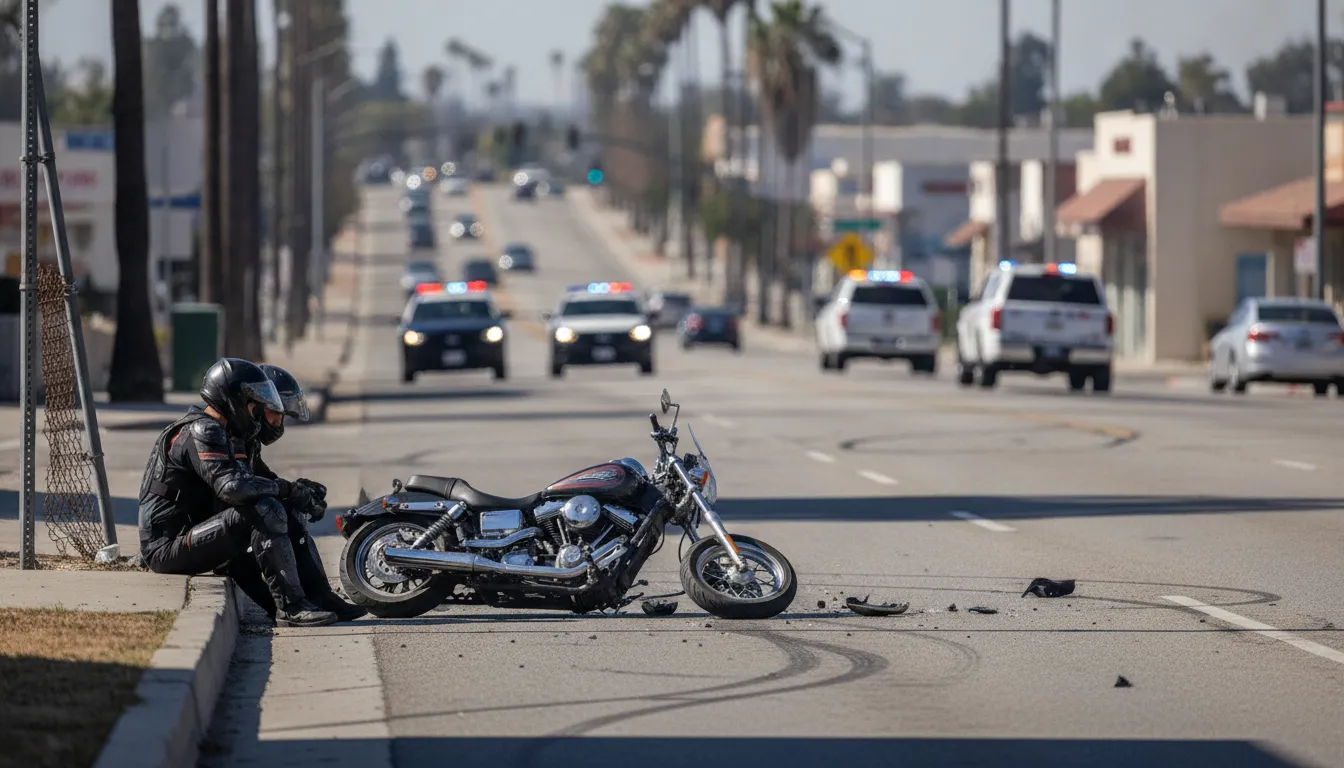
A motorcycle crash in Riverside can leave fault contested before the physical injuries are fully understood. Insurance arguments may focus on lane position, visibility, speed, or protective equipment, but a motorcycle's presence does not establish negligence. The relevant questions are what each person did, what each person could reasonably see, and what the collision evidence shows.
A riverside motorcycle accident lawyer evaluates liability through the available evidence, including vehicle and lane positions, witness accounts, scene photographs, medical records, and the sequence of events. California's comparative negligence rules make that analysis important because damages may be reduced by any negligence attributed to the injured rider. Call DC Law Group at (310) 571-8860 for a case evaluation.
That evaluation should also account for rider bias. The first step is separating assumptions from proof, then testing whether the evidence supports a driver's turn, lane change, or other alleged explanation of the collision.
How a Riverside Motorcycle Accident Lawyer Evaluates Liability and Rider Bias
Liability begins with evidence, not assumptions about the person riding the motorcycle. In a Riverside collision, the analysis generally asks whether another person or entity owed a duty of reasonable care. Breached that duty, and caused the crash and resulting injuries. California motorcycle claims can be disputed, so the injured rider must connect the alleged negligent conduct to both the collision and the injuries. That causation question is separate from the severity of the impact or the understandable concern that a rider may be blamed simply because a motorcycle was involved. See the motorcycle accident representation page for the broader service context.
For example, the investigation may examine whether a driver turned left across the motorcycle's path, changed lanes unsafely, or struck the motorcycle from behind. It may also consider whether a slippery roadway or another hazardous condition contributed to the event. Those possibilities do not establish fault by themselves. They identify questions that must be tested against the collision scene, vehicle damage, lane placement, photographs, witness accounts, traffic footage, and other available records. A careful review can help distinguish what each person could see, where each vehicle was positioned, and how the impact occurred. NHTSA recognizes that motorcycles present size and visibility challenges, which makes driver awareness relevant to the analysis. But a visibility issue still must be evaluated through the facts of the particular crash. See NHTSA motorcycle safety guidance.
Rider bias can enter a claim when an insurer, witness, or other decision-maker treats speed. Protective equipment, lane position, or the rider's choice of motorcycle as proof of negligence without reliable support. A motorcycle's presence does not establish that the rider was careless. The relevant questions are more precise: What did the rider do immediately before the impact? What did the other driver do? Were traffic controls, roadway conditions, or visibility factors involved? Is there evidence that another party also contributed to the collision? Multiple parties may share accountability, and liability, comparative negligence, and damages depend on the evidence and circumstances of each collision. In Riverside, a fact-specific record is especially important when early statements or incomplete reports leave room for stereotypes to replace reconstruction. The goal is not to excuse proven misconduct. It is to evaluate duty, breach, causation, and each party's conduct using collision evidence rather than a generalization about motorcyclists.
Why Lane Positioning and Visibility Matter After a Riverside Motorcycle Crash
A collision record should show where each vehicle was, how it was moving, and what each driver could reasonably observe. Lane placement can help explain whether a motorcycle was traveling within its lane, changing position, or approaching an intersection when the impact occurred. It does not, by itself, establish negligence. The legal analysis must connect the conduct at issue to the collision and the injuries that followed.
Turning movements deserve close attention. A vehicle that turns left across a motorcycle's path may create a conflict that is not apparent from a short description such as "the motorcycle hit the car." Unsafe lane changes can raise different questions: Did the vehicle move into the motorcycle's lane? Was the motorcycle already established there? Did either driver have time and space to avoid the contact? These questions require evidence, not assumptions about which vehicle was larger or which person was riding.
Rear-end impacts also require a careful reconstruction. Investigators may examine the point of impact, damage patterns, skid or tire marks, vehicle positions, traffic signals, and the timing of each movement. A rear-end description may seem simple, but lane position, following distance, sudden braking, visibility, and roadway conditions can affect how the event is understood. A slippery roadway or another hazardous condition may also be relevant to causation and to whether more than one party contributed to the crash.
Visibility is a genuine safety issue. The National Highway Traffic Safety Administration identifies motorcycle size and visibility as challenges that drivers should understand, and urges all road users to remain alert. See the NHTSA motorcycle safety guidance. But limited visibility is not a legal conclusion. A reconstruction may test whether a motorcycle was obscured, whether a driver checked mirrors or blind spots. Whether lighting or traffic affected perception, and whether an asserted "I did not see it" account fits the physical evidence.
Scene reconstruction brings those competing accounts together. Photographs, vehicle positions, lane markings, witness observations, available video, and event data can clarify sequence and sight lines. The investigation may also consider whether another driver, a roadway condition, or the rider's conduct played a role. As DC Law Group's accident guidance explains, relevant evidence includes lane placement and witness accounts. While liability and comparative negligence depend on the evidence and circumstances of each collision. A California accident representation review should therefore remain fact-specific rather than deciding fault in the abstract.
How Comparative Negligence Can Affect a Motorcycle Injury Claim
California comparative negligence is a proportional approach to evaluating fault. It does not automatically bar a claim because an injured rider may have made an error. Instead, the analysis considers whether the rider's conduct contributed to the collision or the resulting injuries. The total damages are then reduced in proportion to the negligence attributed to that rider. The California Courts guidance explains that the total damages are determined first, before applying the plaintiff's share of negligence. California comparative negligence guidance describes this framework.
That legal question is separate from assumptions about motorcycles or riders. A statement that a rider was traveling quickly, changed position, or wore particular protective equipment does not resolve liability by itself. The relevant questions are what each person did, what each person could reasonably see. Which traffic movements were occurring, and how those actions related to the impact and the injuries. Evidence can include vehicle positions, lane placement, photographs, physical marks, witness accounts, video, traffic conditions, and medical records linking the injuries to the crash.
More than one party may share responsibility. For example, the evidence may require examination of a turning driver's conduct, an unsafe lane change. A rear-end impact, a roadway hazard, or another person's role in creating the collision. California comparative negligence analysis considers the combined negligence of the plaintiff and defendants whose conduct contributed to the injury. The allocation must be based on the evidence and circumstances of the specific collision, not a general rule about who tends to be at fault in motorcycle crashes.
| Allegation | Evidence to test | Legal significance |
|---|---|---|
| The rider contributed to the collision through lane position or movement | Scene photographs, vehicle positions, lane markings, damage patterns, video, and witness accounts | May affect the comparative negligence analysis only if the evidence connects the conduct to the crash |
| Another driver failed to see, yield to, or safely move around the motorcycle | Turn signals, sight lines, traffic control, surveillance, vehicle damage, and independent witnesses | May support a negligence theory against the driver when the conduct caused or contributed to the impact |
| A roadway condition contributed to the event | Photos, maintenance records when available, incident reports, weather, lighting, and testimony | May require examining whether another responsible party contributed to the unsafe condition |
| Injury extent or causation is disputed | Prompt medical records, treatment chronology, diagnostic findings, and prior medical history when relevant | Addresses whether the claimed injuries resulted from this collision and what damages are supported |
Because these issues can overlap, an early review should preserve the sequence of events rather than focus on a single accusation. A California accident representation review can examine the available evidence, identify possible parties, and separate supported facts from speculation. No responsible lawyer can predict a rider's percentage without investigating the particular Riverside collision.
What Medical Documentation Should Follow a Motorcycle Crash?
Seek prompt medical evaluation after a motorcycle crash, even if symptoms seem manageable at first. A qualified health care professional can examine you, document your injuries, and begin appropriate treatment. The Centers for Disease Control and Prevention reports that more than 218,000 motorcyclists were treated in emergency departments for crash injuries in 2022. That statistic does not predict what happened in any individual collision, but it underscores why medical follow-up should not be delayed. CDC motorcycle safety information also explains that helmets reduce the risk of head injury. Helmet use does not eliminate the need for an examination.
Keep a clear record of symptoms and treatment
Tell the provider what happened, where you feel pain, and which symptoms began after the crash. Be specific about headaches, dizziness, neck or back pain, weakness, numbness, limited movement, sleep disruption, or changes in concentration, but do not attempt to diagnose yourself. A medical record should reflect your reported symptoms, the provider's findings, testing, treatment plan, referrals, and follow-up instructions. A closed head injury, for example, may not be immediately apparent without a medical examination. Only a qualified clinician can evaluate that possibility.
Follow the instructions you receive and attend recommended follow-up appointments when you can. If treatment creates transportation or scheduling problems, ask the provider's office about appropriate options and document the issue. Do not stop prescribed care or change activity restrictions based only on how you feel on a particular day. If symptoms change or worsen, contact a medical professional promptly.
Document the timeline and effects on daily life
Keep copies of discharge papers, visit summaries, imaging reports, prescriptions, bills, referrals, and work restrictions. A simple dated log can record symptoms, appointments, medications, therapy, and activities you could not perform. Also preserve information about missed shifts, reduced duties, transportation needs, and other work disruption. These records help show the chronology of care and how the injury affected ordinary activities. Medical expenses, lost wages, earning capacity, pain, and other damages may be evaluated differently in each claim, depending on the collision, injury severity, and recovery.
Medical records alone do not automatically establish legal liability. A claim generally requires evidence connecting the alleged negligent conduct to the crash and the resulting injuries. That connection may be evaluated alongside vehicle positions, lane placement, witness accounts, and other evidence. DC Law Group's California accident representation resource explains why medical records and documentation connecting injuries to the crash are important evidence categories. Preserve your records and be accurate with every provider. The complete chronology, rather than a single note viewed in isolation, may help a *riverside motorcycle accident lawyer* assess the facts without assuming a diagnosis or outcome.
What Evidence Should Be Preserved at a Riverside Collision Scene?
Evidence can become harder to locate as vehicles are moved, roadway conditions change, and witnesses leave. A prompt investigation helps preserve facts, materials, and witness accounts while the information is still fresh. The goal is not to decide fault from one photograph or a first impression. It is to create a reliable record that can be evaluated with the collision circumstances, vehicle positions, lane placement, witness accounts, medical records, and injury documentation.
- Get to safety before collecting anything. Move away from traffic when it is safe, call 911 when emergency assistance is needed, and follow directions from responding personnel. Do not stand in an active lane, approach unstable vehicles, or return to the roadway merely to take a photograph. If you cannot safely document the scene, ask a bystander or another appropriate person to help, or leave the evidence collection to responding authorities and later investigators.
- Photograph the scene, vehicles, and visible injuries when practical. Take wide images showing the intersection, roadway, signs, signals, lighting, weather, debris, skid marks, and apparent hazards. Then photograph damage and the positions of the motorcycle and other vehicles from several angles. Photographs of the scene, vehicles, and injuries may be important evidence. Do not move injured people or damaged vehicles solely to improve a photograph.
- Record vehicle and lane positions. Note where each vehicle came to rest, the direction of travel, lane placement, turn paths, and any visible debris or fluid trail. Write down what you remember as soon as you can, before details blur. These observations may help assess how the collision occurred without assuming that a rider or driver was responsible.
- Identify witnesses and preserve their information. Ask willing witnesses for their names and contact information, but do not pressure anyone or argue about what happened. Record whether a witness was traveling behind the motorcycle, waiting at the intersection, or observing from a nearby property. Witness accounts can be especially important when the parties describe different lane movements or visibility conditions.
- Obtain the police report and other official records. Request the report when it becomes available and keep any exchange-of-information materials. Evidence categories may include police reports, traffic laws, witness testimony, and expert analysis. A report is useful, but it is not necessarily the final word on liability, particularly if key witnesses, video, or physical evidence were not available at the scene.
- Preserve video quickly. Ask whether nearby businesses, homes, vehicles, traffic systems, or other sources may have recorded the collision. Video can be overwritten, so note the location and approximate time and make a prompt preservation request when appropriate. For a hit-and-run, review what to do after a Riverside collision for additional evidence-preservation considerations.
- Keep medical and insurer communications organized. Seek medical attention so a qualified health care professional can examine you, document injuries, and begin necessary treatment. Preserve medical records, discharge instructions, photographs, and notes connecting symptoms to the crash. Save every insurer letter, email, text, and recorded-statement request. Before giving a detailed statement or signing a release, consider discussing the evidence and your options with counsel. California accident representation can include reviewing how the available evidence relates to liability, comparative negligence, and injury linkage.
What Should You Do After a Motorcycle Accident in Riverside?
After a Riverside motorcycle crash, move from immediate safety to careful documentation. If you can do so safely, get out of active traffic, call 911, and follow instructions from emergency personnel. Do not put yourself at greater risk to photograph the roadway or retrieve damaged property. If another driver leaves the scene, preserve whatever identifying information you have and review what to do after a Riverside collision.
Seek medical evaluation promptly, even if symptoms seem limited at first. A qualified healthcare professional can examine you, document injuries, and recommend necessary treatment. Follow the provider's instructions and keep records of appointments, restrictions, prescriptions, therapy, and changes in symptoms. Medical documentation can help establish the timing and connection between the crash and the injuries, but only a medical professional can diagnose your condition.
Preserve evidence while it is available. Save photographs and video of the scene, motorcycle, other vehicles, road surface, traffic controls, visible injuries, and property damage. Write down the approximate time, location, weather, direction of travel, lane position, and what you remember before details fade. Identify witnesses and retain the police report or report-request information. Relevant evidence may include vehicle positions, lane placement, witness accounts, medical records, and documentation connecting injuries to the collision. These categories are starting points for investigation, not a guarantee that any particular item exists.
Be cautious when speaking with an insurer. Provide necessary factual information, but avoid guessing about speed, fault, or the full extent of an injury. Do not give a recorded statement or sign a release without understanding what it covers. Keep a file of claim correspondence and document accident-related losses, including medical care, missed work, transportation difficulties, repair records, and other verified effects of the crash. A guide to California personal injury damages can provide general context.
Deadlines and notice requirements can depend on the parties involved, the type of claim, and other facts. Do not assume that an insurer's investigation extends a legal deadline. Consider speaking with counsel early if liability is disputed, injuries are serious or ongoing, evidence may disappear, or an insurer asks you to accept a release. DC Law Group serves the Inland Empire, including Riverside, and can review the collision-specific evidence before advising you about next steps.
Call DC Law Group at (310) 571-8860 to discuss your Riverside motorcycle accident.
Frequently Asked Questions
How can I prove that the other driver caused my Riverside motorcycle crash?
Preserve photographs of the scene, vehicle damage, road position, visible injuries, and any traffic signals or roadway conditions. Obtain witness names and contact information, and keep the collision report, video, medical records, and insurance communications. Prompt investigation can help preserve facts while memories and physical conditions are still fresh. Liability depends on the evidence, including whether a driver turned in front of a motorcycle, changed lanes unsafely, or failed to see a rider.
Can comparative negligence affect a motorcycle accident claim in California?
Yes. California comparative negligence principles can reduce damages in proportion to the negligence attributed to the injured person. The analysis may consider the conduct of the rider and each other party whose conduct contributed to the injury. A motorcycle crash should not be assigned fault based on assumptions about riders. Lane position, speed, visibility, signals, road conditions, and witness or video evidence should be evaluated together. California Courts guidance explains the proportional reduction approach.
Why should I seek medical care after a Riverside motorcycle accident?
A qualified health care professional can examine you, document injuries, and begin appropriate treatment. Follow-up records can also create a clear chronology of symptoms, restrictions, diagnostic findings, and care. Some injuries may not be obvious immediately, so do not ignore symptoms or discontinue recommended care without discussing it with your provider. The medical record should accurately reflect what you experienced and what treatment was provided.
What should I say to an insurance company after a motorcycle crash?
Provide basic factual information requested for the claim, but avoid guessing about fault, minimizing symptoms, or giving a recorded statement before you understand what is being asked. Do not post speculation about the crash on social media. Keep copies of communications and preserve evidence. If the insurer asks for a release, statement, or detailed account, consider getting legal guidance first so your response is accurate and does not omit important facts.
Talk With DC Law Group About Your Riverside Motorcycle Accident
Understanding liability after a motorcycle crash often requires a careful review of the collision evidence, medical records, and each driver's actions. DC Law Group can listen to the facts and help explain potential next steps without assuming the outcome of your claim.