
After a California crash, the first insurance decision can shape how quickly you access coverage and how much evidence you preserve. You may need to notify your own carrier even when another driver caused the collision. But that report does not necessarily replace a claim against the at-fault driver's insurer.
If you are asking, car accident should i go through my insurance or theirs, the answer depends on fault, available coverage, policy limits, disputed facts, and the nature of your injuries. Your insurer may provide collision, MedPay, or uninsured and underinsured motorist benefits, while the other driver's insurer may be responsible for damages caused by its policyholder. Review the policy terms before making assumptions, and avoid statements that speculate about fault or the full extent of your recovery.
Call DC Law Group at (310) 571-8860 for case-specific guidance.
The practical choice becomes clearer when you separate first-party coverage from a third-party liability claim and examine what each carrier is actually required to pay.
Car Accident: Should I Go Through My Insurance or Theirs?
In many California crashes, the answer is not strictly one insurer or the other. You may need to notify your own carrier promptly while also pursuing a claim against the driver who caused the collision. The correct path depends on fault, the coverage available under each policy, the severity of your injuries, and whether liability is disputed.
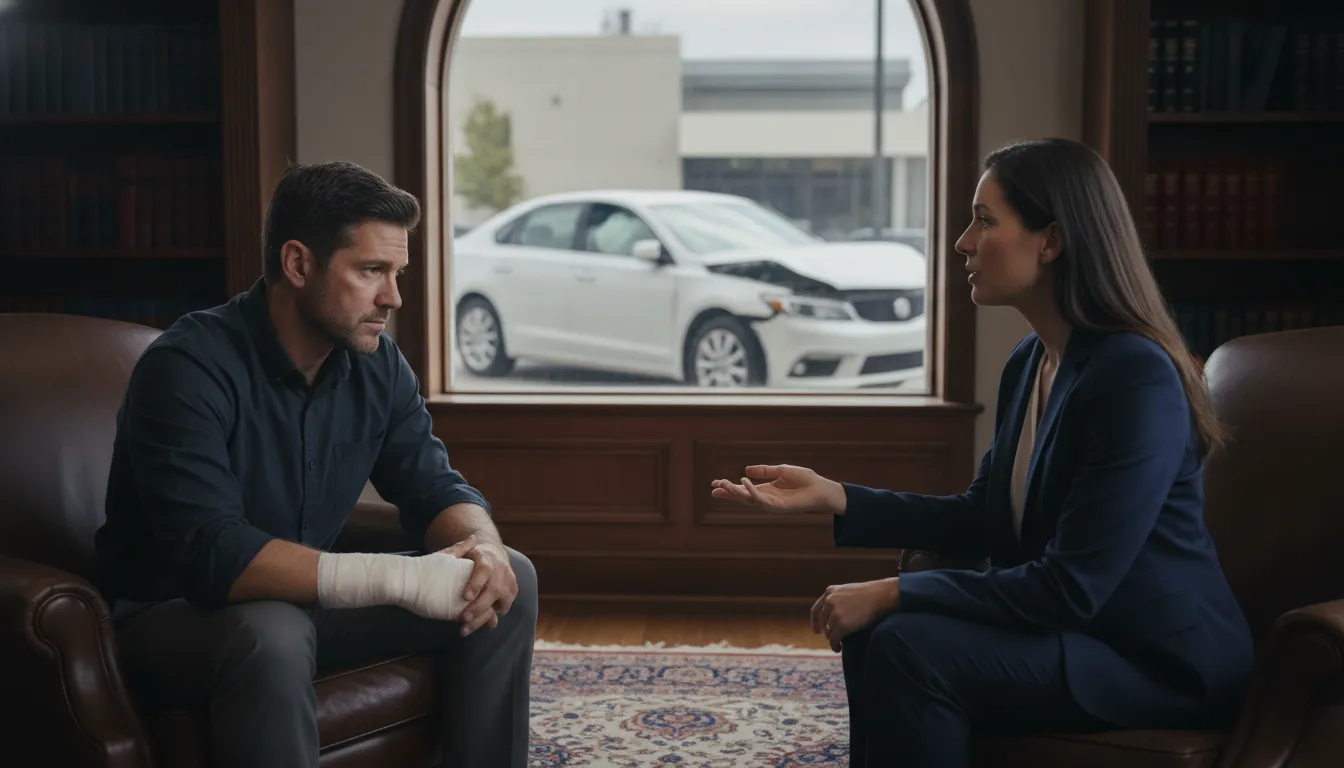
California car accident victim meeting with an attorney about insurance coverage
A claim under your own policy is called a first-party claim. It may involve collision coverage for vehicle damage, medical payments coverage, or uninsured and underinsured motorist coverage, depending on the policy. A claim against the at-fault driver's carrier is a third-party claim. That claim seeks compensation from the policy of the person whose negligence caused the accident.
Notifying your insurer does not waive a claim against the other driver
People sometimes hesitate to contact their own insurance company. They may believe this means accepting the insurer's version of events or abandoning a claim against the other driver.
That is not necessarily how the process works. Your policy may require prompt notice of an accident, even when you believe another driver was entirely responsible. Review the policy and follow its notice requirements.
At the same time, notifying your carrier can preserve access to coverage that may apply while the third-party claim is investigated. For example, your collision coverage may address vehicle damage under the policy's terms. Your own uninsured or underinsured motorist coverage may become relevant if the responsible driver has no insurance or insufficient limits. Whether that coverage applies requires a review of the policy and the facts.
Choose the claim path based on coverage and evidence
The at-fault carrier is not your advocate. Its adjuster evaluates the claim under the other driver's policy and may dispute liability, the extent of an injury, or the amount supported by the evidence. A quick settlement offer also may not account for continuing treatment or lost wages after a serious collision. Avoid making assumptions about what any policy will pay before reviewing the available coverage and documenting the claim.
The California Department of Insurance advises accident victims to understand what their policy covers and excludes. It also recommends preserving information such as photographs of vehicle damage, traffic controls, visual obstacles, and witness contact details. Those materials can matter when the insurers disagree about responsibility. For an overview of the broader process, review the steps in the car accident claim process.
When multiple carriers are involved, statements to an adjuster can affect how the claim is evaluated. An attorney can review the policies, coordinate communications, and help protect your position while the evidence develops. The California Department of Insurance provides consumer guidance on accident claims and fair claims practices at its auto accident guide.
When Filing Through Your Own Insurance May Make Sense
Filing a first-party claim with your own insurer can be practical when you need to use coverage already available under your policy. This may be especially useful while fault remains disputed. The right path depends on the policy language, coverage limits, exclusions, evidence, and the nature of your injuries. The California Department of Insurance advises policyholders to read their policies carefully. Review the policy terms before choosing a claim strategy.
Collision coverage may help address vehicle damage under the terms of your policy. Medical payments coverage, often called MedPay, may help with covered medical expenses regardless of who caused the collision, subject to its limits and conditions. Uninsured or underinsured motorist coverage may become important when the driver who caused the crash has no liability insurance or insufficient limits. California Insurance Code section 11580.2 addresses uninsured and underinsured motorist coverage, but your policy still controls the available protection.
Your own carrier may also be a practical starting point after a hit-and-run, when the responsible driver cannot be identified, or when the other driver's insurer denies liability. Filing through your policy does not automatically resolve fault or determine the full value of an injury claim. It creates a separate claim that must be evaluated under the contract. Notify the carrier promptly if your policy requires notice, and follow any hit-and-run reporting requirements in the policy.
Do not assume the first offer or adjuster's position is the final answer. Keep photographs, witness information, medical records, and communications organized. If multiple carriers are involved, or if the crash caused significant or developing injuries, a California car accident lawyer can assess both claim paths before you make statements or sign a release.
When the At-Fault Driver's Insurance Should Pay
California generally follows a fault-based system for vehicle collisions. The driver whose negligence caused the crash may be responsible for the resulting losses, and the injured person can pursue a third-party claim with that driver's liability carrier. California also requires vehicle owners and operators to satisfy financial responsibility requirements, typically through liability insurance. The California Department of Insurance explains these requirements in its California auto insurance and financial responsibility guidance.
A third-party claim is different from a claim under your own policy. You are asking the at-fault driver's insurer to evaluate liability and pay covered damages arising from its policyholder's conduct. Depending on the facts and available proof, those damages may include vehicle repair or replacement-related losses, reasonable medical expenses, lost income, and compensation for pain and suffering. The exact recovery depends on the evidence, the legal issues, and the policy terms.
How the third-party claim works
After you report the collision, the carrier assigns an adjuster to investigate. The adjuster may review the police report, photographs, witness accounts, vehicle damage, medical records, and statements from the drivers. You may be asked to explain what happened and provide documentation supporting your injuries, treatment, property damage, and other losses. Keep copies of what you submit and maintain a detailed record of communications and appointments.
The insurer's investigation is not a court ruling. An adjuster works for the carrier and evaluates the claim under the policy and the information available to the company. The adjuster may accept responsibility, assign some or all of the blame to you. Dispute whether an injury relates to the crash, or question the extent of your losses. That position can change when additional evidence is presented. It does not decide the ultimate legal question of negligence or the amount a claimant may be entitled to recover.
Policy limits can restrict payment
Even when the evidence strongly supports fault, the at-fault driver's liability limits may not cover every loss. The carrier generally will not pay beyond the applicable policy limits without another legal basis for recovery. If the driver is uninsured, has insufficient limits, or liability is disputed, your own uninsured or underinsured motorist coverage may become important, subject to its terms and limits. A California car accident lawyer can compare the available policies, identify the damages supported by the record, and respond before you accept a settlement or sign a release.
Do not treat a quick offer or an initial denial as the final word. A settlement may be offered before the full medical picture is known, while a denial may rest on incomplete evidence. For a broader overview, review the steps in the car accident claim process and consider obtaining case-specific advice before making a binding decision.
What Should You Tell an Insurance Adjuster After a Crash?
Tell the truth, provide basic identifying and accident information, and avoid guessing about fault or the full extent of your injuries. An adjuster is evaluating a claim under an insurance policy, not serving as your advocate. The California Department of Insurance advises accident victims to document the scene, contact police where appropriate, and collect witness information. Those steps create a reliable record before memories and physical evidence fade.
1. Give prompt notice of the crash. Report the collision to the insurer or insurers identified in your policies, and check the policy for notice requirements. Prompt notice is often required by the policy. If the crash involved a hit-and-run, determine whether the policy requires police notification within a specified period. A notice of loss is not the same as agreeing with an adjuster's assessment of liability or injury.
2. Contact police when appropriate and obtain the report information. Follow emergency instructions first. If officers respond, record the agency and report number. If the circumstances require a report but officers do not attend, ask the appropriate agency how to proceed. The California Department of Insurance recommends calling police and preserving the resulting documentation: California's accident guide.
3. Preserve photographs and witness details. Photograph vehicle damage, the roadway, traffic controls, lighting, lane markings, signs, and visual obstacles when it is safe. Obtain the names, addresses, and telephone numbers of passengers and witnesses. Do not edit, discard, or overwrite the original files. Send copies only through a traceable channel and keep a backup.
4. Describe medical symptoms accurately. Obtain appropriate medical care and follow the provider's instructions. Explain what hurts, when symptoms began, and how the injury affects ordinary activities. Do not minimize symptoms because they seem manageable, and do not speculate that a symptom is unrelated or permanent. Some conditions evolve after a collision, so say when you are uncertain rather than making a prediction for the adjuster.
5. Keep a complete claim file. Save medical records, appointment information, prescriptions, repair documents, photographs, police materials, emails, letters, and every claim number. Maintain a dated log of calls, names, statements made, requests received, missed work, and treatment. Read your policy so you understand applicable coverage, exclusions, and limits.
6. Use caution with recorded statements and releases. Answer basic factual questions accurately, but do not guess, exaggerate, minimize, or casually characterize fault. Before giving a recorded statement, signing a broad medical authorization, or accepting a settlement, consider having a California car accident attorney review the request. An attorney can manage communications with your own carrier and the other driver's carrier, helping reduce the risk that an unguarded statement is taken out of context. That representation does not guarantee a particular result, but it can help protect the claim while the evidence and medical picture develop.
How MedPay and UM/UIM Coverage Affect the Decision
MedPay and uninsured or underinsured motorist coverage are first-party protections. They can matter when the other driver's insurer is disputing fault, moving slowly, or offering limits that do not address the full injury claim. They do not replace a liability claim against the driver who caused the crash. Each coverage serves a different purpose, and the policy language controls.
MedPay addresses certain medical expenses
Medical Payments coverage, commonly called MedPay, may help pay qualifying accident-related medical bills under your own auto policy, regardless of who caused the collision. The available limit is policy-specific. MedPay is generally narrower than a liability recovery because it is designed for covered medical expenses, not every category of harm. It ordinarily does not determine who was negligent, and using it does not necessarily resolve your claim against the at-fault driver.
Before submitting bills, review the declarations page and the policy provisions. Confirm the MedPay limit, eligible treatment, notice requirements, exclusions, and any language addressing other insurance or reimbursement. Do not assume that a payment under MedPay waives your right to pursue the responsible driver's insurer. That question depends on the policy, the payment documents, and the facts of the claim.
UM/UIM coverage protects against inadequate liability limits
Uninsured motorist coverage may apply when the responsible driver has no applicable liability insurance. Underinsured motorist coverage may become relevant when that driver's liability limits are insufficient for the damages supported by the claim. California Insurance Code section 11580.2 addresses uninsured and underinsured motorist coverage, but the statute does not eliminate the need to examine the actual policy and claim facts: California Insurance Code section 11580.2.
UM/UIM is not an automatic guarantee of payment. Coverage can depend on whether the policy applies, the available limits, fault, proof of injury, notice, and policy conditions. There may also be disputes about how payments, settlements, or other insurance affect the claim. Do not agree to a release with the at-fault carrier before understanding how it could affect your own UM/UIM rights.
Start with the declarations page, then obtain the full policy and endorsements. Compare bodily-injury liability limits, MedPay, and UM/UIM limits, and look for exclusions or consent-to-settle provisions. If multiple carriers are involved, a California car accident lawyer can evaluate the coverage paths without treating one insurer's position as the final word.
When Should You Speak With a California Car Accident Lawyer?
You should consider speaking with a California car accident lawyer before making substantive statements, accepting an offer. Or signing a release when the claim is more complicated than a straightforward property-damage report. Early legal review can clarify whether you should pursue a third-party claim against the other driver. Use your own collision or uninsured motorist coverage, or notify and coordinate with multiple carriers.
Liability or injury is being disputed
Contact counsel if the other driver or insurer blames you, denies responsibility, or argues that your injuries were pre-existing or unrelated to the crash. A liability dispute may depend on scene evidence, witness accounts, vehicle damage, traffic controls, and the timing of medical treatment. California is a comparative-fault state, so an insurer's position about fault is not automatically the final legal determination. Do not guess about speed, distance, or what another driver saw. Preserve photographs, reports, messages, and medical records instead.
Your injuries are serious or did not appear immediately
Some crash injuries become clearer over time. If symptoms persist, treatment is ongoing, or you have missed work, a quick settlement may not reflect the full effect of the injury. You should understand the likely scope of treatment and the legal significance of your records before signing a release. Once a release is signed, it may limit your ability to pursue additional compensation for the same accident.
Several insurers or special vehicles are involved
Multiple carriers can create overlapping investigations and conflicting requests for statements. The issues become more involved when the vehicles include a commercial truck, company car, delivery vehicle, or rideshare vehicle. Coverage may depend on who was driving, whether the driver was working, and which policy applies. A lawyer can help identify the relevant parties and manage communications with your own insurer and the other carrier.
The available coverage is limited or the claim is denied
Low policy limits, an uninsured driver, or a denial can change the practical claim strategy. Your own uninsured or underinsured motorist coverage may matter, but its terms and limits must be reviewed with the facts of the crash. Read the policy and declaration page, and keep a detailed record of calls, letters, medical appointments, and expenses. The California Department of Insurance provides guidance on fair claims handling and consumer complaints, but a case-specific review is different from general agency information.
DC Law Group can evaluate the insurance issues and explain your options. For additional context, review the steps in the car accident claim process and the benefits of hiring a car accident attorney.
Frequently Asked Questions
Should I notify my own insurance company after a California crash?
Usually, yes, even if you believe the other driver caused the collision. Your policy may require prompt notice, and your insurer may provide collision, medical-payment, or uninsured or underinsured motorist coverage. Review the policy so you understand its coverage and exclusions, as the California Department of Insurance advises.
Can I file claims with both insurance companies?
Yes. A claim against the at-fault driver's insurer is a third-party claim. A claim under your own collision, MedPay, or UM/UIM coverage is a first-party claim. The available options depend on the policy language, the evidence of fault, and whether the other driver's coverage is adequate.
What should I do if the other driver's insurer denies fault?
Preserve evidence and avoid guessing about the collision or your injuries. Save photographs, medical records, witness information, and claim communications. The California Department of Insurance recommends photographing the damage and scene and collecting witness contact information: California Department of Insurance accident guidance. Your own collision or UM/UIM coverage may provide another route, subject to the policy.
Should I accept a quick settlement offer?
Do not sign a release before you understand the full extent of your injuries and losses. A quick offer may not account for continuing treatment or missed work. Once a release is signed, pursuing additional compensation can become difficult. Have the offer and supporting records reviewed before accepting it.
When should I speak with a California car accident lawyer?
Speak with a lawyer when injuries are serious or developing, fault is disputed. Multiple insurers are involved, coverage limits appear inadequate, or an adjuster requests a recorded statement or release. Legal counsel can manage communications with the carriers while protecting your claim and evaluating the available paths.
Ready to Review Your California Insurance Options?
Choosing between your insurer and the other driver's carrier can depend on coverage, fault, injuries, and the evidence available. A case-specific review can help you understand your claim path and which communications require care. For guidance tailored to your crash, call DC Law Group at (310) 571-8860 to discuss your California car accident insurance options.