

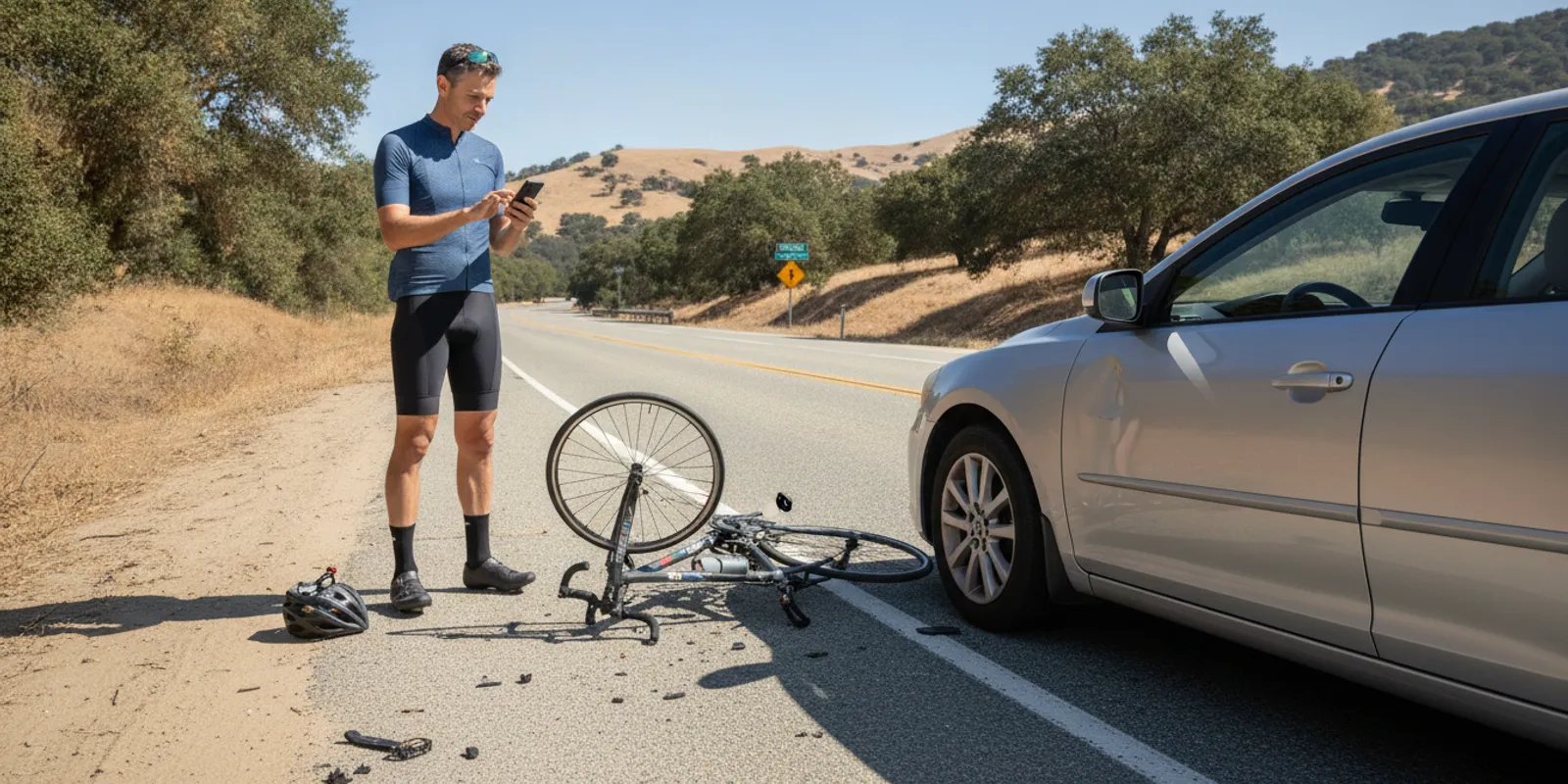
A bicycle collision can leave you dealing with injuries, damaged property, insurance questions, and uncertainty about what to do next. A bicycle accident lawyer California residents consult can review how the collision happened, what evidence exists, and which insurance policies may apply. Start by protecting your health and preserving information while it is still available.
Request a consultation with DC Law Group
What should you do immediately after a bicycle collision?
Move out of active traffic if you can do so safely. Call 911 when anyone is injured, traffic is blocked, or an emergency response is needed. Do not leave simply because the other person suggests handling the matter informally. A prompt report can create an official record and help identify the people and vehicles involved.
Get medical attention as soon as appropriate. Some symptoms are not obvious at the scene, and a medical assessment creates a record of what you reported and what clinicians observed. Tell the provider about every area that hurts and how the collision occurred. Follow the care plan and keep copies of visit summaries, referrals, imaging reports, and receipts for related treatment.
- Move to a safe location and request emergency help when needed.
- Exchange names, contact details, driver’s license information, vehicle registration, and insurance information.
- Get names and contact details for witnesses, without pressuring them to adopt a particular version of events.
- Photograph the scene, vehicles, bicycle, roadway, signs, and visible injuries if it is safe.
- Make a report to the appropriate law enforcement agency and note any report number.
- Preserve damaged equipment and clothing, and avoid repairing or discarding them until they have been documented.
Do not argue about fault at the scene or guess about speed, distance, or what another person saw. Keep statements factual. If an insurer contacts you before you understand your injuries or the available records, ask for the request in writing and take time to review it. Do not sign a release or give a recorded statement without understanding its purpose and effect.
How can you document the collision scene?
Photographs can preserve details that may change quickly. If you are able, take wide views showing the road layout and close views of relevant details. Record the direction each person was traveling, lane markings, bicycle lane boundaries, parked vehicles, traffic signals, signs, sight obstructions, debris, skid marks, and the final positions of the bicycle and vehicle. Capture the surrounding intersection or block, not only the point of impact.
Write down your own recollection as soon as you can. Include the approximate time, weather, lighting, route, direction of travel, and sequence of events. Keep the original files and note who took each image. Avoid editing images in a way that removes metadata or changes the scene. If a nearby business or residence may have video, record its location and promptly ask that footage be preserved; recordings may be overwritten.
Evidence is most useful when it answers a specific question. A photograph of a door’s position may matter in a dooring collision. A view of a turn lane, signal, or sight line may help explain a turning-driver dispute. A clear picture of lane markings may help establish where the bicycle was traveling. Preserve context so a reviewer can understand how each image relates to the roadway.
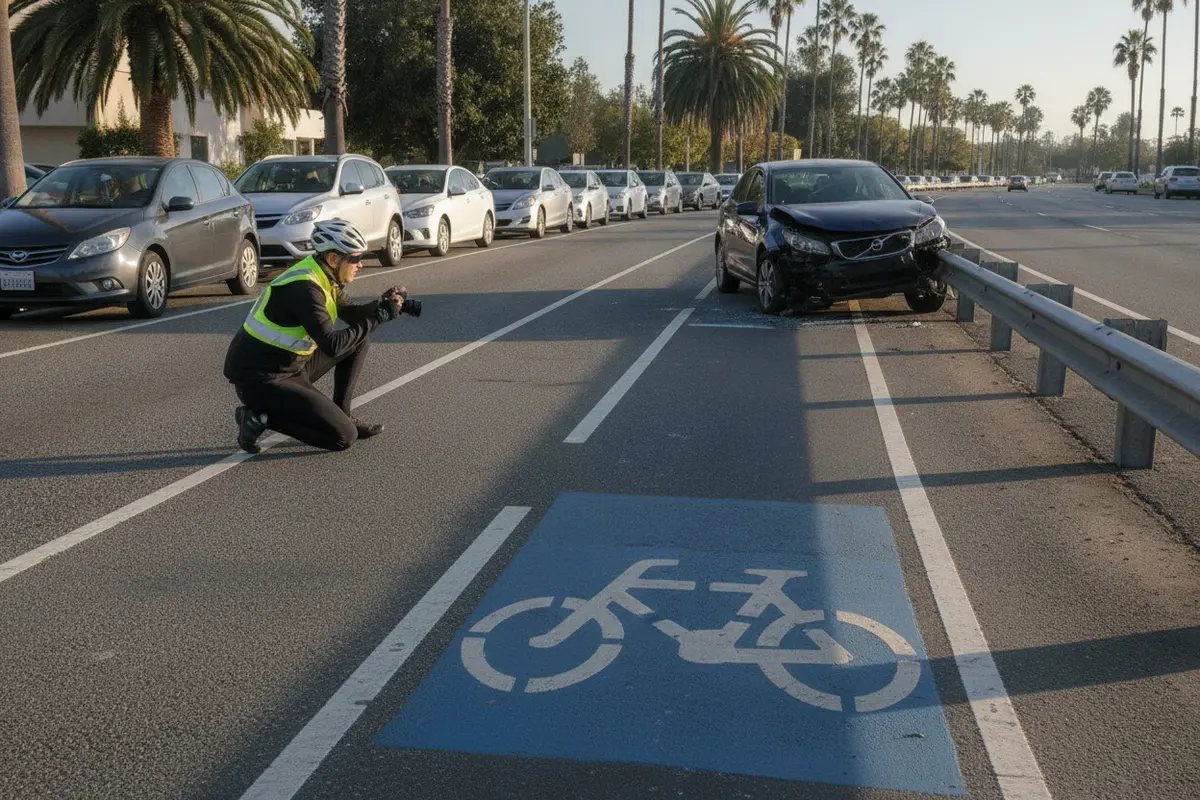
Cyclist photographing a bicycle collision scene and roadway markings
Do not enter traffic or put yourself at risk to obtain a better image. You can return later, if safe, or ask someone else to photograph the location. A lawyer may also assess whether additional records, such as a collision report, nearby video, or vehicle data, should be requested.
What evidence matters in a dooring or turning-driver collision?
In a dooring incident, a driver or passenger may open a vehicle door into a cyclist’s path. Useful evidence can include where the vehicle was stopped, which side the door opened from, how long it was open, visibility, parking restrictions, the cyclist’s direction and position, witness accounts, and damage patterns. Photograph the vehicle and door only when safe. Avoid claiming that one fact automatically decides responsibility; the full circumstances matter.
In a collision involving a turning vehicle, document the driver’s approach, turn direction, signal use if observed, traffic control, sight lines, and the bicycle’s position. Record whether the collision happened at an intersection, driveway, or entrance. Witnesses may have seen whether the vehicle crossed a bicycle lane or whether the cyclist had a signal. Ask for contact details and let investigators or counsel obtain a formal account when appropriate.
California’s rules of the road and local traffic controls may be relevant, but a single citation does not necessarily resolve every civil liability question. The evidence must be considered as a whole, including each person’s actions before impact. For context on bicycle safety and roadway interactions, the National Highway Traffic Safety Administration bicycle safety fact sheet discusses safety and crash prevention. It is not a substitute for applying California law to an individual claim.
How do bicycle lanes and right-of-way evidence matter?
A bicycle lane, shoulder, or shared travel lane may help establish where a cyclist was positioned, but lane presence alone does not answer every question. Preserve photos of lane markings, signs, obstructions, parked cars, construction, pavement defects, and the available width. Note whether a vehicle entered, crossed, or blocked the lane and what was happening immediately before impact.
Right-of-way questions often depend on the exact location and timing. Record signal phases if known, stop signs, crosswalk markings, turn controls, and the direction each party traveled. Do not assume a signal was green based only on a later recollection; note what you personally remember and identify any witnesses or available video. A collision report, photographs, and independent accounts may help establish the sequence.
If a roadway condition contributed, document it before it changes. Note the precise location and take photographs from more than one angle. Depending on the circumstances, a public entity or another party may be involved, and notice rules can differ from ordinary injury claims. Get legal guidance promptly rather than assuming the standard civil deadline applies.
Which records should you keep after the collision?
Create one organized file for the claim. Keep the collision report number, photographs, witness details, insurer correspondence, repair or replacement records for the bicycle, and medical records. Save original documents and make a simple chronology. A dated log can record symptoms, missed activities, appointments, and how the injury affects ordinary tasks. Keep entries factual and consistent with what you report to care providers.
| Record or evidence | What it may help show | Practical step |
|---|---|---|
| Scene photographs and video | Road layout, visibility, vehicle position, lane markings, and damage | Save original files with date and source details |
| Medical records | Reported symptoms, examination findings, diagnosis, and treatment | Request copies and keep appointment summaries |
| Witness information | Independent observations of movement, signals, and impact | Record names and contact details promptly |
| Bicycle and gear documentation | Damage and condition after the collision | Photograph before repair; retain repair records |
| Insurance documents | Available policies, notices, and claim communications | Keep full letters, emails, and policy information |
Medical documentation should tell a clear and accurate story. Provide your provider with relevant history and describe changes in symptoms over time. If you miss an appointment or cannot follow a recommendation, communicate the reason. A gap in care can raise questions, but the explanation should be truthful; do not alter records or exaggerate symptoms.
For broader information about how an attorney may assist after a roadway injury, see DC Law Group’s pedestrian injury practice page and its guide to how a pedestrian accident lawyer may help. These resources address related roadway injury issues, while bicycle claims require attention to the cyclist’s own route, equipment, and applicable traffic rules.
How can uninsured or underinsured motorist coverage apply?
If the driver is uninsured, underinsured, or cannot be identified after a hit-and-run, your own insurance may need review. Uninsured or underinsured motorist coverage may be available under a policy, depending on its wording, the people insured, the type of collision, and other facts. Do not assume that coverage exists or that a particular policy automatically applies to a bicycle collision.
Locate the declarations pages and full policy for each potentially relevant household or vehicle policy. Check policy definitions, notice requirements, exclusions, and claim procedures. Preserve proof of when and how you notified the insurer. A late notice or incomplete claim can create avoidable disputes, so seek advice if you are unsure what to send or whether a policy may cover the incident.
For a deeper look at policy issues, review the firm’s guide to uninsured and underinsured motorist claims in California. That information is general. Coverage depends on the actual policy and facts, and an insurer’s position should be assessed against the full policy language.
Can your own conduct affect a California bicycle claim?
California follows comparative fault principles. More than one person may share responsibility for a collision, and a person’s assigned share may affect the damages recoverable. A driver or insurer may argue that a cyclist’s position, speed, visibility, equipment, or response contributed. The argument is not the final word: each point should be tested against records, physical evidence, witness accounts, and applicable law.
Keep your description precise. Distinguish what you saw from what you inferred. If you do not know a speed or cannot remember a signal, say so rather than estimating. Preserve evidence that may address disputed issues, including road conditions, lighting, visibility, and the relative positions of vehicles. Do not post speculation about fault or injury on social media while facts are being reviewed.
A claim review may compare the statements of all involved people with photographs, reports, medical records, and available video. It may also examine whether an injury or loss is connected to the collision. No single record necessarily controls. A careful chronology can help identify inconsistencies and questions that need follow-up.
Which California deadlines should you check?
California generally sets a time limit for filing a personal injury lawsuit, but the applicable deadline depends on the claim and circumstances. Claims involving a public entity can require an administrative claim much sooner than an ordinary lawsuit deadline. Other issues, including the injured person’s age, delayed discovery questions, or a defendant’s identity, may affect the analysis. Do not rely on a general article to calculate a filing date.
Write down the collision date, identify every potentially responsible person or entity, and promptly ask a qualified California attorney to confirm the deadlines that apply. Preserve insurance notices and any public-agency correspondence. Negotiating with an insurer does not necessarily suspend a court deadline. Waiting for treatment to end or for an insurer to make an offer can put legal rights at risk.
Other procedural requirements may apply to claims against public bodies or particular defendants. The identity of a road owner, contractor, vehicle owner, or employer may affect what notices and records should be pursued. A timely review can help identify the correct parties and the steps needed to preserve a claim.
How can you prepare for a consultation?
Bring or gather the collision date and location, a short description of events, the report number, photographs, witness details, medical provider information, and all insurer letters. Include any policy declarations pages you can locate. Tell the attorney about prior injuries or relevant earlier symptoms accurately. The goal is not to arrive with every answer; it is to make the available facts easier to assess.
Ask who may be responsible, what additional evidence should be preserved, which insurance policies may need notice, and what deadlines require immediate attention. You can also ask how the firm communicates and what documents it needs next. DC Law Group represents people with personal injury matters in California; information on the firm’s car accident practice and firm website can help you learn more. The facts of a bicycle collision still require an individual review.
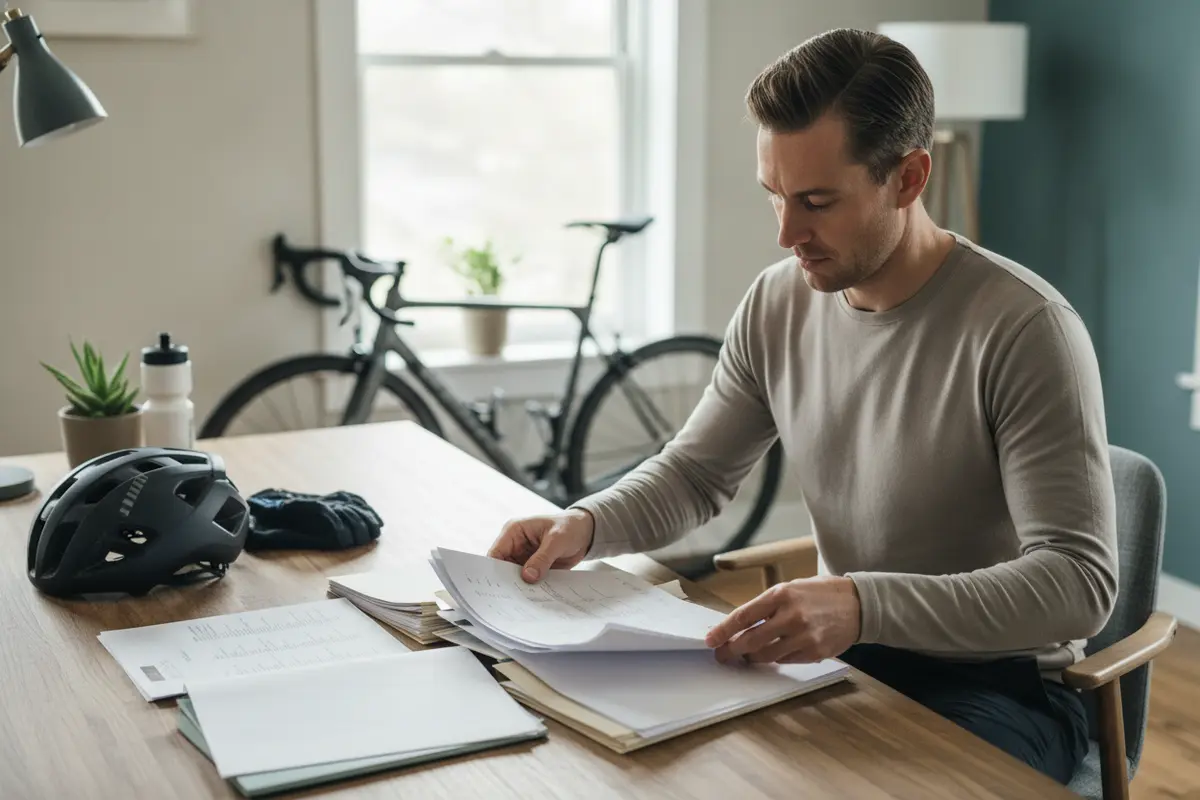
Cyclist organizing medical paperwork and collision records at a desk
Speak with DC Law Group about your options
How should you handle insurance communications?
Report the collision to the insurer that may cover you, following the policy’s notice instructions. Give accurate basic facts, including when and where the collision occurred, the parties involved, and whether you sought care. Keep a copy of your notice and write down the date, time, and name of each person you speak with. Ask for claim numbers and written confirmation of important requests.
An adjuster may ask for a recorded statement, broad medical authorization, or a signed release. Before agreeing, understand what period and records the request covers and whether it could affect other claims. You can ask to receive requests in writing and seek legal advice before responding. Do not speculate or minimize symptoms just to make a conversation easier. If you do not know an answer, say that you do not know.
Keep communications professional and consistent. Send copies rather than originals unless specifically required, and retain proof of delivery. Make a note of any deadline stated in correspondence, but verify it against the policy and applicable law. An insurer’s deadline for paperwork does not necessarily replace a statutory filing deadline.
What should you know about bicycle damage and personal property?
Photograph the bicycle from several angles before cleaning or repair. Capture the frame, wheels, brakes, handlebars, lights, helmet, and any damaged accessories. Record the make, model, identifying number, and purchase or service records if available. Preserve damaged components where practical. A qualified repair assessment may help describe whether the bicycle can be safely repaired, but do not ride equipment that may be unsafe.
Keep receipts for reasonable transport, storage, replacement equipment, and other out-of-pocket items connected to the collision. Separate these documents from medical records and note why each item was needed. Avoid replacing an item before photographing it when circumstances allow. If urgent replacement is necessary for safety, preserve the damaged item and document the reason and date.
Property documentation is distinct from proof of bodily injury. A damaged bicycle can help show the point or force of contact, but damage alone does not establish the nature or extent of an injury. Medical assessment and the broader evidence remain important. Do not assume an insurer’s initial property assessment resolves bodily injury issues.
How can you build a clear event timeline?
Start with the trip itself: where you began, your route, the approximate time, and any stops. Then record the approach to the collision location, what you observed, the impact, and what happened immediately afterward. Mark uncertain details as uncertain. This avoids turning an estimate into a false certainty later.
Add dates for the first medical visit, follow-up care, insurer notices, repair assessments, and communications with witnesses. Keep the original notes and make later additions with their dates rather than silently rewriting earlier entries. If your recollection changes after seeing a photograph or report, note what prompted the change. A transparent timeline is more useful than a polished account that hides uncertainty.
Evidence may come from multiple sources: a witness may recall a signal, a photograph may show lane position, and a medical record may document symptoms. Keep each source identifiable. A lawyer can compare accounts and flag gaps that need attention. Preserve messages, video clips, and original photographs in more than one secure location.
What does a careful claim review consider?
A thorough review considers liability, causation, injury documentation, available insurance, and the legal deadlines. It may ask whether a person or entity owed a duty, whether conduct breached that duty, and whether that conduct was a cause of the claimed harm. These are legal questions applied to the evidence, not conclusions drawn from a single photograph or a traffic citation.
Responsibility may be disputed. The driver may describe events differently, a witness may have seen only part of the encounter, or a report may contain an error. Identify inaccuracies promptly and gather support for a correction where possible. Do not alter a report yourself; ask the issuing agency about its process for adding or correcting information.
A lawyer may also consider whether other parties or policies warrant investigation. For example, vehicle ownership, employment, roadway maintenance, or a separate policy could matter depending on the facts. This does not mean every case has additional defendants or coverage. The purpose of investigation is to identify the relevant evidence and parties before positions become fixed.
Frequently asked questions
Should I report a bicycle collision if I feel mostly fine?
When a collision involves injury, vehicle damage, or a safety concern, make an appropriate report and seek medical guidance. Symptoms can change, and a contemporaneous record may help clarify what happened. Do not claim an injury you do not have; describe your condition honestly.
What if the driver left the scene?
Call law enforcement and provide the vehicle description, direction of travel, and any plate information you remember. Seek medical care as needed, identify witnesses, and ask nearby businesses or residents to preserve relevant video. Notify potentially applicable insurers promptly and keep a record of each contact.
Can I bring a claim if I was partly responsible?
Possibly. California comparative fault principles can allow responsibility to be divided among people, which may affect a claim. The evidence and applicable law determine how fault is assessed. A statement from an insurer is not a substitute for an independent review.
What if the driver has no insurance?
Check whether uninsured motorist coverage or another policy may apply. Coverage depends on policy wording and the circumstances, so collect the full policy and contact an attorney promptly. Preserve notices and do not assume that a particular policy will cover the collision.
How long do I have to take legal action?
Deadlines depend on the claim, the parties, and other facts. Public-entity claims may involve a much shorter administrative deadline. Ask a California attorney to identify the applicable dates promptly rather than relying on a general estimate.
Every collision is different, and evidence can become harder to obtain with time. If you have questions about a bicycle collision, contact DC Law Group to discuss the facts and the next steps that may be appropriate.