
When a fatal collision takes someone you love, the first days can feel impossible to organize. Important records, witness details, and questions about what happened may begin to disappear while your family is grieving. A calm, deliberate response can help preserve information without forcing you to make decisions before you are ready.
A bakersfield wrongful death lawyer can help a surviving family understand potential California claims, identify the evidence that may matter, and assess who is legally eligible to act. The right next steps depend on the collision facts, family relationship, available records, and applicable deadlines.
Contact DC Law Group to discuss your Bakersfield-area matter.
This article provides general educational information, not legal advice. It does not determine whether a particular family member has an individual claim or predict an outcome. Begin by protecting the available information and documenting what your family knows, then consider the practical steps that should follow in the first days after a fatal collision.
What Should a Family Do in the First Days After a Fatal Bakersfield Collision?
The first days after a fatal collision can feel disorganized and overwhelming. A calm, documented approach can help preserve information while your family decides what assistance it needs. Consider these steps:
- Focus first on immediate family needs. Designate one person to keep a written record of important calls, messages, names, claim numbers, and documents. Avoid deleting photographs, messages, vehicle information, or other material connected with the collision. Do not guess about how the crash happened or identify a responsible person before the available evidence has been reviewed.
- Identify the investigating agencies. Ask which agency investigated the collision and note the incident number, investigating officer, and insurer information provided to the family. The California Highway Patrol describes a vehicle collision report as a CHP 555 Traffic Collision Report together with supplemental investigation documentation. Those records may become important when the circumstances are evaluated.
- Ask about obtaining the collision report. CHP policy states that a person with proper interest can obtain a CHP-generated collision report from any CHP Area in California. Regardless of which CHP jurisdiction handled the collision. A request involving a California wrongful-death claim under Code of Civil Procedure section 377.60 may require special counsel clearance under that policy. So the family should ask about the applicable request process rather than assume the record will be released immediately.
- Preserve related records. Keep medical and death records, funeral documentation, insurance correspondence, employment and household records, photographs, witness information, and notes about conversations in one secure location. Do not provide a recorded statement or sign a release without understanding what it covers. If another party or insurer requests documents, keep copies of everything provided.
- Obtain individualized legal guidance. A California wrongful-death claim depends on the evidence, the identity of eligible claimants, and the specific circumstances. Learn about the California wrongful-death lawsuit process and consider speaking with counsel familiar with automobile collisions and wrongful-death claims, including DC Law Group's work for surviving family members in California.
*This section provides general educational information, not legal advice. Claimant rights and next steps require an individual review of the facts.*
How Early Investigation Preserves a Wrongful-Death Claim
A fatal collision can leave a family facing unanswered questions while important records and physical evidence are still being collected. Early investigation does not assume that any person, driver, employer, or vehicle owner is at fault. It creates a reliable factual record so potential legal issues can be evaluated rather than decided by speculation.
Start with the available collision evidence
Scene photographs, vehicle condition, roadway information, witness names, and available video can help establish what happened. Depending on the circumstances, a review may also need to address driver records. Vehicle ownership, employment relationships, insurance information, medical records, and the official record of the decedent's death. Family members should preserve what they already have and avoid altering, discarding, or annotating original materials.
For collisions investigated by the California Highway Patrol, the agency describes a vehicle collision report as including a CHP 555 Traffic Collision Report and supplemental investigation documentation. A person with proper interest may obtain a CHP-generated collision report from any CHP Area in California, regardless of which CHP jurisdiction handled the collision. Access to a particular record can depend on the request and applicable review requirements, so families should not assume that every document will be released automatically.
These materials can be relevant when assessing whether a death resulted from another person's wrongful act or neglect, the standard described in California's wrongful-death statute. They do not, by themselves, establish liability. The report, physical evidence, witness accounts, and other records must be considered together.
Preserve questions before drawing conclusions
Family members may benefit from keeping a written timeline, identifying everyone who may have information, and saving communications with insurers or agencies. Do not give a recorded statement or make a public accusation without understanding how it may affect the factual record. A California wrongful-death lawsuit process can involve claimant, evidence, and procedural issues that require individual review.
This section provides general educational information, not legal advice. A Bakersfield wrongful death lawyer can review the available evidence and explain what additional investigation may be appropriate for the specific family and collision.
Who May File a California Wrongful-Death Claim?
California law does not give every relative an automatic individual claim after a death. A wrongful-death cause of action may arise when a person dies because of another person's wrongful act or neglect. But eligibility depends on the relationship to the decedent and the circumstances identified in California Code of Civil Procedure section 377.60.
Spouses, domestic partners, children, and heirs
The statute generally identifies a surviving spouse or domestic partner, children. And the issue of deceased children as potential claimants. "Issue" can include descendants who may stand in the place of a deceased child. If the decedent has no surviving issue, people who would inherit under California's intestate-succession rules may also qualify. That analysis can require careful review of the family structure and estate circumstances.
Dependents and certain minors
Other categories may apply in narrower situations. A putative spouse, the putative spouse's children, stepchildren, parents, or the decedent's legal guardians may qualify if they were dependent on the decedent. A minor outside the listed categories may also qualify when the minor lived in the decedent's household for the preceding 180 days and received at least half of their support from the decedent.
When a personal representative files
A decedent's personal representative may assert the wrongful-death action on behalf of eligible persons. This representative role does not make every family member eligible. It provides a procedural way to bring the claim for those who meet the statutory requirements. Family members should avoid assuming that a parent, sibling, or other relative can file without reviewing section 377.60 and the specific facts. See this guide to California wrongful-death claim eligibility for additional background.
This is general educational information, not legal advice. Eligibility can depend on family relationships, dependency, and other facts that should be reviewed individually.
What Damages May Be Available After a Fatal Collision?
California wrongful-death damages are evaluated under the circumstances of the case. The law permits damages that may be just, while the court determines the respective rights of people entitled to assert the claim. That means the available categories and the evidence supporting them require an individualized review, rather than a fixed formula.
Economic damages
Economic damages address measurable financial losses connected to the death. Depending on the evidence, they may include the financial support the decedent would have contributed to the family. Expected gifts or benefits, funeral and burial expenses, and the reasonable value of household services the decedent would have provided.
Noneconomic damages
Noneconomic damages address losses that are real but not measured through an invoice or wage statement. The California adult wrongful-death jury instruction identifies the loss of love, companionship, comfort, care, assistance, protection, affection, society, and moral support. It also identifies the loss of the decedent's training and guidance as a possible noneconomic damage.
| Category | Examples | Proof considerations. |
|---|---|---|
| Economic | Financial support, expected gifts or benefits, funeral and burial expenses, and household services | Financial records, expense documentation, and evidence of the services and support the decedent provided may help establish the loss. |
| Noneconomic | Love, companionship, care, assistance, protection, affection, society, moral support, training, and guidance | Evidence describing the relationship, daily responsibilities, family interactions, and guidance provided may be relevant. |
The jury instructions caution that jurors must not speculate or guess when awarding damages. Future economic damages must also be reduced to present cash value. Grief, sorrow, or mental anguish alone is not used as a measure of wrongful-death damages under the adult instruction. Although the loss of the relationship and support may be considered within the recognized noneconomic categories. See California Civil Jury Instruction CACI 3921 for the instruction's framework.
Surviving family members should also understand that not every relative necessarily has an individual claim, and the court may determine the respective rights of eligible claimants. For a broader explanation of who may qualify, review this guide to California wrongful-death claim eligibility. This information is educational and does not determine what damages may be available in a particular matter.
How Long Do Families Have to File in California?
California's general rule gives a family two years to bring an action for a death caused by another person's wrongful act or neglect. This deadline appears in California Code of Civil Procedure section 335.1. The statute is an important starting point, but it should not be treated as a complete answer for every wrongful-death matter.
The relevant dates should be identified and documented as early as possible. Waiting can make it harder to preserve records, locate witnesses, and evaluate the events that led to the death. A family should avoid assuming that having time remaining means immediate review is unnecessary. The deadline may arrive sooner than expected when records are incomplete or the legal theory is not yet clear.
Other related claims may involve different rules, and exceptions or claim-specific limitations issues can depend on the facts and the parties involved. The applicable deadline may also require analysis of how a claim is characterized and who is legally entitled to assert it. A choosing a wrongful-death attorney resource can help explain questions to raise, but only an individualized legal review can assess a particular family's filing timeline.
For families in or near Bakersfield, preserving the timeline and seeking guidance promptly can help prevent an avoidable deadline problem. Contact DC Law Group to discuss the next steps for your matter.
*This information is for educational purposes only and is not legal advice. Deadlines and legal rights depend on the facts of each matter.*
How Is Fault Evaluated in a Bakersfield Fatal Collision?
Fault is evaluated by examining whether another person's wrongful act or neglect caused the death, rather than by assuming responsibility from the collision alone. California's wrongful-death statute recognizes a cause of action when a death was caused by another's wrongful act or neglect. The available evidence must be reviewed before anyone reaches a legal conclusion. See California Code of Civil Procedure section 377.60.
What evidence can clarify what happened?
An early investigation may compare the physical evidence with statements and official records. Relevant materials can include photographs, available video, witness accounts, vehicle information, and records describing the collision response. The California Highway Patrol explains that its vehicle collision report includes a CHP 555 Traffic Collision Report and supplemental documentation of the investigation. Those materials may help establish the sequence of events, but they still require careful interpretation.
Why the official collision report matters
A collision report is one source of evidence, not an automatic determination of civil liability. CHP policy states that a person with proper interest may obtain a CHP-generated collision report from any CHP Area in California. Regardless of which CHP jurisdiction handled the collision. Families should preserve the report and related records rather than relying on summaries or informal accounts. The policy is available in the CHP collision-information guidance.
Can more than one person or entity be involved?
Potential responsibility depends on facts developed during the investigation. More than one contributing factor may need review, but no particular person or entity should be identified as legally responsible before the evidence is assessed. An individualized review can also clarify which records are available and whether they support a wrongful-death claim. This section provides general information, not legal advice about any specific collision.
How a Bakersfield Wrongful Death Lawyer Can Help After a Fatal Crash
After a fatal crash, a family may be dealing with grief, urgent practical decisions, and questions about what happened. A conversation with counsel can provide a structured way to identify the issues that require attention without asking the family to reach conclusions before the evidence is reviewed. The discussion should be focused on the specific facts of the collision, the people involved, and the family member's relationship to the decedent.
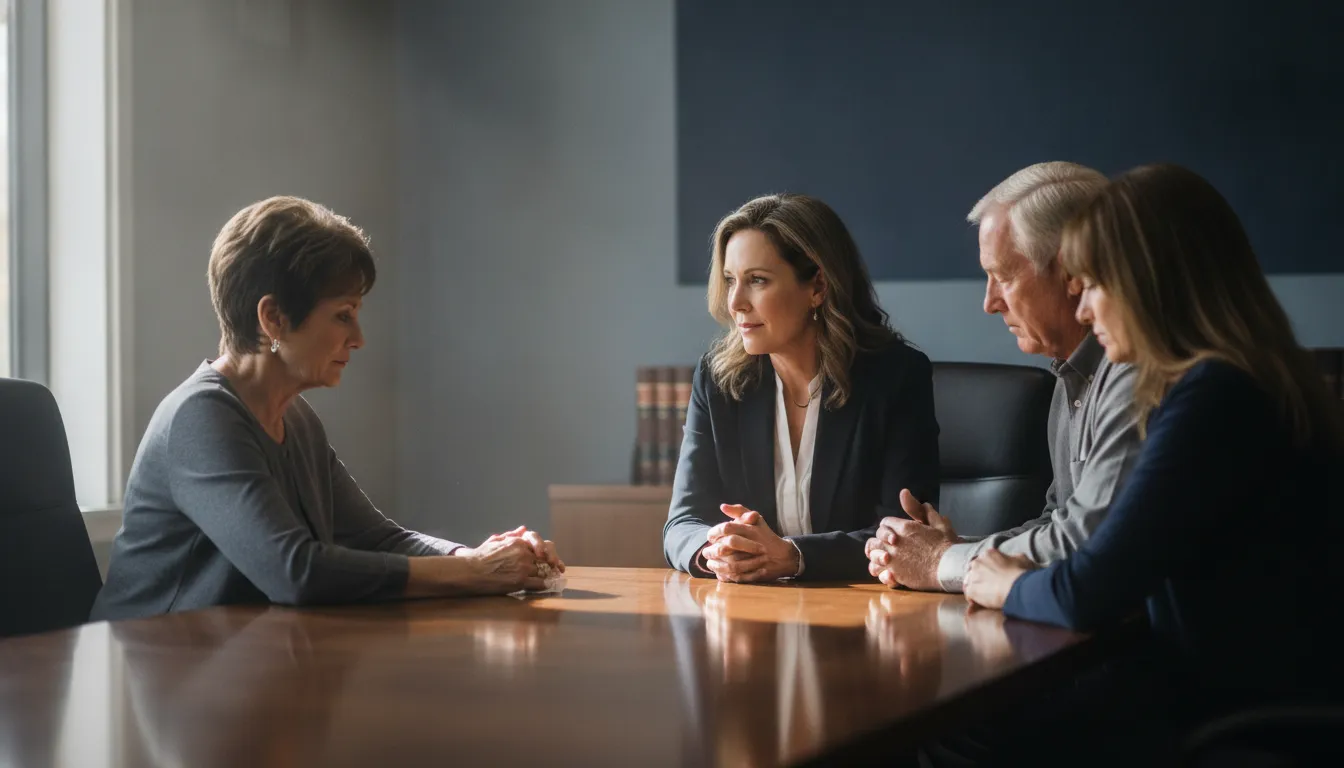
Bakersfield wrongful death lawyer meeting with a family after a fatal collision
What to bring to an initial discussion
Bring any documents that are readily available, but do not delay seeking guidance because a record is missing. Helpful materials may include the collision date and location, law-enforcement or California Highway Patrol paperwork, insurance correspondence. Medical or death records, funeral documentation, photographs, videos, names and contact information for witnesses, and messages exchanged with insurers or other parties. A short timeline can also help organize what the family knows and identify unanswered questions.
It is useful to explain who may be involved in the potential claim, including the decedent's spouse or domestic partner, children, dependents, heirs, or personal representative. Not every relative has the same legal standing, so claimant status should be reviewed under the facts of the particular family. A California wrongful-death claim eligibility guide can provide additional background, but it cannot replace an individual review.
What counsel can clarify
An initial discussion can help separate known facts from assumptions, identify evidence that may need to be preserved or requested. And outline questions about insurance, responsible parties, and the applicable filing deadline. The goal is not to promise a result. It is to determine what additional information is needed and whether the facts support further evaluation of a wrongful-death claim.
DC Law Group handles automobile collisions and wrongful-death claims on behalf of surviving family members, and Bakersfield is among the Central Valley markets identified in its geographic strategy. Families can also review this overview of wrongful-death claim steps as they prepare questions. This article provides general legal information, not legal advice; deadlines and rights depend on the facts of each matter.
Contact DC Law Group to discuss your Bakersfield-area matter.
Frequently Asked Questions
Who may bring a California wrongful-death claim?
Eligibility may include a surviving spouse or domestic partner, children, or the issue of deceased children. Depending on the family situation, intestate-succession heirs, certain dependents, or a qualifying minor may also be included. A personal representative may assert the action on behalf of eligible persons. The full claimant category is set out in California Code of Civil Procedure section 377.60.
How long do I have to file after a fatal collision?
California generally allows two years for an action for death caused by another person's wrongful act or neglect, under Code of Civil Procedure section 335.1. The date of death, claim type, and other facts can affect the analysis, so do not assume the general deadline answers every case.
What damages may be available in a wrongful-death case?
Potential damages may include funeral and burial expenses, lost financial support, expected gifts or benefits, household services, and the loss of companionship, care, guidance, and support. California groups these into economic and noneconomic categories. The specific damages and supporting proof depend on the claimant's relationship and the evidence available.
What must be proven in a fatal collision claim?
The claim generally requires evidence that the death resulted from another person's wrongful act or neglect. Collision reports, supplemental investigation records, witness information, medical records, and other evidence may help evaluate what happened and who may be responsible. Fault should not be assumed before the evidence is reviewed.
Contact us about a Bakersfield wrongful-death matter
Each wrongful-death matter depends on the available evidence, the claimant's legal status, and applicable deadlines. A conversation with DC Law Group can help your family understand the issues that may require prompt attention after a fatal collision. For legal information tailored to your circumstances, call DC Law Group at (310) 571-8860 to discuss the next steps.
This article provides general information, not legal advice or a promise of any result.