
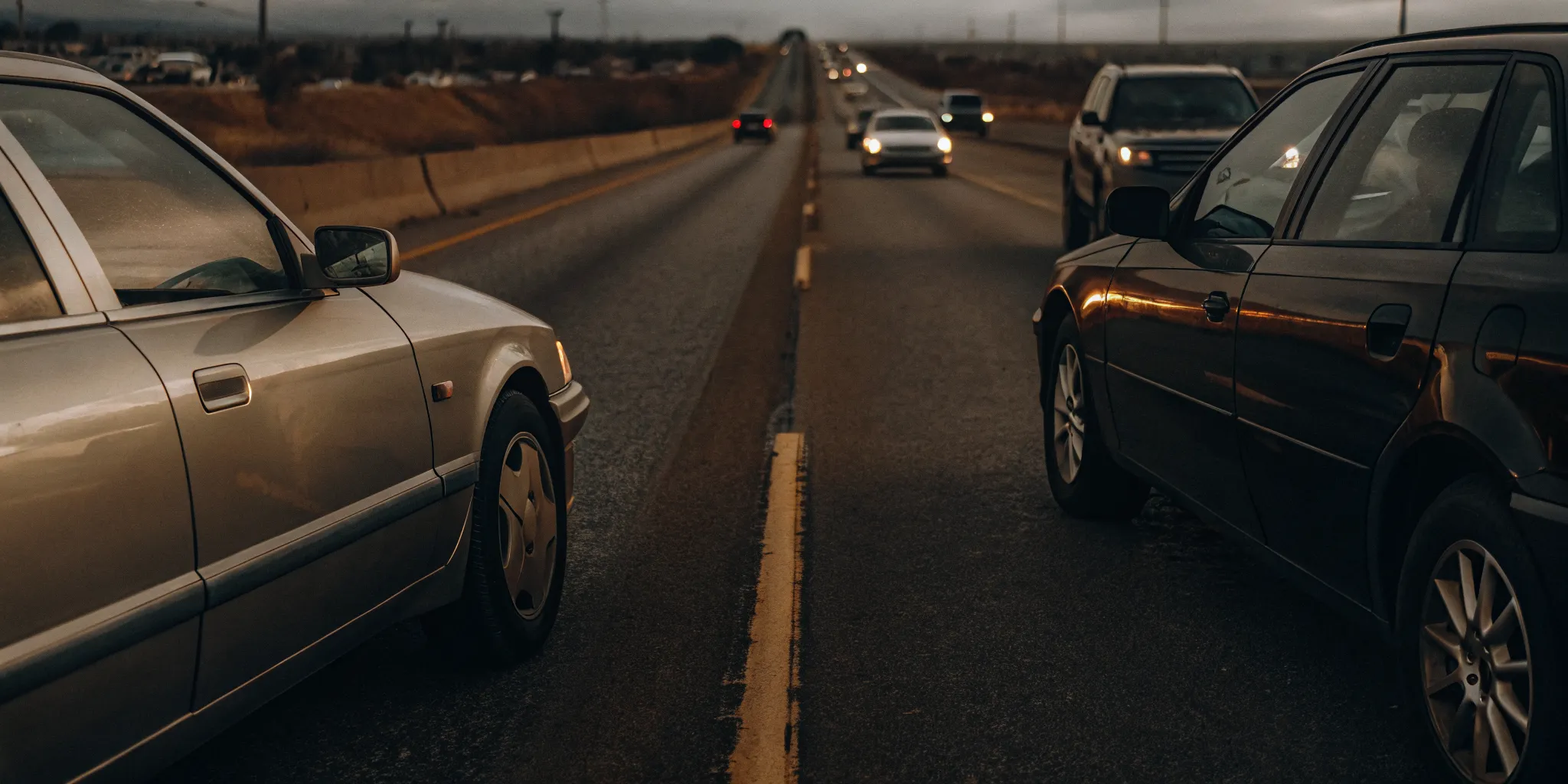
A lane-change sideswipe can leave clear vehicle damage but a fierce dispute over fault. The evidence preserved after impact often decides which driver's account holds up.
A California sideswipe accident lawyer investigates which vehicle left its lane, whether either driver signaled, and what the physical evidence proves before it disappears. California Vehicle Code Section 22107 requires a driver to ensure a lane movement is safe and give an appropriate signal before moving.
Photos of scrape patterns, dashcam footage, witness accounts, police reports, and nearby video can show how contact occurred. They may also identify the point of impact. If both drivers contributed, California comparative negligence can reduce an injured person's recovery by that person's share of fault.
Prompt legal review helps preserve evidence, challenge insurer blame tactics, document injuries, and connect vehicle damage and medical records to the crash's actual cause.
The central question is not simply whether the cars touched, but which driver failed to hold a lane or changed lanes unsafely. To answer it, start with the evidence and rules covered in How fault is established after a California sideswipe. The path begins with:
How fault is established after a California sideswipe
Fault usually turns on which driver left a safe path or failed to hold a lane. Investigators look beyond the point where the vehicles touched. They ask what each driver did in the seconds before impact.
Lane changes and drifting
A driver changing lanes must first make sure the move is reasonably safe. The driver must also signal when another vehicle may be affected. These duties appear in California Vehicle Code section 22107.
A missed blind-spot check does not excuse an unsafe move. A driver may also cause a sideswipe without planning to change lanes. Drifting across a lane marker can point to fault when it places a nearby vehicle at risk.
A turn signal does not give a driver the right to enter an occupied lane. It gives notice of a planned move. The driver must still check mirrors, look over a shoulder, and wait for a safe opening.
Evidence that shows what happened
Vehicle damage can help show the direction and angle of contact. Scrapes along one side may support the account of a driver who held a steady course. Damage alone rarely tells the full story.
- Dashcam or traffic camera footage may show lane position, speed, and signal use.
- Witness statements can describe which vehicle moved and whether either driver drifted.
- Scene photos can preserve lane markings, debris, skid marks, and final vehicle positions.
- Phone records or other records may support a claim that distraction caused the drift.
Statements made at the scene also matter, but they should be checked against physical proof. A California sideswipe accident lawyer can seek video and records before they disappear. That work may help resolve conflicting accounts.
A police report can organize witness names, statements, and scene details. Yet the officer may not have seen the crash. Investigators should compare the report with photos, video, repair records, and the location of damage.
Shared fault under California law
Sometimes both drivers played a role. One driver may have started an unsafe lane change while the other sped up or moved toward the same gap. California then allows fault to be divided between them.
Under California's comparative negligence rule, a person's recovery is reduced by that person's share of fault. Clear proof therefore matters even when one driver seems mainly responsible. Each photo, statement, and record can affect how fault is assigned.
An insurer may argue that both drivers drifted or failed to react. A consistent account backed by early photos and witness details can answer that claim. It can also show why one driver's conduct caused the impact.
What should you do immediately after a sideswipe crash?
The first minutes after a sideswipe crash can feel confusing. Focus on safety, medical needs, and facts that may help explain what happened.
Safety and emergency response
1.
Get out of danger. Stop, turn on your hazard lights, and check whether anyone is hurt. If the vehicles can move, pull to a safe nearby place without leaving the scene.
2.
Call 911 and request police. Tell the dispatcher about injuries, traffic hazards, and your location. Ask the responding officer how to get the police report number before you leave.
3.
Get medical care. Accept emergency help when needed, even if an injury seems mild at first. Follow up promptly and describe every symptom clearly to the medical provider.
4.
Exchange key information. Collect each driver's name, contact details, license number, plate number, and insurance information. Also ask witnesses for their names and contact details.
5.
Document the scene. Take wide and close photos of both vehicles, lane markings, debris, signs, and nearby damage. Save dashcam video and note the direction each vehicle traveled.
6.
Keep your statements factual. Do not argue, guess about fault, or apologize for the crash. Give police accurate facts, but avoid making assumptions about speed, distance, or injuries.
Evidence from the roadway
Sideswipe cases often turn on how each vehicle used its lane. California law says a driver must stay within one lane when practical. A driver may move only when it can be done with reasonable safety under California Vehicle Code section 21658.
Photos of lane lines, vehicle contact points, and final positions may help show how the crash occurred. Write down what you saw while the details are fresh. Keep the police report number, medical papers, photos, videos, and witness details together.
Early claim safeguards
Be careful when an insurance representative asks for a recorded statement soon after the crash. Share required facts, but do not guess or downplay symptoms. California uses comparative negligence, so a person's share of fault can reduce recovery, as the California Courts explain.
Before signing forms or giving a detailed recorded account, consider getting advice about California personal injury law. A California sideswipe accident lawyer can review the report, preserve evidence, and help you respond with accurate facts.
Evidence that can prove who crossed the lane line
Evidence often decides a sideswipe claim when both drivers blame each other. The strongest case uses several sources that point to the same lane movement. Each item should help show where the vehicles were, how they moved, and when contact began.
Damage patterns and scene photos
Scrapes, dents, paint transfer, and broken parts can show the direction and height of contact. A repair professional can document whether marks run from front to back or back to front. Investigators can then compare those marks with each driver's account. Damage alone may not settle fault, but it can expose an account that does not fit.
Take wide photos of the full scene before vehicles move, if doing so is safe. Then photograph each vehicle from every side, followed by close views of contact marks. Include lane lines, signs, road debris, skid marks, and the final resting positions. A broader guide to California personal injury law also explains why early evidence preservation matters.
Video and witness accounts
Nearby traffic cameras, business cameras, home doorbells, and dashcams may capture the lane change. Ask property owners to save footage at once because routine systems may erase older files. A witness in another vehicle may have seen a turn signal, drift, or sudden merge. Get each witness's name and contact details before people leave.
Independent accounts are strongest when they describe what the witness saw without guesses. Record the witness's viewing position, travel direction, and any blocked sightline. Compare those details with photos and video rather than relying on one statement.
Digital data, reports, and records
Some vehicles store event data about speed, braking, steering, and other inputs near a crash. This data may help test whether a driver braked or changed direction before impact. It may also place vehicle movement in a short timeline. Preserve the vehicle before repairs or disposal can affect available evidence.
When lawfully obtained, phone and app records may help test claims about distraction or navigation. Police reports can identify drivers, witnesses, road conditions, and statements made near the time of the crash. Review the report for errors. Medical and repair records can connect the impact with documented injuries and vehicle damage.
California law requires a driver to remain within one lane as nearly as practical. The driver must not move lanes until the movement can be made with reasonable safety. The text of California Vehicle Code section 21658 gives the collected evidence a clear legal question: which driver moved before it was safe?
Can both drivers share fault for a sideswipe?
California's pure comparative negligence rule
Yes. California's pure comparative negligence system can assign fault to both drivers after a sideswipe. Under this rule, an injured person's damages are reduced in proportion to that person's share of fault. The California Courts' comparative negligence guidance explains how a claimant's own negligence reduces the damages they may recover.
Fault shares depend on the facts, not just which vehicle crossed a lane line. Investigators may review photos, vehicle damage, witness accounts, video, and each driver's statement. These details can show how each action helped cause the crash.
How two drivers may contribute
One driver may start an unsafe lane change while the other driver is speeding or looking at a phone. The first driver may bear fault for moving over without enough space. The second driver's speed or distraction may have made a safe response less likely.
- A driver merges without checking a blind spot, while the nearby driver speeds up.
- A distracted driver drifts left, while another driver makes a sudden lane change.
- A driver swerves around debris, while the next driver follows too closely to react.
An evasive move does not always make the swerving driver negligent. The reason for the move, available space, and speed all matter. California law requires drivers to remain within one lane when practical and move only with reasonable safety. That rule appears in Vehicle Code section 21658.
Evidence that shapes fault shares
Small facts can change how responsibility is divided. Scrape direction may show which vehicle moved sideways. Dashcam footage may reveal speed, signals, distraction, or a sudden hazard. Medical records and prompt scene photos can also connect the sideswipe to the injuries claimed.
A California sideswipe accident lawyer can review competing accounts and preserve useful evidence. No single fact guarantees a set fault share or result. The final assessment depends on the full record and how well each claim is supported.
Common injuries after a lane-change collision
Why a glancing impact can still cause harm
A sideswipe can look minor because the first contact may only scrape a door, mirror, or fender. But the force may push a vehicle toward a barrier, another car, or oncoming traffic. California law requires drivers to remain in one lane until a move can be made with reasonable safety.
Injuries can result from the first impact, a second crash, or a sudden attempt to regain control. People may report neck and back pain, headaches, bruises, cuts, or pain in the shoulders and knees. More severe crashes may involve broken bones, head injuries, or damage to the spine. Only a medical professional can diagnose an injury and link symptoms to the right care.
Symptoms that appear later
Pain and other symptoms are not always clear at the crash scene. Stress and confusion can also make it hard to notice what has changed. Watch for new pain, headaches, dizziness, numbness, weakness, sleep trouble, or problems with focus. Seek prompt medical care for any concerning symptom, especially after a head impact or a second collision.
Do not assume that a small dent means there was no injury. Tell the clinician how the collision happened, where your body struck the car, and when each symptom began. If symptoms change, report the change rather than trying to explain the cause yourself. A California sideswipe accident lawyer can review the records alongside other crash evidence.
Medical records and the injury timeline
Clear records help show what happened after the lane-change collision. Keep discharge papers, visit summaries, test results, treatment instructions, and notes about follow-up visits. Also keep a simple daily log of symptoms and limits on work, driving, sleep, and routine tasks. Use plain details, and do not guess about a diagnosis.
Consistency matters throughout the claim. Attend recommended visits, follow care instructions, and explain any missed appointment in your records. Share earlier injuries or health issues with your care team so the history is accurate. These steps help connect the crash timeline, the medical findings, and the ways the injury affected daily life.
How the insurance claim process works
Opening the claim and preserving proof
The claim usually starts when you notify the insurers involved and provide basic crash details. Give the date, location, vehicles, and report number if available. Keep your first report brief and accurate while you gather stronger proof.
Useful records include scene photos, vehicle damage photos, witness contacts, the police report, medical records, and missed-work records. Save every email and letter from an insurer. This paper trail can show what happened and how the crash affected your health and daily life.
Evidence matters because insurers may dispute who moved from a lane. California uses comparative negligence, so a person's recovery can be reduced by their share of fault. The California Courts explanation of comparative negligence shows why clear proof of fault is important.
Handling adjuster questions
An adjuster investigates the collision for the insurance company. The adjuster may compare driver accounts, inspect vehicle damage, review records, and ask about injuries. Their questions can sound routine, but your answers may shape the insurer's view of the claim.
You may be asked to give a recorded statement soon after the crash. Do not guess about speed, distance, fault, or injuries that are still being assessed. Ask who will receive the recording and why it is needed before agreeing.
Also review any document before signing it. A broad medical release may seek records beyond the injuries tied to the sideswipe. For more guidance on early proof, see these steps for preserving evidence after an accident.
How counsel manages the claim
A California sideswipe accident lawyer can organize evidence, handle insurer calls, and challenge an incomplete fault review. Counsel may also track treatment records and present a clear account of the injuries. This lets the claim reflect both the collision and its effects.
Before a claim resolves, counsel can review the insurer's position and explain the available options. If fault remains disputed, a lawyer can use photos, witness accounts, reports, and damage patterns to support the case. DC Law Group's accident claim services explain the support available after a collision.
When should you contact a California sideswipe accident lawyer?
A minor sideswipe may seem simple when no one is hurt, both drivers agree on what happened, and the insurer handles the claim fairly. You may be able to manage that claim yourself. Contacting counsel becomes more useful when the facts, injuries, or insurance process grow complex.
Claims you may be able to handle alone
A straightforward claim often involves light vehicle damage, clear photos, a police report, and no injury symptoms. Both drivers may also give matching accounts. Keep copies of every photo, repair record, medical note, and message from the insurer.
Do not assume that a sideswipe is always minor. Pain can appear after the crash, and a dispute can arise once insurers review the evidence. If circumstances change, a California sideswipe accident lawyer can assess the new issues.
Warning signs that call for legal help
Consider speaking with counsel when fault is disputed, injuries affect daily life, or several vehicles were involved. Legal help may also matter if an insurer seeks a recorded statement, pushes for a quick release, or delays its response.
Fault disputes can directly affect a claim. California uses comparative negligence, which reduces recoverable damages based on the injured person's share of fault. The California Courts explanation of comparative negligence shows why strong evidence matters when each driver blames the other.
Factor.Clear claim.Complex claim.Fault.Drivers agree.Fault disputed.Injuries.No symptoms.Ongoing care.Vehicles.Two vehicles.Several vehicles.Evidence.Clear records.Missing records.Insurer.Clear response.Pressure or delay.
What counsel can review
A lawyer can compare driver statements with photos, vehicle damage, witness accounts, video, and the police report. Counsel can also review lane-change duties under California law. State law says a driver must remain in one lane until a move can be made with reasonable safety.
Early review can help preserve video and locate witnesses before evidence disappears. It also gives you a clearer view of deadlines, disputed facts, and the insurer's requests. DC Law Group's Accident Services Page explains the support available for injury claims.
Frequently Asked Questions
Who is at fault in a sideswipe collision?
Fault usually rests with the driver who left a lane, drifted, or changed lanes unsafely. California law requires drivers to stay within one lane and move only when reasonably safe. Investigators review vehicle damage, road markings, photos, video, witness accounts, and police reports. Both drivers may share responsibility, which can reduce an injured person's recovery.
What steps should I take after a sideswipe accident?
Move to a safe location if possible, call emergency services, and seek medical care for any injuries. Exchange contact and insurance details without arguing about fault. Photograph both vehicles, lane markings, debris, traffic signs, and the wider scene. Collect witness information and preserve dashcam footage. Report the crash promptly, keep treatment records, and avoid recorded insurer statements before understanding your options.
How much will I get from a sideswipe settlement?
There is no fixed settlement value for a California sideswipe claim. The outcome depends on injury severity, treatment records, missed work, vehicle damage, available insurance, and the strength of fault evidence. Future care needs and lasting physical limits may also affect the claim. Any share of responsibility assigned to the injured person can reduce the final recovery under California's comparative negligence rule.
Is it worth suing for pain and suffering after a sideswipe accident?
Whether a claim is worthwhile depends on the injury's effects, supporting medical evidence, disputed fault, and available coverage. Pain and suffering may include physical discomfort and reduced enjoyment of daily activities. However, California may restrict noneconomic recovery when an injured vehicle operator cannot establish required financial responsibility, as explained by the California Courts. Individual legal advice can clarify the available options.
Why hire a California sideswipe accident lawyer?
A California sideswipe accident lawyer can investigate which vehicle left its lane and preserve evidence before it disappears. The lawyer can obtain reports, interview witnesses, review damage patterns, organize medical records, and address insurer disputes. Legal counsel can also assess shared-fault arguments and document the full effects of an injury. Representation may be especially useful when liability is disputed or injuries require ongoing care.
Ready to Protect Your California Injury Claim?
Waiting after a lane-change sideswipe can make it harder to preserve details, organize records, and explain how the crash affected you. Starting now gives your legal team more time to review the collision, address fault disputes, and prepare a clear injury claim. Early guidance can help you avoid statements or decisions that may weaken your position. It also creates a clearer path for handling insurer questions and documenting your injuries.
Do not let uncertainty delay a careful review of your rights and options. Schedule a consultation with DC Law Group to discuss the crash and learn which next steps fit your situation.