
Riding a motorcycle in California traffic brings unique freedom, but it also brings major safety risks. If you are hurt while riding between slow or stopped cars, getting fair financial help can be a complex battle. You need an expert on your side. Someone who knows both local traffic laws and insurance company tactics.
Get a free case evaluation today. Call DC Law Group at (310) 571-8860 if you have been injured in a lane-splitting crash. David Cohan personally handles each case on a contingency fee basis. You pay nothing unless we win money for you.
A California motorcycle lane splitting accident lawyer helps injured riders secure maximum compensation for medical bills, lost wages, and pain after a crash. Under California Vehicle Code Section 21658.1, lane splitting is fully legal, but insurance adjusters often try to blame the motorcyclist to avoid paying claims. Your attorney will gather police reports, interview witnesses, and hire traffic experts to prove the other driver made a sudden lane change or failed to look. Having legal representation ensures your rights are protected so you can focus on physical recovery. David Cohan personally handles each case on a contingency fee basis. You pay nothing unless we win money for you.
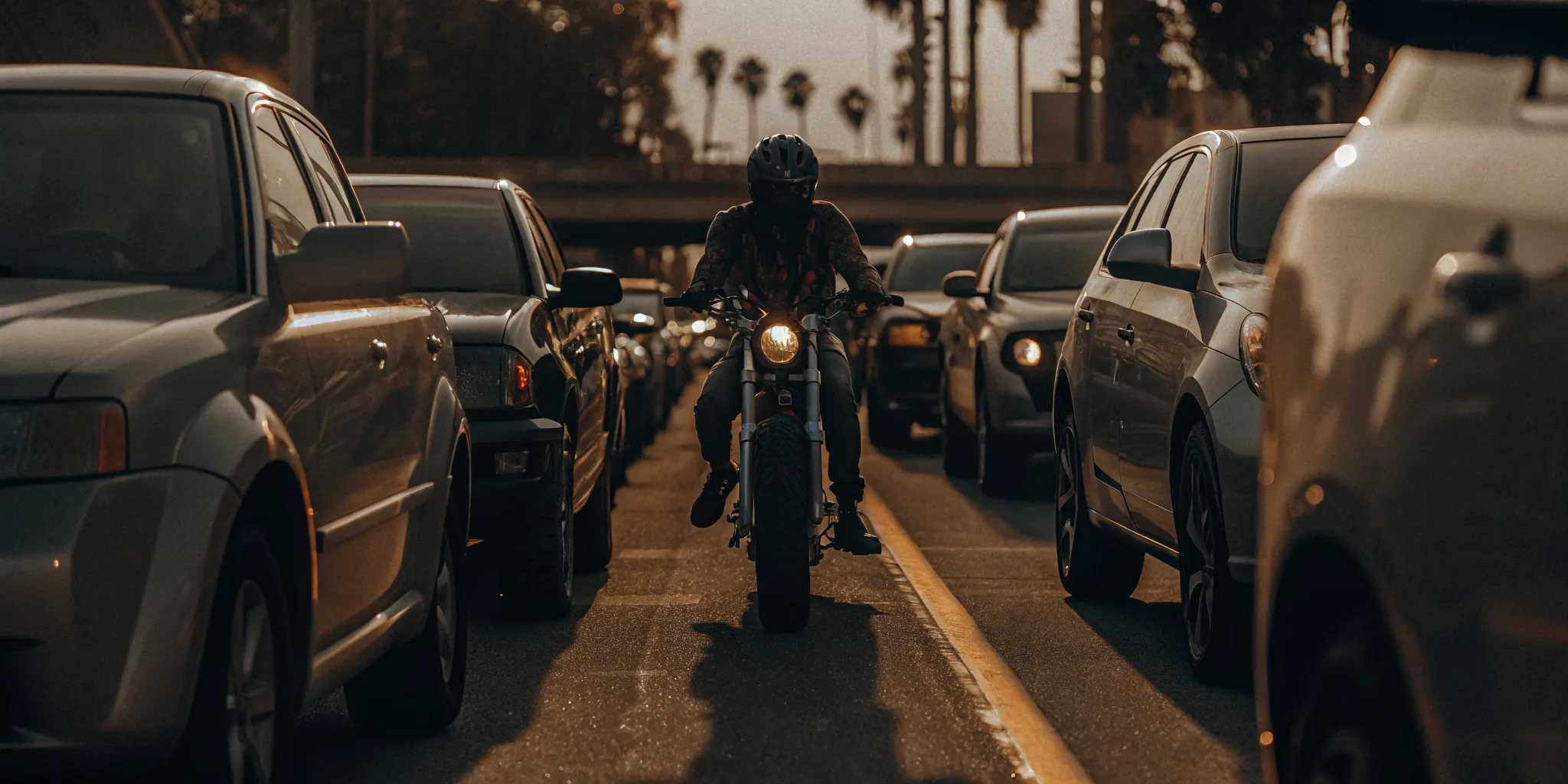
Before you speak with an insurance adjuster or sign any settlement offers, you must understand how local traffic laws apply to your collision. Many drivers and claims agents still do not realize that riders have a legal right to share the lane. We will explore these laws in detail, starting with the fundamental question: Is Lane Splitting Legal in California? ## Is Lane Splitting Legal in California? For many years, riding a motorcycle between rows of stopped or moving cars was common in the Golden State, but the practice had no formal legal definition. That changed when Assembly Bill 51 passed, making California the first state to officially define and authorize the practice. Under California Vehicle Code Section 21658.1, lane splitting is defined as driving a two-wheeled motorcycle between rows of stopped or moving vehicles in the same lane. This legal definition applies to divided and undivided streets, roads, and highways across the state. ### The Role of the California Highway Patrol To keep riders and drivers safe on busy roads, the state did not just legalize the practice; it also set up a way to teach road safety. Under the same vehicle code section, state lawmakers gave the California Highway Patrol the power to create educational guidelines for safe riding. To make these safety rules, the California Highway Patrol must consult with other key state agencies. These partners include the Department of Motor Vehicles, the Department of Transportation, and the Office of Traffic Safety. This teamwork ensures that the safety tips are based on real road data and help protect everyone on the highway.
Understanding Safe vs. Unsafe Riding
While sharing a lane is legal, riders must always do so in a safe, prudent manner. State safety groups suggest that riders should not split lanes when traffic is moving faster than 30 mph. Additionally, riders should keep their speed differential low, ideally traveling no more than 10 mph faster than the cars around them. You should also avoid splitting lanes next to large trucks, buses, or big rigs, as these large vehicles have massive blind spots. If a rider weaves through traffic at high speeds or in a reckless way, law enforcement can still pull them over and issue a ticket for unsafe behavior. ### Legal Lane Splitting and Fault in an Accident Just because lane splitting is legal does not mean that a rider is never at fault if a crash occurs. When a collision happens, insurance companies and courts look closely at the actions of both the motorcyclist and the motorist. If you are hurt while riding, proving that you followed all safety rules is vital to winning your case. Working with a skilled California motorcycle accident lawyer can help you build a strong claim. An attorney can show that you were riding safely while the other driver failed to check their mirrors or signal before changing lanes. Helping you recover the compensation you deserve.
Common Lane-Splitting Crash Scenarios and Causes
When you ride a motorcycle between rows of stopped or slow cars, you face unique risks. Understanding how these collisions happen can help you stay safe on the road. It can also help you protect your legal rights after a motorcycle crash if you get hit by another vehicle.
The Danger of High Speed Differentials
The speed gap between a motorcycle and other traffic is a major factor in most lane-splitting crashes. A famous study by researchers at UC Berkeley shows that lane splitting is relatively safe in traffic moving at 50 mph or less. However, the rider must not travel more than 15 mph faster than surrounding cars.
The study analyzed key details. These included travel speeds, time of day, and helmet use. Researchers found that the risk of injury rises significantly once a rider exceeds that 15 mph speed gap. When a motorcyclist travels too fast through slow traffic, other drivers cannot see them in time to avoid a crash.
Sudden Lane Changes by Motorists
Sudden lane changes are the single most common cause of lane-splitting accidents. UC Berkeley researchers found that the most frequent crash scenario involves a rider traveling at a high speed differential when a driver attempts to change lanes. Because cars are often stopped or moving slowly, drivers do not expect a fast-moving vehicle to pass between the lanes.
Drivers often fail to use their turn signals, or they change lanes without checking their mirrors. If a rider is moving too fast, they cannot stop or swerve in time to avoid the turning car. If you have been hurt in this type of collision, a California motorcycle accident attorney can help you hold the driver at fault responsible.
Blind Spot Obstructions and Poor Visibility
Riders who split lanes often travel through the blind spots of surrounding vehicles. Large trucks, sports utility vehicles, and delivery vans have large blind spots where a motorcycle can easily disappear. When traffic is heavy, drivers are often focused on the cars directly in front of them and fail to notice a rider approaching from behind.
Poor visibility due to bad weather or darkness makes these blind spots even more dangerous. If a driver cannot see you, they may turn or drift directly into your path. To build a strong case. You will likely need the help of an experienced motorcycle accident lawyer to gather the necessary evidence. ## California Helmet and Licensing Requirements for Motorcyclists Riding a motorcycle in California comes with strict legal rules. Motorcyclists must follow these rules to stay safe and protect their rights under the law. Two of the most critical rules involve wearing a proper helmet and holding the correct driver license. Failing to meet these standards can lead to traffic tickets or complicate your legal claim if a motorist strikes you on the road.
Required DOT Compliant Helmets
Under California law, every rider and passenger must wear a helmet that meets federal safety standards. Specifically, a Department of Transportation (DOT) compliant helmet is required at all times. These helmets have a thick inner liner, strong chin straps, and a solid build to protect against head injuries during a crash.
If you get into a crash while not wearing a DOT helmet, the other driver's insurance company may try to deny your claim. They will argue that your own actions caused your head injuries, even if the other motorist caused the collision. To protect your health and your legal rights, always secure a certified helmet before you start your ride.
Motorcycle License and Endorsement Rules
You must also have the proper license class to operate a motorcycle on public roads. The exact license you need depends on the type of bike you ride. For standard two-wheeled motorcycles, you must obtain a special endorsement on your license. The California Highway Patrol states that an M-1 endorsement is required for all two-wheeled motorcycles.
This rule also applies to smaller bikes with less engine power. Any two-wheeled motor-driven cycle with a motor displacement under 150cc also requires an M-1 endorsement. However, there is an exception for three-wheeled vehicles or bikes with a sidecar. If your motorcycle has more than two wheels or an attached sidecar. You only need a Class C driver license to operate it. ### How Legal Compliance Affects Injury Claims Riding without a valid M-1 license or a proper helmet can hurt your case if you need to file an injury claim. In California, courts use a system of comparative fault. If you do not follow the law, the insurance company will argue that you were negligent. They will try to reduce the compensation you receive by blaming you for riding illegally.
This is especially true in lane-splitting cases, where insurance adjusters already try to blame the motorcyclist. Working with an experienced California motorcycle accident lawyer can help protect your claim. An attorney can show that your licensing status or safety gear did not cause the crash. Allowing you to seek full compensation for your medical bills and other damages.
Who Is at Fault in a Lane-Splitting Accident?
Determining fault in a lane-splitting crash can be complex. Because motorcycle lane-splitting is legal in California, a rider is not automatically at fault for a collision. Instead, insurance adjusters, police officers, and courts must look at the specific actions of both the motorcyclist and the other motorist. A skilled California motorcycle accident lawyer can help you build a strong case to show how the other driver caused the crash.
The Impact of Speed Differential on Liability
One of the primary factors in proving fault is the speed of the motorcycle compared to the surrounding traffic. Researchers at UC Berkeley found that lane-splitting is relatively safe when traffic moves at 50 mph or less. Provided the rider does not exceed the speed of surrounding vehicles by more than 15 mph. A high speed differential can complicate liability when a driver makes a sudden turn or lane change. If a rider travels too fast for traffic conditions, the insurance company may argue that the rider had less time to react to hazards. Shifting some or all of the fault onto the motorcyclist.
Unsafe Lane Changes and Driver Negligence
While insurers often try to blame the motorcyclist, car drivers frequently cause these crashes through negligent behavior. The most common scenario for a collision involves a motorist who attempts to change lanes without signaling or checking their blind spots. Under the California Vehicle Code, drivers have a legal duty to make lane changes only when it is safe to do so. When a driver turns suddenly into the path of a lane-splitting rider, that driver is often primary at fault for the crash. To protect your legal rights after a motorcycle crash, it is critical to document driver errors like failing to signal, distracted driving, or texting behind the wheel.
California's Comparative Negligence Rule
California uses a pure comparative negligence system. This rule means that even if you are partially at fault for an accident, you can still seek compensation for your injuries. If a court finds that your speed differential or lack of caution contributed to the collision, your final payout will be reduced by your percentage of fault. For example, if you are found 20 percent at fault and your total damages are $100,000, you can still recover $80,000. Insurance companies often use this system to their advantage, making aggressive defense arguments to artificially inflate a rider's fault percentage. An experienced attorney can counter these tactics by gathering objective evidence from the crash scene.
Proving Your Case With Accident Reconstruction
To overcome biased insurance defenses, your legal team may use accident reconstruction experts. These professionals analyze physical evidence such as skid marks, vehicle damage, and dashcam footage to establish exactly how the crash occurred. Reconstruction can calculate the precise speed of both the motorcycle and the car, the angle of impact, and the exact moment the driver initiated an unsignaled turn. This scientific evidence can prove that the driver's sudden maneuver left you with no chance to avoid the collision, regardless of your lane-splitting path. By presenting clear, objective data, your attorney can hold the negligent motorist fully responsible for your medical bills, lost wages, and pain and suffering.
What Damages Can You Recover After a Lane-Splitting Crash?
When you suffer harm in a lane-splitting collision, California law allows you to seek payment for your losses. Motorcyclists often face severe bodily injuries when a car changes lanes without warning. If you find yourself in this situation, you have the right to seek recovery for both your financial losses and your personal pain. Hiring a California motorcycle accident lawyer can help you obtain the compensation you need to cover these mounting expenses.
Types of Recoverable Damages
Injury claims in California fall into two main groups: economic and non-economic damages. Economic damages cover your direct financial losses. These include medical bills, hospital stays, physical therapy, and lost wages if you cannot work. Non-economic damages cover non-financial losses, such as physical pain and mental suffering. To protect your legal rights after a motorcycle crash, you must keep track of every medical bill and pay stub to support your claim.
<table><thead><tr><th scope="col">Damage Type</th><th scope="col">What It Covers</th><th scope="col">Examples of Losses</th></tr></thead><tbody><tr><td>Economic</td><td>Direct financial costs</td><td>Emergency room bills, surgery costs, physical therapy, lost wages, and bike repairs</td></tr><tr><td>Non-Economic</td><td>Personal, non-financial harm</td><td>Physical pain, emotional distress, loss of enjoyment of life, and physical scarring</td></tr></tbody></table>
Settlements and the Filing Timeline
Real cases show how much support injured riders can secure when they have strong legal help. For instance, some firms have won a $7.8 million verdict for a motorcycle vs. SUV left-turn crash, and a $1.95 million settlement for an unsafe lane-change impact. However, you must act quickly if you want to pursue a recovery. Under California Code of Civil Procedure Section 335.1, riders have a strict limit of two years from the date of the crash to file a personal injury lawsuit. If you miss this deadline, you will lose your right to seek compensation from the negligent driver.
Immediate Financial Relief
Waiting for an insurance company to settle your claim can take a long time, but your bills will not wait. To help you manage during this stressful period, DC Law Group provides a 24-hour cash advance program. This program can give you immediate funds to cover your daily needs while your case moves forward. We also work on a contingency fee model, which means you pay no fees unless we win your case. This structure ensures that you can focus on your physical recovery without worrying about upfront legal bills.
How a California Motorcycle Lane Splitting Accident Lawyer Can Help
Riders often face bias from police and insurance firms after a crash. A specialized legal team knows how to protect your rights. An attorney helps you navigate the complex recovery process and fights to secure your compensation.
Gathering Critical Evidence
An attorney immediately starts building your case by collecting key proof from the crash scene. They obtain the official police report, speak with witnesses, and secure video from nearby dashcams or storefronts. To counter driver bias, your legal team may work with accident reconstruction experts to prove how the motorist caused the crash.
Negotiating with Insurance Companies
Insurance adjusters often try to blame the motorcyclist for lane splitting, even when the move was safe and legal. A skilled lawyer handles all talk with the insurance carrier so you do not get tricked into a low settlement. They use data from safe riding reports, such as studies on speed differentials from UC Berkeley, to show you acted in a safe manner.
Navigating the Legal Claim Process
Your legal team manages the entire process from start to finish. If the insurer refuses to pay a fair amount, your lawyer can file a lawsuit to take your case to court. By finding an experienced motorcycle accident attorney, you ensure that every court filing is accurate and submitted before the state's strict deadlines.
- Free Case Evaluation: You speak with an attorney to review the facts of your crash, check your options, and find out if you have a valid claim.
- Evidence Collection: The legal team gathers police records, medical charts, and witness accounts to build a strong foundation for your case.
- Insurance Negotiation: Your lawyer presents your demand package to the insurance firm and fights their attempts to lower your claim value.
- Settlement or Court Trial: If the insurer offers a fair payout, your lawyer helps you settle. If not, they take your case to trial to seek a verdict from a jury.
- Recovery and Closure: After you receive your settlement or verdict, your attorney ensures all medical liens are paid and you keep the rest to move forward with your life.
Frequently Asked Questions
Is lane splitting legal in California?
Yes. Under California Vehicle Code Section 21658.1, lane splitting is legal. The law defines it as driving a two-wheeled motorcycle between rows of stopped or moving vehicles in the same lane. This applies on both divided and undivided streets, roads, and highways throughout the state.
Who is at fault in a motorcycle lane splitting accident?
Fault is not automatic. Liability depends on whether you were riding safely and if the other driver was negligent. A driver who changes lanes without signaling or cuts you off is often at fault. However, if your speed was too high for traffic conditions, a court may share the blame between both parties.
Are there speed limits for lane splitting in California?
California does not have a specific lane-splitting speed limit. However, a study by UC Berkeley shows lane splitting is safest when traffic is moving at 50 mph or less. The study also shows that the risk of injury rises significantly if a rider travels more than 15 mph faster than surrounding vehicles.
Do I need a special license to ride a motorcycle in California?
Yes. To operate a two-wheeled motorcycle on public roads, you need an M-1 endorsement on your California driver license. This includes smaller bikes with engines under 150cc. Riders without a valid M-1 endorsement may face traffic citations and complications in personal injury claims.
What should I do immediately after a lane-splitting accident?
First, check yourself for injuries and call 911. Exchange information with the driver, take photos of the scene, and get contact details from any witnesses. Do not discuss fault with the insurance company. Contact a motorcycle accident lawyer before giving any recorded statement to an insurance adjuster.
How can a California motorcycle lane splitting accident lawyer help?
Insurance companies often try to blame motorcyclists for lane-splitting crashes. A skilled lawyer protects your rights by gathering critical evidence. This includes police reports, witness statements, and crash site photos. Your attorney will negotiate with the insurer to secure full compensation for your medical care and lost wages while you focus on healing.
Ready to Protect Your Rights After a Lane-Splitting Crash?
Waiting to take action after a motorcycle crash can hurt your personal injury claim. Physical evidence on the road disappears fast, and insurance companies often try to blame the rider for lane splitting. Getting an experienced attorney on your side early helps protect your rights, secures vital witness statements, and ensures you get the medical care you need. We handle your case on a contingency basis, so you face no risk of legal fees up front. Let us deal with the insurance adjusters while you focus entirely on your physical recovery.
Call DC Law Group at (310) 571-8860 for a free, no-obligation consultation about your lane-splitting accident. David Cohan has the experience to fight for the compensation you deserve.